
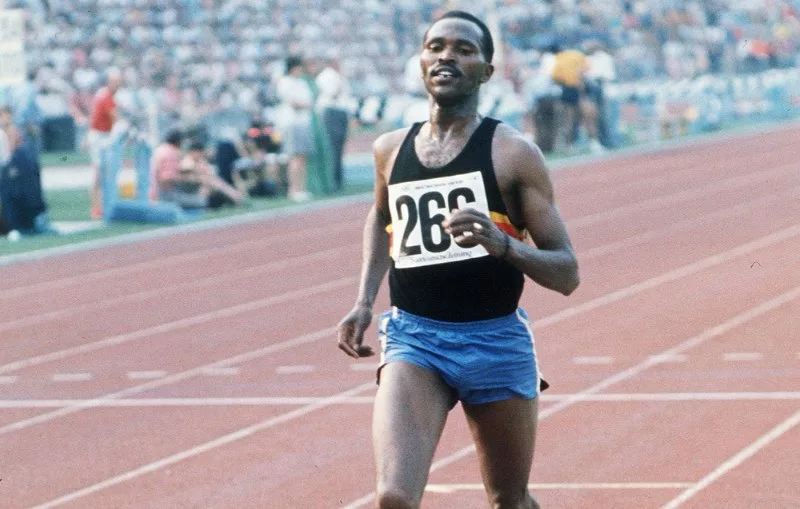
The decision to host Mashujaa Day 2026 at the facility gives the venue added historical significance, with the celebrations coinciding with the anniversary of Keino’s Olympic gold medal victory
Kipchoge Keino Stadium in Eldoret, Uasin Gishu County, carries the name of one of Kenya's most celebrated athletes, whose achievements helped establish the country as a global powerhouse in distance running.
The decision to host Mashujaa Day 2026 at the facility gives the venue added historical significance, with the celebrations coinciding with the anniversary of Keino’s Olympic gold medal victory, which cemented his place among the pioneers of Kenya’s Olympic success.
The Ministry of Interior marked the occasion by reflecting on the connection between Keino’s achievement and the national celebrations.
“Exactly 58 years ago today, legendary Police Constable Kipchoge Keino raced to Kenya’s first Olympic gold. Today, we commemorate Mashujaa Day 2026 in a new stadium bearing his name in Eldoret, Uasin Gishu County," the ministry stated.
"A remarkable convergence of history, where the date, the place and the legacy come together in a celebration of national pride."
But what exactly happened on that day in 1968 that made Keino one of Kenya’s most celebrated sporting figures?
Keino's achievements
On October 20, 1968, Keino won the men’s 1,500 metres final at the Mexico City Olympic Games, clocking 3:34.91 to claim gold. He also won silver in the 5,000 metres at the same Games.
World Athletics records show that Keino's victory in the 1,500 metres was achieved in an Olympic record time, with the Kenyan beating his rivals by almost three seconds.
His performance was particularly remarkable because he had suffered from illness during the Games. He had collapsed during the 10,000 metres final and was later advised against competing in the 1,500 metres because of his health.
Despite the concerns, Keino took to the track and delivered a performance that became a defining moment in Kenya's sporting history.
Who was Kipchoge Keino?
Born on January 17, 1940, in Kipsamo, Nandi County, Keino rose from humble beginnings to become one of the pioneers of Kenya's international athletics success.
According to Olympedia, the historical database of the Olympic movement, he served in the Kenya Police Force before beginning his international athletics career.
His sporting breakthrough came in the 1960s, when he established himself as one of the world's leading middle-distance runners. In 1965, he broke the world records in the 3,000 metres and 5,000 metres, demonstrating his growing dominance on the track.
At the 1966 Commonwealth Games in Kingston, Jamaica, he won both the mile and three-mile races, further cementing his reputation as an international competitor.
His Olympic success continued at the 1972 Munich Games, where he won gold in the 3,000 metres steeplechase and silver in the 1,500 metres.
The two gold and two silver medals he won across the 1968 and 1972 Olympics placed him among the most influential athletes in Kenya's sporting history.
In 2012, World Athletics named Keino among the inaugural members of its Hall of Fame, recognising his achievements as a double Olympic champion and multiple world-record holder.
"It gives me the greatest pleasure on the closing of the African Championships to announce the inclusion of Kip Keino to the IAAF Hall of Fame," said IAAF President Lamine Diack at the time.
"He is an inspirational figure who achieved worldwide fame thanks to his phenomenal deeds on the track, and since his retirement has selflessly 'given back’ to his country, building schools, an orphanage and an elite training facility for athletes."
Four years later, the International Olympic Committee awarded him the first Olympic Laurel at the Rio 2016 Olympic Games, recognising his contributions to education, culture, development and peace through sport.
The IOC highlighted his work supporting disadvantaged children, including initiatives that provided education and care for orphans.
The story behind the stadium
In 1996, the stadium in Eldoret was named in honour of Kipchoge Keino, recognising his contribution to Kenyan athletics.
Over the years, the stadium has served as a key sporting venue in the North Rift region before undergoing major modernisation works.
The facility has been identified as one of the venues expected to support Kenya's preparations for the 2027 Africa Cup of Nations, which will be jointly hosted by Kenya, Uganda and Tanzania.
Its selection as the main venue for Mashujaa Day 2026 places the stadium at the centre of both national celebrations and the country's broader sporting ambitions.
The celebrations are being co-hosted by Uasin Gishu, Nandi and Elgeyo-Marakwet counties, bringing the national event to a region closely associated with Kenya's achievements in athletics.
A legacy beyond athletics
Keino's influence extends beyond his performances on the track. After retiring from competitive athletics, he remained involved in sports administration and community development.
He served as president of the National Olympic Committee of Kenya from 1999 to 2017 and supported initiatives aimed at improving educational opportunities for disadvantaged children.
His career illustrates how sporting achievements can contribute to national identity while inspiring future generations to pursue excellence.
Mashujaa Day is observed annually on October 20 to honour Kenyans who have contributed to the country's history, independence and development.
Holding this year's celebrations at a stadium named after Keino creates a connection between that national tribute and a sporting achievement recorded on the same date 58 years earlier.
As Eldoret hosts the country, Kipchoge Keino Stadium stands as a reminder of the athlete whose Olympic triumph helped introduce Kenya to the world as a force in distance running.
The occasion brings together the history of a remarkable sporting achievement, the development of a modern sports facility and the national tradition of honouring those whose contributions continue to inspire the country.
This keeps the original structure and facts, while making the transitions and phrasing tighter for publication.






