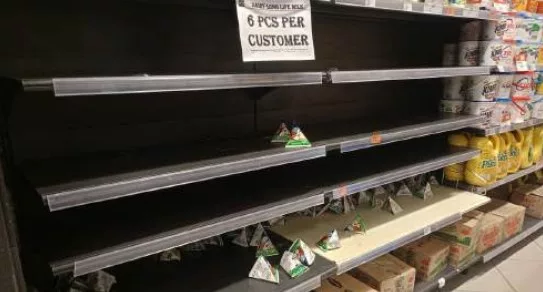
Drought, soaring feed costs and falling deliveries to processors have exposed the vulnerability of the dairy industry that produces billions of litres annually but often struggles to keep supermarket shelves stocked.
Despite overtaking Egypt as Africa’s largest milk producer, Kenya is grappling with shrinking deliveries to processors, rising production costs and increasingly expensive milk.
Farmers blame drought and costly feeds, while consumers and industry players question why the country cannot cushion itself against recurring supply shocks.
Empty shelves are becoming an increasingly familiar sight for Kenyans walking into supermarkets and retail outlets in search of milk, with those lucky enough to find a packet having to dig deeper into their pockets to meet one of their most basic household needs.
The shortage, which has intensified since mid-2026, is exposing a troubling contradiction in Kenya’s dairy industry: a country producing an estimated 5.4 billion litres of milk annually is struggling to ensure a reliable supply of affordable milk to her consumers.
Prices have climbed, some retailers have resorted to rationing purchases, and hotels are adjusting their menus as supplies dwindle.
Behind the shortage is a combination of drought, expensive animal feeds, declining milk deliveries to processors, and weaknesses in the systems meant to absorb surplus production and protect the market against seasonal disruptions.
On Sunday, President William Ruto committed to clear bills owed to milk farmers estimated at Sh400 million to ease the burden. His economic adviser David Ndii however attributed the problem to rising demand.
"There’s no milk production crisis. Processed output crossed one billion litres last year. Half year production this year is same as last year. Shortage reflects demand exceeding supply. Whose demand? Lower income people," he wrote on Twitter.
For dairy farmers, the crisis is threatening incomes and pushing up the cost of production. For consumers, it is adding to the cost of living at a time when food prices are already under pressure.
According to the Kenya National Bureau of Statistics (KNBS), the price of fresh packaged milk rose by six per cent in September 2026, while ultra-high-temperature (UHT) long-life milk increased by eight per cent.
The price increases contributed to broader food inflation, with Kenya’s annual inflation rate rising from 6.6 per cent in August to 6.8 per cent in September.
Yet the problem is not that Kenya has run out of milk. Rather, the country is confronting a growing mismatch between production, the amount entering formal processing channels and the ability to maintain a steady supply of packaged milk in retail outlets.
Data from the Kenya Dairy Board (KDB) shows formal milk deliveries to processors fell from 84.4 million litres in June to 81.3 million litres in July and 75 million litres in August.
The decline came after deliveries reached 88.89 million litres in May, before dropping by about five per cent in June.
KNBS data shows that June’s formal-sector milk intake was 6.4 per cent below the 90.24 million litres recorded in the same month in 2025.
By August, deliveries had fallen by about 16 per cent from June levels, putting pressure on processors and retailers seeking to maintain consistent supplies.
The figures highlight the vulnerability of a sector that supports an estimated 1.8 million smallholder dairy farmers and provides raw materials for a wide range of businesses, from milk processors to hotels, restaurants and food manufacturers.
Livestock Development PS Jonathan Mueke attributed the decline largely to drought, which has reduced pasture availability and increased pressure on animal feed.
However, the extent of the shortage and the reasons behind it remain contested.
The Consumers Federation of Kenya (COFEK) has challenged public claims that milk supply is expanding, arguing that the formal-sector intake figures point to a weakening supply trend.
COFEK secretary-general Stephen Mutoro says consumers deserve a transparent, evidence-based explanation of the shortage and its impact on prices.
The organisation has called on the Ministry of Agriculture, the Kenya Dairy Board and the National Treasury to coordinate an emergency response, including feed support, price monitoring and the establishment of strategic milk reserves.
Kitale farmer John Kimani, with more than two decades of experience, has watched his milk output fall sharply as the cost and availability of animal feeds deteriorate.
His herd of 23 cows now produce between 400 and 460 litres of milk daily, down from about 700 litres previously.
The reduction has cut the amount of milk available for sale while increasing the cost of keeping his animals productive.
He told the Star that finding quality fodder has become increasingly difficult, forcing him to travel longer distances to secure supplies and incur additional transport costs.
“The milk is decreasing because of the cost of food,” he says.
In Borabu, Nyamira county, farmers describe a similar struggle.
Margaret Gechuki from Mwongori said drought caught farmers unprepared, leaving many without sufficient feed for their animals.
John Mosomi, a small-scale farmer in Isoge village, also blamed the dry conditions, saying his grazing fields dried up and he had to purchase nappier grass at a high cost, without getting enough to sustain production.
The problem is not confined to individual farms. It extends into the commercial feed industry, which depends heavily on grain and imported protein ingredients.
Dr James Gakuo Mwangi, the Association of Kenya Feed Manufacturers (AKEFEMA) Mt Kenya region chair, says the maize shortage is creating pressure across the livestock value chain.
“About 70 per cent of manufactured animal feeds are made from grains. So when grain prices go up, the cost of feed also goes up,” Gakuo says.
At the 2026 African Feed Conference and Exhibition, AKEFEMA chairman Joseph Karuri said more than 80 per cent of critical feed ingredients, including soybean, sunflower meal and cottonseed meal, were imported.
Raw materials account for an estimated 70 to 80 per cent of feed manufacturing costs, leaving producers vulnerable to fluctuations in local grain supplies, international commodity prices and transport expenses.
The Ministry of Agriculture’s 2026 National Agriculture Sector Investment Plan estimates available feed at about 25 million tonnes against a national requirement of 55 million tonnes of dry matter annually.
This leaves a gap that becomes more difficult to manage during drought.
Gakuo said Kenya needs to diversify its sources of feed raw materials and expand the production of alternative grains and protein crops.
“We need to diversify our sources of animal-feed raw materials and develop another grain basket, including through irrigation,” he said.
He argues that relying heavily on the Rift Valley as the country’s principal grain-producing region leaves the feed industry vulnerable whenever the region experiences drought or crop failure.
In July, the government announced plans for a Sh465 billion National Feed Strategy intended to improve the availability, affordability and quality of livestock feeds.
Not every dairy-producing area has experienced the same decline, suggesting that feed management, market incentives and collection arrangements are also influencing the supply.
In Murang’a county, Fredrick Kinyanjui, chairperson of Kamahuha Dairy Cooperative Society, says daily milk collection has increased from about 1,500 litres earlier in the year to 2,000 litres currently.
The cooperative has about 2,000 registered members, but only 160 are active suppliers. Many of the others sell milk to local vendors and private processors.
Kinyanjui attributes the movement partly to differences in the prices farmers can obtain from alternative buyers.
Murang’a County Creameries Union, an umbrella organisation for more than 35 dairy cooperatives, previously paid farmers Sh47 per litre. Following a change in management in August, the price rose to Sh50 per litre.
But some farmers continue to find local vending more attractive.
The cooperative has a cooler with a capacity of 5,000 litres, meaning it can collect substantially more milk if additional members returned to its formal supply chain.
Kinyanjui says farmers are also learning to conserve feed to make it last longer during dry periods.
After visiting a successful dairy farm, he says he plans to invest in machinery that can help farmers prepare and compact silage properly, reducing spoilage and the losses associated with poor storage.
His experience illustrates another challenge facing Kenya’s dairy industry: milk produced on farms does not automatically enter formal processing channels.
Prices, payment arrangements, collection infrastructure and access to nearby buyers influence where farmers sell their milk, even when processors are seeking additional supplies.
In Kirinyaga, the county government has partnered with cooperatives to distribute 13 milk coolers, while it supplied two more, bringing the total to 15.
County executive for cooperatives Calbert Njeru says the equipment has capacities of 2,000, 5,000 or 10,000 litres, depending on the needs of the beneficiary cooperatives.
The county also supports routine livestock vaccination and deploys extension officers to train farmers on feed quality and improved production practices.
Milk collected through cooperatives in the county stands at approximately 123,000 litres daily, Njeru said.
At Kirima Slopes Dairy Cooperative Society, chairperson Samuel Gachoki said daily production ranges around 80,000 litres, with the cooperative operating above its existing cooling capacity.
The society has about 6,000 members and pays farmers Sh53 per litre, alongside a Sh1-per-litre bonus.
It sources feed for members and deducts the cost from their milk payments, helping farmers access supplies without paying the full amount upfront.
Gachoki says the cooperative plans to establish its own feed manufacturing plant to improve access and reduce costs.
It has also acquired equipment to detect poor-quality milk at farm-gate level, reducing losses.
The cooperative has installed a processing plant that is expected to be launched, which could allow it to process milk locally rather than relying entirely on private processors.
These examples demonstrate how organised collection, feed access, quality control and local processing can help strengthen the dairy supply chain. But they also show that infrastructure and production capacity need to expand together.
The current shortage comes after years of growth in Kenya’s dairy industry.
Annual milk production has increased from about 4.6 billion litres in 2022 to an estimated 5.4 billion litres, according to figures cited by the government.
Kenya has consequently overtaken Egypt to become Africa’s largest milk producer and has emerged as a leading exporter of processed dairy products.
Government figures indicate the value of dairy exports increased from approximately Sh4.9 billion to Sh14.2 billion, reflecting growing opportunities in regional and international markets.
The government has attributed the expansion to improved animal genetics, disease control, access to inputs and better market infrastructure.
Subsidised fertiliser has helped farmers produce fodder, while improved breeding and livestock vaccination programmes have supported efforts to increase productivity.
The installation of bulk milk coolers has also helped reduce post-harvest losses by allowing farmers to preserve milk before it is transported to processors.
More than 200 government-backed coolers have been installed across the country, according to government officials.
Mueke said the government wants to increase production and ensure that a greater proportion of milk enters the formal market.
“Our commitment was to double dairy production, increase exports and ensure most of our milk goes through formal processing,” he said.
According to the PS, only about 30 per cent of milk previously entered the formal market, with the government targeting 70 per cent.
But the current shortage highlights the distinction between increasing annual production and maintaining a stable supply of fresh milk throughout the year.
A country can produce more milk over a full year and still experience shortages if output falls during a dry spell, collection systems fail to capture available supplies or processing and distribution cannot respond quickly enough.
Kenya’s growing export market also makes it important to balance the interests of farmers seeking profitable markets with the need to maintain adequate domestic supplies. The available figures do not establish that exports caused the current shortage.
The 2025 National Agriculture Production Report shows that Meru led milk production in 2024, with about 479 million litres, followed by Uasin Gishu at 462.8 million litres and Kiambu at 368.7 million litres.
Nyandarua and Nakuru each produced 314 million litres, while Murang’a, Kericho, Trans Nzoia, Nandi and Kakamega were also major milk-producing counties.
The geographical spread of production means that a national response must account for differing weather conditions, feed availability, farmer practices and market access.
The effects of the shortage are being felt beyond households.
In Kisii town, hotelier Kevin Gichana says declining supplies from Borabu and Sotik have forced businesses to adjust their operations and increase the price of tea.
“Our supplies went down and in the supermarkets in town, we were only allowed to pick four packets. It has been tough for us,” he says.
The September price increases recorded by KNBS underline the pressure. Fresh packaged milk rose by six per cent during the month, while UHT milk increased by eight per cent.
Paul Kipsiele, a former steeplechase runner who now operates Kaso Dairy Farm in Sotik, Bomet county, says his production was not significantly affected because he had stored enough silage.
He attributes the wider decline to small-scale farmers who have not adopted zero-grazing systems and remain dependent on pasture that is vulnerable to changing weather patterns.
“With the unpredictable weather patterns, one cannot rely on traditional farming. Zero grazing is the way to go,” he says.
Story By Martin Mwita, Alice Waithera, Angwenyi Gichana, Mathews Ndanyi, and Agatha Ngotho