

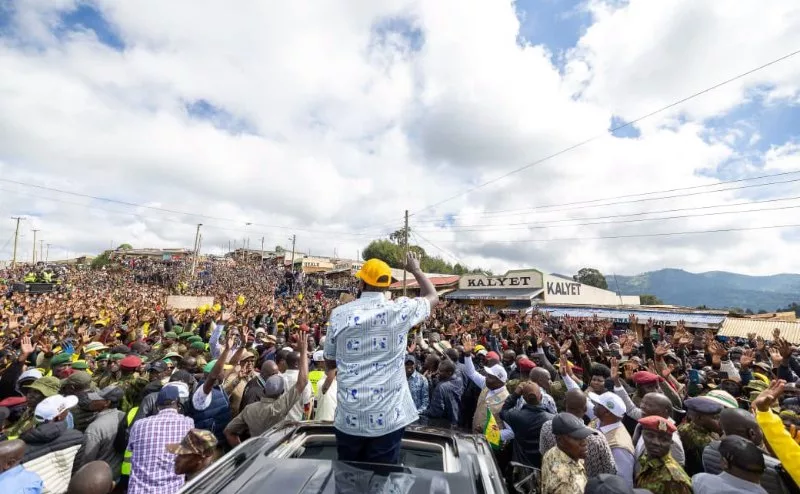
 President William Ruto in Elgeyo Marakwet County on Tuesday /HANDOUT
President William Ruto has mounted an aggressive charm offensive in his Rift Valley turf in an apparent effort to consolidate his support and ringfence the region ahead of next year's election.
Ruto, who is on a 10-day tour of the North Rift region, is launching projects, attacking the opposition and making emotional appeals to consolidate his support base.
The latest campaign came weeks after he intensified his political offensive in the South Rift in a calculated strategy to ringfence his political bedrock against opposition incursions.
The entire Rift Valley region has 14 counties, with 5.06 million registered voters, according to data captured by the Independent Electoral and Boundaries Commission in 2022.
The counties are Nandi, Uasin Gishu, Baringo, Elgeyo Marakwet, Narok, Nakuru, Kajiado, Samburu, Trans Nzoia, West Pokot, Turkana, Kericho and Bomet and Laikipia.
“Don’t be worried. Those people do not have an agenda. They can’t measure up. Those guys of wantam, Kasongo and Must Go are angry for nothing. I will beat them hands down very early in the morning,” Ruto said in Sigor, West Pokot county on Wednesday.
In the offensive, dubbed development tours, Ruto is seeking to appeal to the hearts and minds of his backyard supporters, repeatedly hitting out at the opposition while dangling multibillion-shilling development goodies.
The President has also intensified calls for mass voter registration in his backyard, signalling his determination to maximise turnout in a region that overwhelmingly backed his successful 2022 presidential bid.
“I need an additional one million votes in this region. Presidency is won by votes, and I need your support to secure another term to serve you,” he said.
Political risk scholar-practitioner Dismas Mokua argues that former Deputy President Rigathi Gachagua’s impeachment and subsequent fallout with Ruto created a political gap that the President must urgently address to stabilise his re-election prospects.
“That is why he must maximise voter turnout in his Rift Valley stronghold. This explains why he is asking folks to take National Identification Cards, register as voters and actually vote. The probability of locking his Rift Valley stronghold is high,” Mokua said.
“President Ruto will also need to maximise turnout in hitherto Raila Odinga strongholds outside his Rift Valley stronghold. He must also secure Western and Coast,” Mokua added.
However, political observer Charles Munyui cautions that the 2027 contest could defy traditional ethnic and regional voting patterns, particularly with the emergence of politically conscious Generation Z voters.
“Balkanisation of the country may not work because of the Gen Z factor, which cannot be dismissed. Eight million people did not vote in the last election, and this could be their time,” Munyui said.
The North and South Rift regions were Ruto’s political fortresses in the last election and are widely expected to remain central to his re-election calculations.
While the President enjoys political dominance across much of the region, Nakuru, Narok, Kajiado, Samburu, Laikipia and Trans Nzoia present potential battlegrounds with the opposition.
The North and South Rift counties, excluding Narok, Kajiado, Samburu, Trans Nzoia and Nakuru, collectively command more than 2.67 million registered voters, according to 2022 electoral data.
These include West Pokot (220,026 voters), Uasin Gishu (506,138), Elgeyo Marakwet (231,884), Baringo (281,053), Kericho (428,067), Bomet (376,985) and Nandi (406,288).
The opposition currently lacks a formidable political figure capable of mounting a serious challenge to Ruto’s dominance in these counties.
In contrast, Mt Kenya East which comprises Meru, Tharaka Nithi and Embu has 1.33 million voters: Meru (772,139), Tharaka Nithi (231,932) and Embu (334,302).
The Mt Kenya West base commands 4.43 million voters across Nakuru (1,054,856), Murang’a (620,929), Nyandarua (361,165), Laikipia (263,012), Kirinyaga (376,001), Nyeri (481,632) and Kiambu (1,275,008).
In 2022, Ruto secured 285,428 votes in Bomet, representing 95.27 per cent of votes cast, while Kericho delivered 318,861 votes, or 95.32 per cent.
He garnered 280,813 votes in Nandi, representing 91.32 per cent, and 160,033 votes in Elgeyo Marakwet, translating to 96.86 per cent.
In Uasin Gishu, the President secured 272,868 votes, or 77.99 per cent, while West Pokot delivered 109,944 votes, representing 63.29 per cent.
Ruto is also keen to wrest control of Turkana, a county that traditionally backed Raila.
With no prominent opposition figure currently commanding significant influence in Turkana, the President sees an opportunity to expand his political territory.
In 2022, Ruto secured 46,696 votes in Turkana against Raila’s 96,117, underlining the challenge of overturning the opposition’s previous dominance.
However, Nakuru, Kajiado, Laikipia and Narok remain potential battlegrounds, particularly with Gachagua seeking to expand the influence of his Democracy for the Citizens Party.
In the last election, Ruto garnered 455,864 votes in Nakuru against Raila’s 226,052.
He received 148,310 votes against Raila’s 159,455 in Narok, while Kajiado delivered him 148,449 votes against Raila’s 158,556.






