
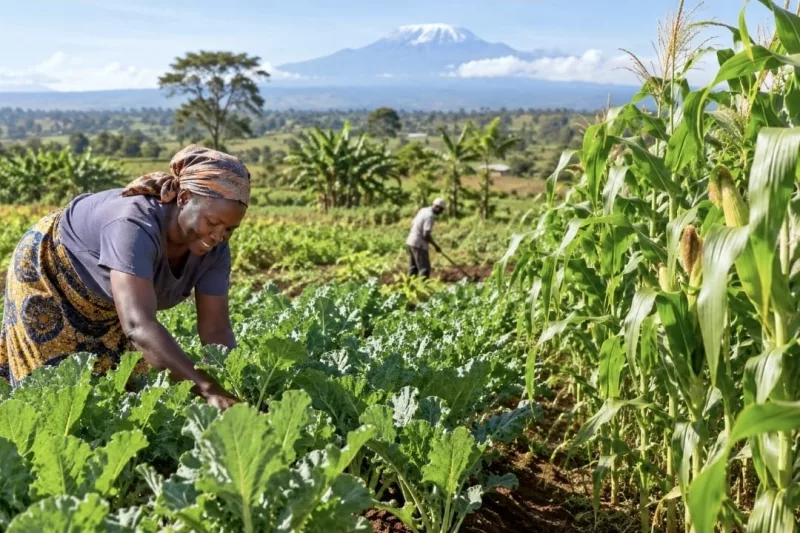
For years, Kenya’s agricultural debate has centred on food security, particularly maize production. This is an important priority. Millions of households depend on maize, and no serious agricultural policy can ignore its role in the country’s food system.
But there is a bigger economic question we must consider: Are we growing crops that merely feed us, or are we also growing crops that help farmers build wealth?
Consider two farmers, one in Central Kenya and another in Kitale. Each owns 20 acres of agricultural land. The farmer in Central Kenya grows tea, coffee and avocados, while the farmer in Kitale concentrates on maize.
For illustration, assume the first farmer’s land is valued at Sh8 million per acre and the second farmer’s land at Sh1 million per acre. The first farmer would hold land assets worth Sh160 million, compared with Sh20 million for the second.
The difference is substantial. However, these figures are illustrative and do not represent established market valuations.
The bigger issue is not simply how much a farmer earns from a harvest. It is the total economic value that farming can generate over time.
Land as collateral and a pathway to opportunity
Suppose both farmers need Sh10 million to invest in another business.
Subject to independent valuations, lending criteria and a lender’s willingness to accept the property as security, the first farmer might secure the amount using two acres of land. The second might need to offer ten acres to provide collateral of equivalent value.
This example illustrates how differences in land values can affect access to finance.
the land value is subject to the crop planted
A farmer whose land commands a higher value may be able to secure capital while committing a smaller portion of the farm as collateral. A farmer whose land has a lower value may need to offer a larger portion of the same acreage.
Lenders also assess repayment capacity, existing liabilities and other factors when determining whether to extend credit. Land value alone does not guarantee a loan.
Nevertheless, commercially viable agriculture, supported by reliable markets and value addition, can improve farmers’ incomes, strengthen the economic value of their assets and expand their financing options.
The question is whether our agricultural systems are helping farmers realise this potential.
What happened to our traditional cash crops?
Consider parts of Ukambani, including Kitui, where coffee, tobacco and cotton were once grown. In Nyanza, areas around Yala and Ambira also have a history of coffee production. Today, many farmers in these regions depend heavily on maize.
There are legitimate reasons for changing crops. These include unreliable rainfall, changing market conditions, production costs, declining farm-gate prices and challenges in managing agricultural cooperatives.
We should not romanticise the past or assume that coffee is automatically profitable. Every crop comes with its own production costs, market risks and environmental requirements.
Nevertheless, we should ask whether Kenya has adequately supported farmers to diversify into commercially viable crops with reliable markets.
Where growing conditions are suitable, coffee, avocados, macadamia, horticultural produce and other high-value crops can create opportunities for better returns.
But production alone is not enough. Farmers also need access to processing facilities, storage, transport, export markets, affordable finance and transparent pricing.
Without these systems, advising a maize farmer to switch to avocados may simply replace one set of risks with another.
Makueni offers an important lesson
Makueni demonstrates why we must look beyond the traditional value of agricultural land. Investments in processing and value addition, including mango-processing capacity, alongside coffee growing and processing, illustrate how agricultural produce can support a broader commercial ecosystem.
Generally means Makueni farmers have more value in land per acre based on crop means they can borrow more money per acre value.
The opportunity is not simply to sell raw produce. It is to capture more value through processing, packaging, branding and access to larger markets.
When farmers participate in profitable value chains, they can generate income from their land while creating opportunities for transporters, processors, traders and other businesses.
This is how agriculture can become an engine of local economic development rather than merely a source of subsistence.
Does Kenya only need maize?
Kenya needs maize, but it also needs agricultural diversification.
Food security should not be confused with dependence on one dominant crop. A resilient agricultural economy must produce staple foods while developing commercially viable crops suited to different regions.
We should assess crops not only by the tonnes harvested, but also by their nutritional contribution, profitability per acre, water requirements, market stability, employment potential and capacity to generate export earnings.
The goal is not to abandon maize. It is to stop treating maize production as the only meaningful measure of agricultural success.
From farming for survival to farming for wealth
Kenya needs a deliberate agricultural strategy that connects crop selection with local growing conditions, value addition, market access and financing.
Farmers should be supported to identify crops suited to their soils and climate, with sustainable market demand and the potential to deliver attractive long-term returns.
Financial institutions, in turn, should develop products that recognise agricultural cash flows, productive assets and the realities of seasonal income.
Ultimately, farmers in Kitale should have opportunities to build wealth just as farmers in Central Kenya do.
Achieving this will require better agricultural planning, stronger markets and investment in value chains, not simply a change of crops.
The future of Kenyan agriculture should be measured not only by how much food we produce, but also by how much economic value each acre generates and how many opportunities that value creates.
The real question is not whether Kenya can grow enough maize. It is whether we can build an agricultural economy in which farmers feed the nation, finance their ambitions and leave their families with assets that continue to create wealth.