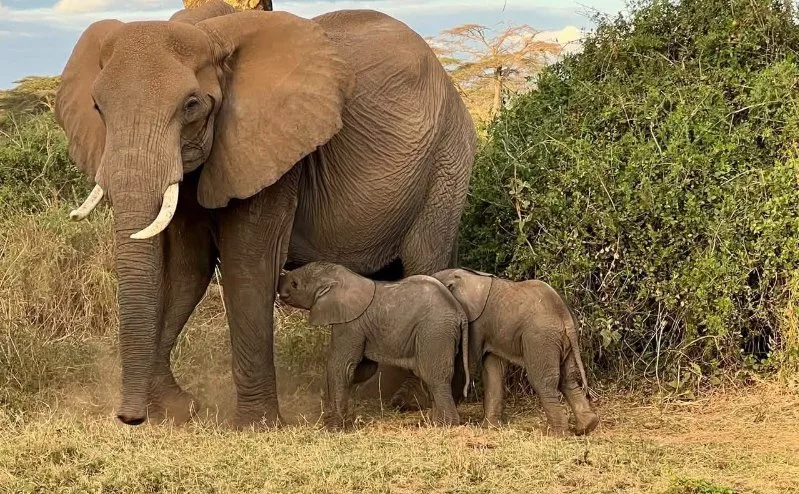
 An elephant with her twins/KWS
A rare wildlife moment is unfolding at Kimana Sanctuary, where a 30-year-old elephant named Twain has given birth to twins, marking the sixth recorded set in the Amboseli ecosystem.
The newborn calves, delivered on October 7, are thriving alongside their mother, according to the Kenya Wildlife Service (KWS), which described the birth as a remarkable milestone for elephant conservation.
“Twain, a remarkable 30-year-old elephant from the TC family in Kimana Sanctuary, has made history by welcoming a set of twins, the sixth recorded set within the Amboseli ecosystem,” KWS said in a statement.
The TC family is a well-documented lineage of African elephants monitored through the Amboseli Trust for Elephants’ research and conservation network.
KWS said the birth was a reminder of the resilience of elephants and the importance of safeguarding the habitats that sustain them.
“The arrival of her twins is not only a special moment for her family, but also a reminder of the importance of protecting elephants, their habitats and the ecosystems they call home,” the service said.
“Six sets of twins. One incredible ecosystem.”
While elephant births are significant in their own right, twins present a particular challenge.
African elephants have the longest gestation period of any living mammal, carrying their young for about 22 months and typically giving birth about every four years.
According to the conservation organisation Save the Elephants, twins account for only about one per cent of elephant births, with male-female pairs being even rarer.
The survival of both calves can be difficult because a mother may struggle to produce enough milk for two offspring.
Elephant calves, however, begin feeding on vegetation at three to four months, gradually supplementing their mother’s milk as they grow.
The challenge was evident in 2020, when an elephant named Angelina delivered male and female twins in Amboseli National Park.
The mother struggled to produce enough milk, leaving the calves emaciated and raising fears about their survival beyond six months.
Elephant families rely heavily on close maternal care, with calves remaining alongside their mothers for years as they learn essential behaviours.
Orphaned calves may also be adopted by lactating females within their family.
Twain’s newborns arrive against the backdrop of Kenya’s wider elephant conservation gains, despite growing pressure on wildlife habitats from human settlements, infrastructure and agriculture.
A 2025 census report by the Wildlife Research and Training Institute estimated Kenya’s elephant population at 42,072 in June that year.
Numbers increased by 5,796 between 2021 and 2025, representing an annual population growth rate of 2.7 per cent over the past 36 years.
The Tsavo ecosystem hosts the country’s largest elephant population, with 17,266 animals, accounting for 41 per cent of the national total.
The Laikipia-Samburu ecosystem follows with 9,360 elephants.
However, the fragmentation of elephant habitats continues to pose challenges, increasing pressure on the spaces wildlife needs to survive.
For KWS, Twain’s twins represent more than a rare birth.
The agency said protecting wildlife habitats gives future generations of elephants an opportunity to thrive and produce more remarkable stories.