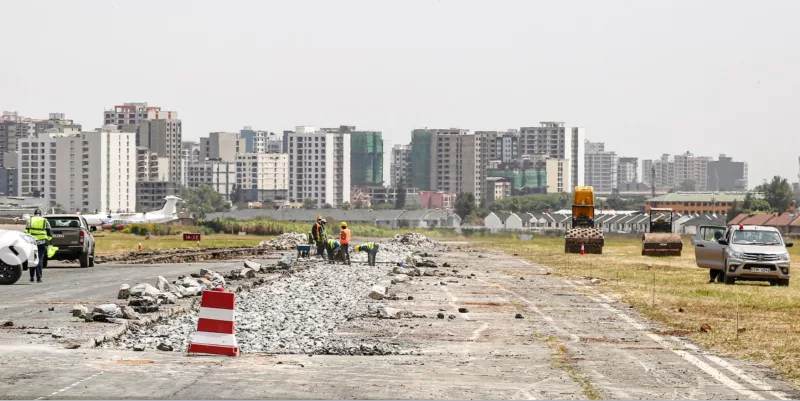
Nairobi County's long term city expansion plan is moving Moi Airbase in Eastleigh and reviewing the future of Wilson Airport to manage the rapid growth, free up land and improve urban planning.
The Moi Airbase was at its inception build to evacuate high profile state officials in cases of conflicts and emergencies.
However, with the development of high structures and increased population, accessibility for emergency purposes is proving difficult prompting the county to call for a change in the land use.
Nairobi Governor Johnson Sakaja says that the relocation of Moi Airbase from Eastlands, should be considered, arguing that the military installation facility usage has changed.
Appearing before the Hamida Kibwana led Senate Committee on Roads, Transportation and Housing, Sakaja said the rapid growth of residential settlements around Moi Airbase had changed the security and land-use considerations that informed its original establishment.
The governor argued that the military facility was built when the surrounding area was far less populated, but the expansion of Nairobi has brought millions of people closer to the installation, raising questions about its suitability within a densely settled urban environment.
“If you ask me, it needs to be relocated, the concentration of people around the airbase could complicate security arrangements in the event of an attack,” Sakaja told the committee.
“This means that people are almost a human shield to the military. Bases and communication infrastructure could become targets during a conflict.”
The governor acknowledged that the proposal could be unpopular with the military but maintained that Nairobi's changing population and development needs warranted a fresh assessment of how strategic public land is used.
Senator Mohamed Chute from Marsabit County, questioned whether the county had engaged the national government6 over the proposal.
“With building-height restrictions around Moi Airbase relaxed and residential settlements increasingly surrounding the military installation, could relocating the airbase compromise national security or improve safety, and has the county consulted the national government on the proposal?” Senator Chute asked.
The proposal comes amidst a debate on the future of aviation infrastructure in Nairobi as the county seeks to accommodate rising demand for housing, public spaces, transport and other urban services.
Sakaja also pointed to the need to reconsider Wilson Airport as part of a broader review of the city's land use and development priorities.
Sakaja said the county would use its proposed Nairobi Vision 2050 framework to reassess how land is allocated for housing, security, transport and public amenities, noting that the city's existing planning framework no longer reflects its population and economic growth.
He said Nairobi's last major urban plan dated back to 1978, with another plan introduced in 2014, leaving the county needing a more comprehensive approach to managing its expansion.
“We have to rethink it actively, and rethink it now. The county was dealing with a city that attracts millions of people daily, putting pressure on infrastructure and intensifying competition for land,” added the governor.
He argued that planning decisions made decades ago must be reviewed to reflect current realities, including the need to provide residents with adequate green spaces, recreational facilities and transport connections.
Sakaja cited the land occupied by Moi Airbase as an example of the competing demands facing the county. He said densely populated neighbourhoods around the installation lacked sufficient public spaces while large tracts of land remained under military control.
He suggested that portions of the land could potentially support public amenities, including recreational facilities, if the relevant authorities agreed to reconsider its use.
The governor also questioned the decision to relax building-height restrictions around the airbase, saying the changes reflected competing interests between security considerations and the economic potential of the surrounding areas.
However, he cautioned that military installations contain sensitive facilities that cannot be opened to the public without proper assessment and clearance.
The future of Wilson Airport also featured in the committee's deliberations, with senators referring to concerns about encroachment around the facility.
“Given the reported encroachment around Wilson Airport and the pressure for urban expansion, should the facility be relocated, and what specific plans does Nairobi County have to address aviation safety and land-use conflicts?” asked Kibwana
The debate comes as Nairobi grapples with unauthorised construction and development in areas where building restrictions are intended to protect public safety and infrastructure.
Sakaja told senators that the county was struggling to enforce planning regulations because of legal and institutional hurdles, including delays in prosecuting alleged violations.
The proposed review of aviation facilities comes as the county considers wider changes to transport and urban development, including mass transit infrastructure intended to ease congestion.
Sakaja said Nairobi needed to move away from planning approaches that prioritised roads without providing adequate public transport options.
He told senators that the county was developing plans for an underground rail system, alongside bus rapid transit and intelligent traffic management measures.
The governor maintained that Nairobi's future development required coordinated planning across government agencies, particularly where decisions on land use intersect with national security, aviation and infrastructure.