

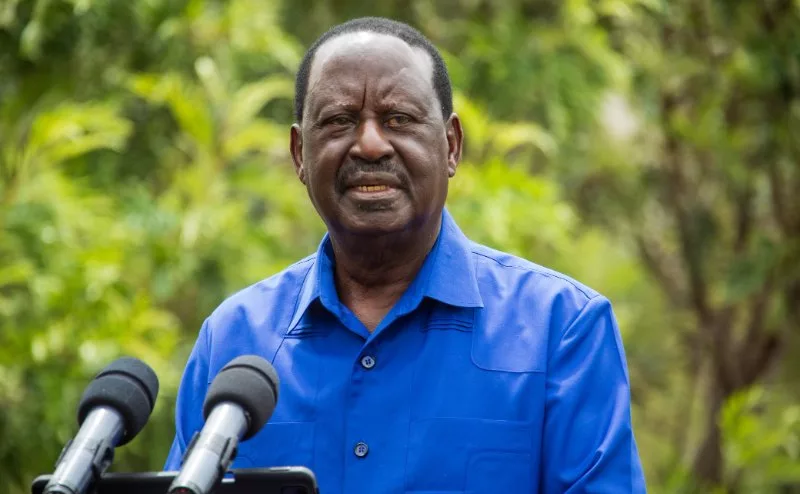
 Former Prime Minister Raila Odinga./FILE
For two decades, Raila Odinga held his ODM party together, commanding a formidable political following and dominating the country's opposition politics even as the presidency repeatedly slipped through his fingers.
But as Raila’s family, ODM and the country mark the first anniversary of his death today, the party he built through sweat and blood faces perhaps its greatest existential crisis.
High-profile defections, bitter infighting and dwindling popularity have rocked the once formidable political force.
The Orange party is now fighting for political survival, with emerging factions tearing apart Raila's political empire ahead of the 2027 general election.
The party's political strength has apparently drastically weakened, with the latest opinion polls suggesting a significant erosion of its traditional support base.
Political pundits warn that without Raila's unifying influence, ODM could struggle to retain its parliamentary and ward seats, particularly outside its traditional Luo Nyanza stronghold.
"The only places ODM is likely to get some seats are Luo Nyanza and some parts of the Coast. Western is gone with Sifuna. Nairobi is gone with Gachagua and Sifuna. Kisii is gone with Matiang'i," political analyst Martin Andati said.
However, party officials insist the outfit is strong today as it was during Raila’s days.
"ODM is still the biggest and strongest party in Kenya. Bigger than even UDA. We are strong and determined to remain so, unlike these other briefcase parties that have no direction," National Assembly Minority Leader Junet Mohamed said last weekend.
ODM chairperson and Homa Bay Governor Gladys Wanga said the party will field candidates in every elective position, except that of the president – a demonstration of the party’s strength.
"From the MCA, to the Woman Rep, MP, senator and governor, we will vote for ODM candidates. But we are supporting President Ruto because he has shown the willingness to work with us," Wanga said.
At the heart of ODM's troubles is a bitter fallout over the party leadership's decision to forge a political alliance with Ruto's UDA ahead of next year's elections.
The move triggered a serial purge of top officials and an exodus of influential politicians who accuse the party's leadership of abandoning Raila's political ideals.
Former secretary general Edwin Sifuna has bolted out and unveiled the Equitable Party, which he intends to use as his political vehicle in the presidential contest.
Recent opinion polls place him second behind Ruto in popularity.
A TIFA opinion poll conducted between June 13 and 22, 2026, revealed the extent of the rebellion within Raila's former political base.
The survey showed that the Linda Mwananchi faction, associated with Sifuna, Siaya Governor James Orengo and Embakasi East MP Babu Owino, commanded 74 per cent support among ODM followers.
In contrast, the Linda Ground faction, associated with party leader Oburu Oginga and supporters of the broad-based government arrangement, attracted only 20 per cent.
The findings exposed the widening disconnect between the party's official leadership and sections of its traditional support base.
Babu has also quit ODM and unveiled the Mwananchi Party, which he intends to use in his bid to unseat Nairobi Governor Johnson Sakaja.
Orengo, another of Raila's longtime political allies, is also preparing to abandon the Orange party, having indicated plans to take over the Liberal Democratic Party.
Former deputy party leader Godfrey Osotsi has similarly severed ties with ODM and joined Sifuna's Equitable Party.
The departures have left ODM facing the prospect of losing influential grassroots networks that helped Raila dominate successive elections.
But the turbulence extends beyond ODM's internal struggles, with Raila's death also complicating Ruto's re-election calculations.
Before his death, Raila had entered into a broad-based government arrangement with Ruto, nominating some of his political allies to the Cabinet following the deadly Gen Z protests that forced the President to dissolve his Cabinet.
However, whether Raila intended to translate that cooperation into a formal electoral coalition in 2027 remained unclear.
But having unsuccessfully contested the presidency five times, Raila was widely expected to abandon another presidential bid, raising speculation that he could back Ruto's re-election.
Such an endorsement would have handed the President a powerful political advantage.
Raila commanded a massive following stretching from his Luo Nyanza backyard to Western, the Coast, Nairobi, North Eastern and Maasailand.
His extensive political networks, built over decades of political battles, could have provided Ruto with a formidable electoral machine.
Instead, the President now faces the difficult task of persuading Raila's supporters to embrace his re-election bid without their longtime political kingpin.
The emergence of Sifuna and other rebellious ODM politicians has further complicated that mission.
Analysts argue that had Raila lived and endorsed Ruto, the President might have avoided the political headache posed by the emerging opposition figures.
INSTANT ANALYSIS
Raila’s death has exposed ODM’s overdependence on his personality rather than strong institutional structures. The widening rebellion, defections and declining grassroots support threaten to reduce the once-formidable party to a regional outfit. For Ruto, the fragmentation complicates efforts to inherit Raila’s political constituency ahead of 2027. Unless ODM resolves its leadership crisis and ideological divisions, it risks losing parliamentary strength, national influence and its bargaining power in future coalitions.






