
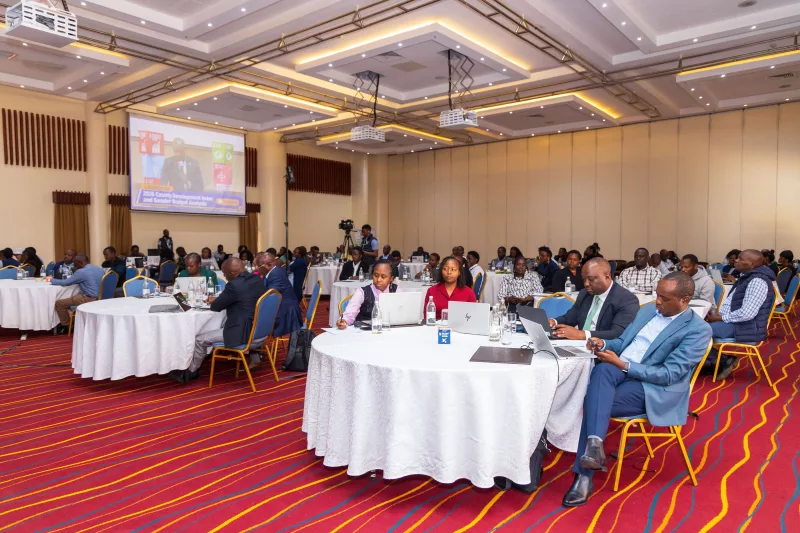
Six counties collected less than Sh250 in own-source revenue per resident, exposing the deep financial disparities among the devolved units according to a new study.
The 2026 County Development Index report, which was launched on Tuesday, found Tana River collects just Sh100 per resident, compared with Sh4,800 in Narok.
This represents a 48-fold difference, illustrating the uneven capacity of county governments to mobilise local revenue.
The CDI report by the Sustainable Development Goals Kenya Forum identified Tana River, Mandera, Wajir, Marsabit, West Pokot and Garissa among counties with the lowest own-source revenue per capita.
Mandera collects Sh134 per resident, Wajir Sh180, while Marsabit and West Pokot each collect Sh200. Garissa records Sh240 per resident.
“The CDI findings reveal a country that is progressing, but unevenly across counties and development dimensions,” the report says.
Among the findings is that urban, metropolitan and agriculturally productive counties demonstrated stronger development outcomes, supported by stronger economic foundations, better infrastructure and higher own-source revenue capacity.
They also enjoy stronger human capital systems and relatively greater institutional capacity.
However, many Arid and semi arid lands and historically marginalised counties continue to face a concentration of structural disadvantages such as high poverty, weak infrastructure, limited economic diversification, low access to essential services, climate vulnerability and institutional constraints
The analysis covers fiscal management and public finance; economic performance and livelihoods; human capital; essential infrastructure and connectivity; water, sanitation and hygiene.
Others are environmental management and climate resilience; governance, transparency and citizen engagement; social protection, inclusion and gender equity; and crime, justice and personal security.
The report shows the poor counties remain heavily dependent on transfers from the national government.
The study found Narok leading in revenue mobilisation at Sh4,800 per resident, followed by Mombasa at Sh4,200, Nairobi at Sh2,500 and Nyeri at Sh2,100. Nakuru collects Sh1,650 per resident, while Kiambu and Laikipia each record Sh1,600.
Own-source revenue comprises money county governments collect through property rates, business permits, parking fees, market charges and other local levies.
It supplements funds received from the national government and other revenue sources available to counties.
The per-capita figures show the amount of locally generated revenue relative to population, with the differences reflecting varying economic conditions.
Counties with major commercial centres, valuable property, tourism and larger formal business sectors have more potential sources of revenue than areas with limited economic activity and dispersed populations.
Many of the counties at the bottom of the rankings face broader development challenges, including weak infrastructure, limited economic diversification and climate vulnerability.
These factors constrain business activity and narrow the base from which county governments collect revenue.
Narok also recorded a fiscal management index score of 0.79, budget execution of 95.5 per cent and a wage bill equivalent to 23.3 per cent.
It emerged as the strongest performer in the report’s overall fiscal management assessment.
By contrast, Nyamira recorded the lowest fiscal management score at 0.16, with personnel costs accounting for 53.9 per cent and budget execution standing at 53.8 per cent.
To improve performance, the CDI report recommends modernising revenue systems through digital collection, updating property valuation rolls, automating billing and strengthening enforcement.
It also proposes county-specific fiscal improvement plans for governments with persistently low scores, alongside stronger internal audits, financial controls and implementation of recommendations by the Auditor General.
The report cautions that enforcement measures should protect vulnerable households and small enterprises from excessive charges.
It also recommends expanding local businesses, supporting agricultural value chains, improving infrastructure and attracting private investment to help broaden revenue bases for counties with limited economic activity.
The findings also raise questions about the role of national transfers in addressing differences in counties’ ability to raise money locally.
While such transfers remain essential to financing devolved services, the report notes, their effectiveness depends on whether resources reach areas with significant needs and translate into measurable improvements in residents’ lives.
INSTANT ANALYSIS
Kenya’s counties face stark revenue disparities, with Tana River collecting just Sh100 per resident against Narok’s Sh4,800, exposing deep economic inequalities and uneven capacity to fund devolved services. The findings highlight the need for stronger revenue systems, local investment and targeted national transfers to help marginalised counties expand their tax base and improve service delivery.