

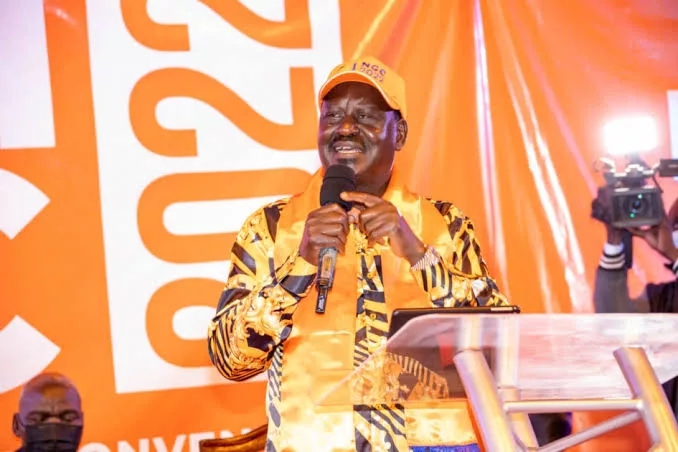
 The late former prime minister Raila Odinga during a past event/COURTESY
When Raila Odinga died on October 15, 2025, Kenya lost more than a former Prime Minister and opposition leader.
The Orange Democratic Movement (ODM) party lost the political figure around whom its formal party structures, grassroots networks, elected leaders and national alliances had revolved for decades.
The biggest question now is not simply who inherited the party leader’s title but whether the political machine he built over nearly two decades could survive without the man who held its many moving parts together.
It is what happened to the machinery he built.
One year later, the answer is emerging in pieces.
The party itself has survived.
Its headquarters are operating, its national leadership has been reorganised, its parliamentary wing remains substantial and its grassroots structures are being reactivated.
But the political network that once revolved around Raila has changed significantly.
While some of his lieutenants remain inside ODM under his brother, party leader Oburu Oginga, others have moved into the Linda Mwananchi movement.
A number of elected leaders have also embraced the broad-based government and President William Ruto's 2027 re-election bid.
The result is a political inheritance spread across several camps.
The first test: who controls ODM?
The immediate post-Raila succession exposed how much authority had been concentrated in the party leader.
Oburu was named acting party leader shortly after Raila's death and was formally ratified at the ODM National Delegates Convention (NDC) in March.
Homa Bay Governor Gladys Wanga became national chairperson while other senior officials were retained or replaced as the party sought to establish a new chain of command.
Wanga acknowledged that Raila's death had shaken the party.
“We lost a leader, and there was bound to be some shakiness, but we pulled in quickly, got a new party leader whom we will be ratifying on Friday, and we have consolidated our leaders,” she said ahead of the March convention.
But consolidation did not end the dispute.
Secretary General Edwin Sifuna, Siaya Governor James Orengo and former deputy party leader Godfrey Osotsi became increasingly critical of the direction ODM was taking, particularly its relationship with Ruto and UDA.
The disagreement eventually produced the Linda Mwananchi movement.
Orengo went as far as declaring himself acting ODM party leader at a Linda Mwananchi rally in Nakuru in April, arguing that the party required a new direction.
That was a significant break from the old arrangement in which disputes were ultimately mediated by Raila.
What survived? The Orange infrastructure
The most important part of Raila's political legacy that survived is the party's formal infrastructure.
ODM still has national, county, constituency and ward structures, as well as elected representatives spread across the country.
The party has been deliberately rebuilding those structures ahead of the 2027 elections.
In May, ODM announced grassroots elections in Taita Taveta, Kisumu and Nyando, with officials to be elected at county and branch levels.
The Nairobi branch has also embarked on a campaign to reactivate its network across all 17 constituencies.
Nairobi ODM chairman George Aladwa said the immediate task was to rebuild the organisation from the bottom.
“We will strengthen our branches, activate ward structures and mobilise our supporters across the city. Our branch chairmen and grassroots officials must begin this work immediately,” he said.
This matters because Raila's strength was not based only on rallies.
Behind every major political event was an extensive network of ward organisers, constituency officials, elected leaders, aspirants, community influencers and party loyalists who did not disappear with Raila.
The battle has moved to the grassroots.
The clearest indication of ODM's rebuilding strategy is its renewed emphasis on grassroots structures.
Oburu has repeatedly told aspirants that party headquarters will not hand them tickets and that they must return to the members.
“Those who want to vie for elective seats on the ODM ticket, do not bother looking for that power at the party headquarters. Look for it at the grassroots. That is where power lies,” he said.
ODM has also said it is reorganising ward executive committees and developing a digital system for aspirants seeking the party's nomination.
The intention is to make the grassroots, rather than individual senior leaders, the centre of the nomination process.
Pawaa Centre becomes a new nerve centre
Raila's political office at Capital Hill in Nairobi was more than a workplace.
It was a meeting point for politicians, businessmen, religious leaders, community representatives, activists and ordinary supporters seeking access to the man they called Baba.
In the post-Raila era, ODM headquarters at Pawaa Centre has attempted to assume some of that coordinating role.
Oburu has been receiving delegations from counties and interest groups in an effort to reconnect with the party's national network.
Among those visiting have been representatives from Marsabit, Isiolo, Mandera, Wajir, Tana River, Turkana, Kilgoris, Nakuru and Baringo.
Oburu described the consultations as part of a strategy to rebuild the organisation.
“Our discussions centered on strengthening party cohesion, expanding our grassroots footprint, and positioning the party for future political milestones,” he said.
The centre is attempting to become the place where the disparate pieces of ODM are brought together again.
Influential figures go in different directions.
Raila's political machinery was held together by a broad cast of senior politicians.
Oburu has inherited the formal party leadership with Wanga emerging as one of ODM's most visible national figures.
Junet remains an important political operator, while governors such as Abdulswamad and Arati occupy key positions in the party hierarchy.
Others, however, have moved outside the mainstream ODM structure.
Orengo and Sifuna became central figures in Linda Mwananchi.
Babu has also been associated with the movement, giving it a youthful and combative political face.
The division is particularly significant because Sifuna was not an outsider.
He was Raila's secretary general and one of the most recognisable younger politicians in the Orange movement.
His eventual decision to seek another political vehicle therefore represented more than an ordinary defection.
In August, Sifuna said supporters would follow their leaders even if Linda Mwananchi had to operate under another party name.
“If they close all doors, we will come here and say ‘Tent Party of Kenya’ or ‘Maua Party’ or ‘Grass Party’, but you will follow your leaders,” he told supporters.
By October, Sifuna had unveiled The Equitable Party as his political vehicle and said it could eventually be rebranded as Linda Mwananchi.
The political infrastructure built around Raila was therefore beginning to reproduce itself outside ODM.
The Ruto alliance has changed the machinery
Perhaps the biggest change has been ideological and strategic.
Raila's ODM spent years as an opposition party and his final political arrangement with Ruto changed that.
After Raila's death, Oburu and other ODM leaders decided to continue the broad-based government arrangement and eventually announced that ODM would not field a presidential candidate in 2027.
Instead, the party would support Ruto.
Oburu made the position official in July.
“I want to make it official that ODM will not field a presidential candidate in the next year's general election. Instead, we are going to support President Ruto to be elected again for a second term,” he said.
That decision has transformed how the Orange machinery is being deployed.
ODM leaders who once mobilised voters for Raila against successive governments are now being asked to use some of the same structures to support the incumbent.
In Nairobi, Aladwa said ODM would use its grassroots network to support Ruto while protecting the party's own candidates.
“Our strategy is to ring-fence ODM's traditional bases, while mobilising voters to support the President in the presidential contest,” he said.
In Nyanza, the change has been even more visible.
During Ruto's September tour of the region, ODM governors, MPs, senators and MCAs turned out in large numbers to welcome him, with much of the region's political establishment now working within the broad-based arrangement.
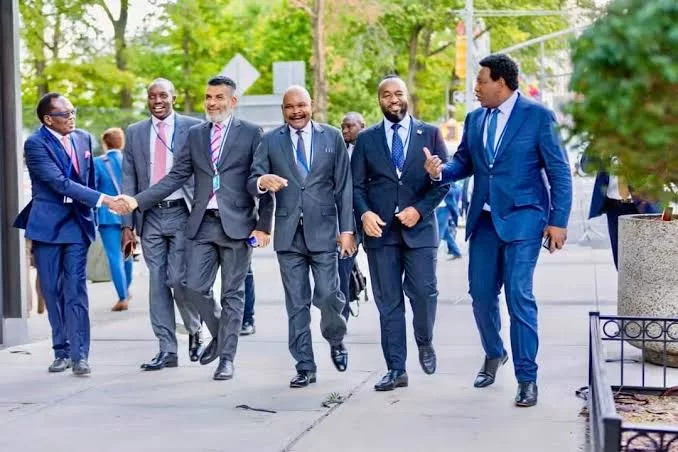 A section of ODM party members during a recent meeting in US /COURTESY
Breakaway machinery is growing.
The emergence of Linda Mwananchi means the post-Raila contest is no longer simply between ODM and its external rivals.
A battle is taking place over who inherits Raila's political language, grassroots networks and opposition constituency.
Orengo has accused the current ODM arrangement of weakening the party, while Sifuna has increasingly presented Linda Mwananchi as a vehicle for ordinary Kenyans.
The Nyanza question
The biggest test remains Raila's traditional backyard.
For years, Nyanza provided ODM with an unusually dependable political base.
Raila's influence extended from elected leaders to local organisers and ordinary voters.
Without him, the region has become contested territory.
Wanga and Oburu have defended the Ruto-ODM arrangement, while Orengo and other Linda Mwananchi leaders have challenged it.
The internal contest has at times become public and bitter.
Wanga has acknowledged the existence of the disagreements while defending her decision to support Oburu.
“Our region deserves leadership that inspires hope, not needless turf wars with a girl the age of your daughter,” she said in May.
The significance goes beyond Nyanza.
If ODM can preserve its organisational structure there while extending its reach elsewhere, it retains a substantial portion of the machinery Raila built.
If competing groups continue pulling leaders and organisers in different directions, the same machinery could become several smaller machines.
So, what exactly survived?
What did not survive intact was the single command structure that connected all of them.
ODM is now trying to rebuild it through grassroots elections, membership mobilisation, party consultations and a new nomination system.
Oburu has insisted the party remains strong.
“Our party, ODM, is not weak. We came to this coalition not because we are unable to fill the presidential candidate, not because we are not prepared at the grassroots,” he said in August.
“We are the largest party.”
But even within ODM there are warnings that the rebuilding process is incomplete.
Rarieda MP Otiende Amollo has urged the party leadership to address unresolved grievances to prevent further fragmentation.
“It is still my view that even those of us who are remaining, there are still small underlying issues and it is important to address those issues because there can still be further fragmentation in the party,” he said.






