
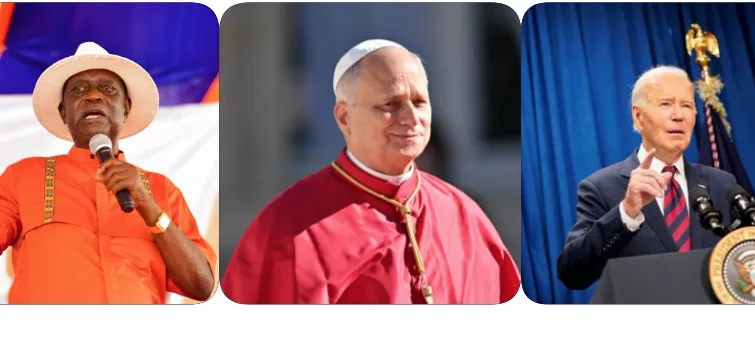
 A collage of ODM leader Oburu Oginga, Pope Leo XIV and former US president Joe Biden./FILE
When public figures fall ill, the decision to keep their medical conditions private can create an information vacuum that fuels rumours, anxiety and speculation among.
The issue has come into focus following the hospitalisation of Orange Democratic Movement (ODM) leader Oburu Oginga in Nairobi, where uncertainty surrounding his condition sparked widespread discussion on social media.
Details about the nature of his illness have not been publicly disclosed, leaving questions about his condition.
The Siaya Senator had previously dismissed reports suggesting that he was seriously ill following an earlier hospital visit, which he described as a routine medical check-up.
At the time, Oburu insisted that he would be transparent with Kenyans should his condition change, saying: “The day I am truly sick, I will inform you all, for I am a very transparent person.”
His experience illustrated the dilemma facing prominent leaders when their health becomes a subject of public interest.
While they are entitled to medical privacy, limited official communication can allow unverified claims to circulate, sometimes forcing families and political associates to respond to rumours rather than provide routine updates.
A similar debate surrounded the late former Prime Minister Raila Odinga, whose medical condition in the months before his death in India on October 15, 2025, was not widely understood by the public.
Despite his decades-long presence at the centre of Kenyan politics, details about the nature and severity of his illness remained limited.
His death prompted renewed questions about what was known about his condition, when its seriousness became apparent and how much information the public could reasonably expect.
Raila’s case highlighted the challenges of communicating health developments involving influential leaders, particularly when family members and close associates seek to protect their privacy during difficult moments.
Pope Leo XIV diagnosis with lung cancer after undergoing surgery in Rome on October 13, 2026 has also drawn global attention.
The Vatican confirmed that the 71-year-old pontiff had lung adenocarcinoma after doctors removed the lower lobe of his right lung. The operation was successful, with no complications reported.
However, the Pope’s diagnosis was not entirely concealed from the public before surgery.
On October 11, he disclosed that doctors had discovered a small, localised lung nodule during medical examinations and that he would undergo an operation to remove it. The cancer diagnosis was confirmed during the procedure.
Former United States President Joe Biden also faced sustained scrutiny over his health, particularly during the final years of his presidency
Questions about his age, memory and public performances intensified after his June 2024 presidential debate against Donald Trump.
Biden subsequently withdrew from the presidential race in July 2024 amid mounting pressure over his suitability to seek another term.
In May 2025, his office announced that he had been diagnosed with an aggressive form of prostate cancer that had spread to his bones.
His office said his last known prostate cancer screening had been in 2014, prompting further questions about the timeline of his diagnosis and whether his health had been adequately communicated during his presidency.
The diagnosis did not establish that the cancer had been deliberately concealed while he was in office, but it renewed public debate about transparency surrounding the health of senior political leaders.
Former US President Franklin D. Roosevelt, who contracted polio in 1921 and was left paralysed from the waist down, worked with his aides and the Secret Service to conceal the extent of his disability.
His public appearances were carefully managed to minimise the visibility of his wheelchair, leg braces and difficulty walking, allowing him to project an image of strength during his presidency.
Former French President François Mitterrand also concealed a major health issue during his time in office.
Diagnosed with prostate cancer in 1981, shortly after becoming president, he kept the condition secret for years.
The diagnosis became public in 1992, during his second term, illustrating how leaders can restrict access to sensitive medical information even while holding the highest public office.
In Africa, Cameroonian President Paul Biya has faced persistent scrutiny over his health, particularly during prolonged absences from the country.
His trips abroad and limited public appearances have fuelled speculation, while the government has at times restricted reporting on his health. His case highlights how official secrecy can intensify uncertainty about the condition of long-serving leaders.
Medical privacy does not require leaders to disclose every diagnosis, test result or treatment.
However, timely and factual communication can help families, political parties and public institutions counter misinformation without revealing sensitive medical details.






