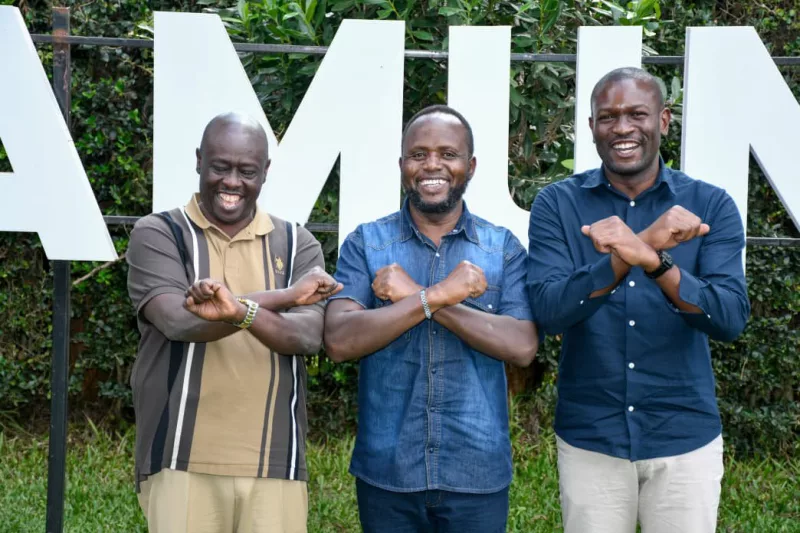
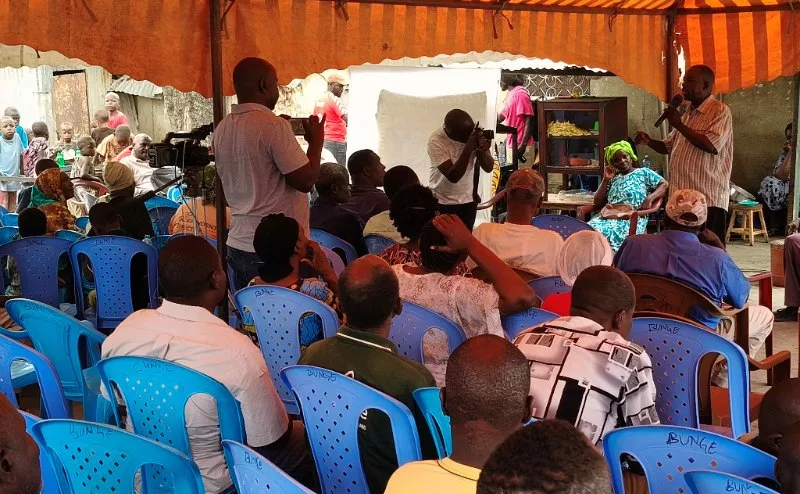
 Owino Uhuru residents on September 27, 2025
The Environment and Land Court in Mombasa has ordered Nema and the National Treasury to pay victims of the Owino Uhuru lead poisoning at least 10 per cent of their Sh1.3 billion award by December 15.
This amounts to Sh130 million.
Failure to comply with the directive will attract penal orders against both institutions and their leadership in their personal capacities, Justice Belinda Akello said on Monday.
Akello also ordered Nema to file a payment plan for the full decretal amount before January 18, 2027.
“The fourth respondent (Nema) and the National Treasury are hereby directed to pay at least 10 per cent of the decretal amount by December 15, 2026, failure of which will attract penal orders of this court to both institutions and their leaderships personally,” she said during a virtual court session.
The Centre for Justice, Governance and Environmental Action (CJGEA) had anticipated a Garnishee Order Absolute after Nema failed to issue a payment plan for the compensation award, as directed by an earlier ruling on July 6.
By then, the court had issued a Garnishee Order Nisi following an application by CJGEA seeking an order to have money held in Nema’s bank accounts used to satisfy the compensation owed to the Owino Uhuru community.
The community has suffered deaths, miscarriages, ailments and broken families after a battery-smelting company, Metal Refinery EPZ, was found guilty of poisoning the environment with lead.
On December 6, 2024, the Supreme Court issued a landmark ruling reinstating a Sh1.3 billion personal injury award for 450 households and a Sh700 million environmental restoration fund for the Owino Uhuru community in Jomvu subcounty, Mombasa county.
The Supreme Court allowed an appeal, overturning the Court of Appeal’s earlier decision to set aside the compensation and remit the case for a rehearing.
It fully restored the Sh1.3 billion awarded by the Environment and Land Court in Mombasa for personal injuries and loss of life suffered by residents.
The Supreme Court also reversed the dismissal of restorative orders, reinstating the Sh700 million allocation for cleaning up the lead-contaminated ecosystem in Owino Uhuru village in Mikindani, Jomvu subcounty.
The court held state regulators Nema and the Export Processing Zones Authority directly liable for negligence, the improper issuance of Environmental Impact Assessment (EIA) licences, and failure to enforce environmental and health safeguards at Metal Refinery (EPZ) Ltd from 2007 to 2014.
However, CJGEA executive director Phyllis Omido, the environmentalist behind the sustained push for compensation for Owino Uhuru residents and the restoration of their village, expressed disappointment the Garnishee Order Absolute was not issued.
In a statement after the ruling, Omido said the garnishee proceedings she had initiated were part of the community’s and CJGEA’s long-standing pursuit of justice, accountability and remedies for violations of the community’s rights.
“While the court’s directive requiring a partial payment by December is a step towards accountability, we are disappointed that a Garnishee Order Absolute was not issued as anticipated,” Omido said.
She said a Garnishee Order Absolute would have enabled the recovery of funds held in Nema’s bank accounts towards compensating the Owino Uhuru community, which has endured a prolonged wait for justice.
“This is particularly concerning given that Nema and the other respondents were ordered to pay compensation within 90 days of the ELC judgment delivered on July 16, 2020, and subsequently the Supreme Court judgment delivered on December 6, 2024, yet the community has not received any compensation to date,” she stated.
During Monday’s proceedings, Charles Onyango, who represented the Owino Uhuru community and CJGEA, said there was an agreement between them and the Export Processing Zones Authority (EPZA) for the settlement of 10 per cent of the Sh1.3 billion decretal amount, equivalent to Sh130 million.
Onyango said that, following the payment plan agreement, the matter had been marked as settled between the authority and the petitioners.
Onyango told the court Nema was to pay the largest portion, 40 per cent of the Sh1.3 billion decretal amount, which amounted to Sh540 million.
Metal Refinery (EPZ) Ltd was to pay 25 per cent of the compensation, amounting to around Sh325 million.
The Ministry of Health and the Environment CS were each to pay 10 per cent of the compensation, equivalent to Sh130 million each, while Penguin Paper and Book Company was to pay five per cent, amounting to Sh65 million.
The Mombasa government had been excused by the court, and the case against it had been dismissed, Onyango told the court.
Nema, through Advocate Kemei from the Attorney General’s Office, told the court the government was to pay the entire amount collectively rather than as individual parties because all the respondents were government entities.
Kemei said NEMA Director-General Mamo Mamo had already explained in an affidavit the steps taken to satisfy the decree, but new developments in the budgetary process had not been captured in the affidavit.
He said Mamo’s affidavit was based on the 2025-26 financial year, but the amounts would now be factored into the 2026-27 supplementary budget.
He said this was because next year was an election year and most allocations were concentrated on the elections.