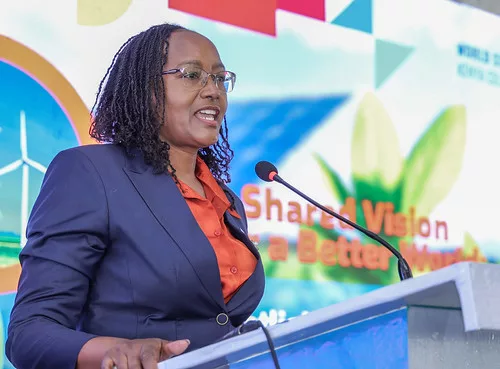
The Kenya Bureau of Standards (KEBS) has called for stronger enforcement of quality standards in the energy sector, warning that substandard products could undermine Kenya’s transition to affordable and clean energy.
KEBS Director General Esther Ngari said standards were essential to ensuring that solar panels, batteries and electrical appliances met safety, quality and efficiency requirements as households and businesses increasingly adopted modern energy technologies.
Speaking on Wednesday during the World Standards Day celebrations in Nairobi, Ngari said inefficient equipment could increase operating costs for households and businesses, undermining efforts to make energy affordable.
She added that standards provide agreed requirements for assessing product safety, quality, performance and efficiency, enabling consumers to make informed choices.
“A solar panel that fails prematurely, a battery that does not deliver the expected performance, or an electrical appliance that presents a safety risk can turn an investment in progress into a source of loss or disappointment,” Ngari said.
Ngari said KEBS would continue working with regulators, manufacturers, importers and research institutions to ensure standards responded to emerging technologies and the country's economic needs.
“Our responsibility is therefore both protective and developmental. We must help ensure that products in the market meet applicable requirements while enabling responsible businesses to demonstrate quality and build consumer confidence,” she said.
She cited collaboration between KEBS and the Energy and Petroleum Regulatory Authority (EPRA) on fuel quality as an example of how institutions with complementary mandates could support consumer protection, fair trade and environmental objectives.
The celebrations were held under the theme Shared Vision for a Better World, focusing on Sustainable Development Goal Seven, which seeks to ensure access to affordable and clean energy.
Speaking at the event, former president of the International Organization for Standardization (ISO) and former KenGen managing director Eddy Njoroge said standards would be critical to expanding access to reliable, affordable and clean energy across Africa.
Njoroge, who chairs the Electricity Sector Association of Kenya, cited figures from the 2026 edition of Tracking SDG 7, which show that about 655 million people worldwide still lack access to electricity, including more than 560 million in sub-Saharan Africa.
He said around two billion people globally continued to rely on polluting fuels and technologies for cooking.
He said the success of energy access initiatives should be measured by their impact on people's lives rather than solely by the number of power plants built or electricity connections made.
“For Africa, then, clean and affordable energy is not simply an environmental ambition. It is a development imperative. Our farms, factories, hospitals, schools, businesses and communications networks all depend on energy. Without it, opportunity narrows,” Njoroge said.
He said reliable energy enabled hospitals to refrigerate vaccines, children to study after sunset, farmers to irrigate their land and manufacturers to operate machinery at competitive costs.
Njoroge urged African countries to strengthen their participation in developing international standards, saying the continent's energy challenges required solutions informed by local expertise and experience.
He cited KEBS' role as the secretariat of ISO Technical Committee 285, which develops standards for clean cookstoves and clean cooking solutions, as an example of Kenya's contribution to global standardisation.
Established in 2013, the committee's work covers the testing and assessment of stove safety, emissions, efficiency and performance. ISO currently lists seven published standards under the committee.
“This means a Kenyan voice is helping set the global yardstick for what ‘clean’ really means in a kitchen. It means Kenyan expertise is helping to shape how the world judges cleaner and safer cooking technology. Africa is not simply receiving standards; it is helping write them,” he said.
Njoroge said millions of households in Kenya still cooked using firewood and charcoal, exposing families, particularly women and children, to harmful smoke. He said access to modern energy should therefore include cleaner cooking solutions and not be limited to electricity connections.
He also called for stronger implementation and enforcement of existing standards, warning that publishing standards alone would not protect consumers unless the requirements were understood, applied and monitored.
“A standard that no one knows about, applies or checks cannot protect a consumer. We need practical awareness, credible testing and consistent enforcement,” he said.
Njoroge said the rapid development of battery storage, distributed solar, electric mobility, smart grids and digital control systems required standards to evolve without compromising safety.
He urged the government and regulators to incorporate appropriate standards into policies and public procurement while investing in the capacity to test and enforce them.
He also challenged manufacturers and investors to build, purchase and finance products that met recognised standards. He encouraged consumers to verify the conformity of solar kits, batteries, extension cables and cooking stoves before purchasing them.
Njoroge cited ISO 50001, an energy management standard, as a framework organisations could use to improve energy efficiency, reduce waste and manage energy consumption.
He recalled efforts during his time on the KEBS Board to address substandard electrical cables and accessories, warning that products that appeared genuine could still contain unsafe conductors or poor insulation.
The leaders said standards would remain central to Kenya's energy transition by protecting consumers, supporting industrial competitiveness and building confidence in emerging technologies.
Ngari said Kenya's energy transition should ultimately be judged by the benefits it delivered to households, businesses and communities.
“A better energy future is not measured by electricity generated at all but by the lives improved, the businesses strengthened, and the opportunities created through its reliable and responsible use,” she said.
Trade Cabinet Secretary Lee Kinyanjui called for stronger quality standards in Kenya’s energy sector, saying the country must translate its growing renewable electricity capacity into lower production costs, job creation and increased industrial competitiveness.
Kinyanjui said affordable and reliable energy was critical to manufacturing, warning that gains in electricity generation would have limited economic impact if businesses continued to face high operating costs.
“The real test is whether energy progress translates into lower production costs, stronger industries, more investment, jobs and better livelihoods,” he said.
 Trade Cabinet Secretary Lee Kinyanjui and KEBS
Director General Esther Ngari during the World Standards Day celebrations in Nairobi on October 14, 2026 / HANDOUT