
KENYA is seeking to expand exports, strengthen manufacturing and improve the reliability of services across healthcare, agriculture and construction.
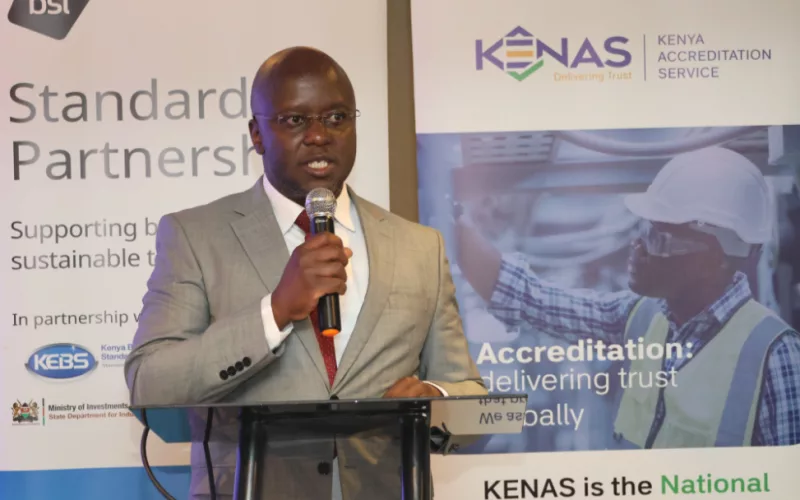
Kenya Accreditation Service (KENAS) chief executive Dr Walter Ongeti explains why accreditation matters to businesses, how it supports international trade, and what must change to make quality assurance more accessible to small enterprises.
He also addresses regulatory oversight, public confidence and the future of Kenya’s accreditation infrastructure.
KENAS recently recognised PharmAccess Foundation, Quest Ace Laboratories, Quality Plus Laboratory & Consultancy Services and AAR Hospital. What does this recognition mean for the organisations and the wider economy?
Accreditation provides independent assurance that an organisation has demonstrated competence to undertake specific activities against recognised requirements.
For the four organisations, it demonstrates their commitment to quality, technical competence and reliable service delivery within their respective accreditation scopes.
The wider economy benefits because businesses, regulators and the public depend on credible results to make decisions. In healthcare, reliable laboratory results inform diagnosis and treatment. In manufacturing, accurate testing and calibration support production quality.
In agriculture, credible testing helps demonstrate that products meet market requirements. Accreditation strengthens confidence in all these services.
KENAS has launched the campaign, “Delivering Trust. Enabling Quality. Building Global Confidence.” Why is this message important now?
Quality infrastructure is fundamental to economic development, consumer protection and international trade. Yet accreditation is often misunderstood as a technical or regulatory requirement rather than an investment in confidence.
We want businesses and consumers to understand who tests their products, verifies their claims and inspects the facilities they depend on. Accreditation provides an independent assessment of competence, helping users make informed choices.
Our campaign seeks to build awareness so that accreditation becomes an important consideration when businesses procure testing, inspection, calibration and certification services. It is about building a culture in which quality is demonstrated through competence and evidence.
What is the current state of accreditation in Kenya, and what does it take to expand the system?
Kenya has continued to develop its accreditation infrastructure to support industry, regulators and consumers. KENAS oversees more than 300 accredited conformity assessment bodies, covering different technical disciplines and sectors.
However, accreditation must keep pace with changes in the economy. As manufacturing expands, healthcare services become more sophisticated and exporters enter new markets, demand for reliable testing, inspection and certification grows.
We must continue strengthening technical expertise, increasing awareness and encouraging more eligible organisations to seek accreditation.
Collaboration with government agencies, industry associations, universities and development partners is also essential to expand the system and address emerging needs.
How do you ensure that your statutory responsibility does not create bureaucracy or unnecessary costs for businesses?
Our responsibility is to establish confidence in the competence of conformity assessment bodies. That requires a rigorous assessment process, but it must also be efficient, transparent and responsive to applicants.
We have a responsibility to communicate requirements clearly, provide guidance and ensure applicants understand the evidence they must present. Businesses should be able to plan for accreditation rather than encounter unexpected requirements during assessment.
We also recognise that different organisations have different levels of technical capacity. Our engagement with applicants should help them understand the requirements without compromising the independence of accreditation decisions. The objective is to maintain confidence while making the process as accessible and predictable as possible.
Accreditation is sometimes associated with lengthy procedures and high costs. How is KENAS addressing concerns among small and medium-sized enterprises?
Accreditation requires investment in competent personnel, appropriate equipment, documented procedures, quality management systems and continuous improvement. These are important safeguards, although the initial investment can be challenging for smaller organisations.
We need to ensure that applicants understand the requirements early and prepare adequately. Clear guidance and effective communication can reduce avoidable delays and repeat assessments.
SMEs should also recognise that accreditation can strengthen their competitiveness. It can help them demonstrate competence to larger buyers, qualify for supply chains and build confidence among customers. Our challenge is to support wider participation while preserving the technical integrity of the process.
How long does accreditation take, and what is KENAS doing to improve turnaround times?
The duration depends on the scope of accreditation, the complexity of the activities being assessed and the applicant’s level of preparedness. Organisations with well-established systems and complete documentation are generally better positioned to progress efficiently.
The process involves application review, assessment, consideration of findings and an independent accreditation decision. Where gaps are identified, applicants must address them before accreditation can be granted.
Our focus is to improve communication, streamline administrative processes and strengthen the management of applications. At the same time, speed must not take precedence over competence. Accreditation decisions must be based on sufficient evidence that an organisation meets the applicable requirements.
Kenya earned Sh216.5 billion from horticultural exports in 2025, according to the KNBS Economic Survey 2026. How can accreditation help exporters protect and expand this market?
Export competitiveness depends not only on producing goods but also on demonstrating that they meet the requirements of destination markets. Buyers and regulators need confidence in test results, inspection findings and relevant certification.
Accredited laboratories and other conformity assessment bodies help provide that assurance. For horticultural exporters, reliable testing can support decisions concerning product quality, safety and compliance with specified market requirements.
This is important because businesses face significant costs when consignments are rejected, delayed or subjected to additional testing.
A credible quality infrastructure can help exporters demonstrate compliance and build stronger relationships with international buyers.
Accreditation does not automatically guarantee market access, because exporters must still satisfy applicable regulations and buyer requirements. However, it strengthens the reliability of the evidence used to demonstrate compliance.
How important are international recognition arrangements in reducing technical barriers to trade?
International recognition arrangements are important because they support confidence in accredited conformity assessment results across participating economies. When results are accepted by trading partners, businesses can potentially avoid unnecessary duplication of testing and inspection.
KENAS participates in regional and international recognition arrangements through the African Accreditation Cooperation and Global Accreditation Cooperation Incorporated. These arrangements support the credibility and international acceptance of results produced by appropriately accredited bodies within the relevant scopes.
For Kenyan businesses, this can reduce compliance burdens, save time and support access to regional and international markets. The benefits depend on the applicable arrangements, the scope of accreditation and the requirements of the importing market.
As Kenya pursues opportunities under the African Continental Free Trade Area, strengthening this infrastructure can help make local producers more competitive.
How do you deal with accredited organisations that fail to maintain the required standards?
Accreditation is not a one-off event. Accredited organisations are subject to continuing oversight to verify that they maintain competence and comply with applicable requirements.
Our approach includes surveillance assessments, reviews of relevant evidence and follow-up where non-conformities are identified. Organisations are expected to address identified shortcomings within the applicable requirements and timelines.
Where serious or unresolved non-compliance occurs, appropriate action may be taken in accordance with the governing framework. Depending on the circumstances, this can include suspension or withdrawal of accreditation.
The purpose is to protect confidence in accredited services. An organisation must continue demonstrating competence after receiving its certificate. Accreditation is a continuing commitment to quality, not simply a document to display.
Kenya continues to face concerns about food safety, substandard construction materials and the reliability of medical testing. What role can KENAS play in addressing these challenges?
These concerns demonstrate why a strong conformity assessment system is necessary. Regulators and consumers need reliable evidence when assessing whether products, materials and services meet specified requirements.
KENAS assesses the competence of conformity assessment bodies within defined scopes. However, our role must be distinguished from that of regulators responsible for enforcing sector-specific laws and standards.
Accreditation can strengthen the evidence available to regulators, manufacturers and consumers, but it cannot replace market surveillance, enforcement or responsible business practices. Effective protection requires coordination among accreditation bodies, regulators, manufacturers and service providers.
The public should also be encouraged to ask whether the testing or inspection service they rely on is appropriately accredited for the specific activity being undertaken.
What must change to make Kenya a stronger regional hub for quality assurance over the next five years?
We must continue investing in technical capacity, modern systems and the development of accreditation schemes that respond to industry needs.
Emerging areas such as renewable energy, electric mobility, pharmaceuticals, carbon markets and advanced manufacturing will require credible assessment services.
We also need stronger collaboration between government, industry, research institutions and county governments. Public laboratories and universities can play an important role in expanding access to reliable testing and research services.
Ultimately, our ambition is to ensure that accreditation supports economic growth, consumer protection and international competitiveness. Businesses must see quality assurance as an investment rather than merely a compliance cost.
When competent organisations produce reliable results, manufacturers can improve their processes, exporters can demonstrate compliance, regulators can make better-informed decisions and consumers can have greater confidence in the products and services they use.
That is the purpose behind our campaign: delivering trust, enabling quality and building global confidence in Kenya’s economy.






