
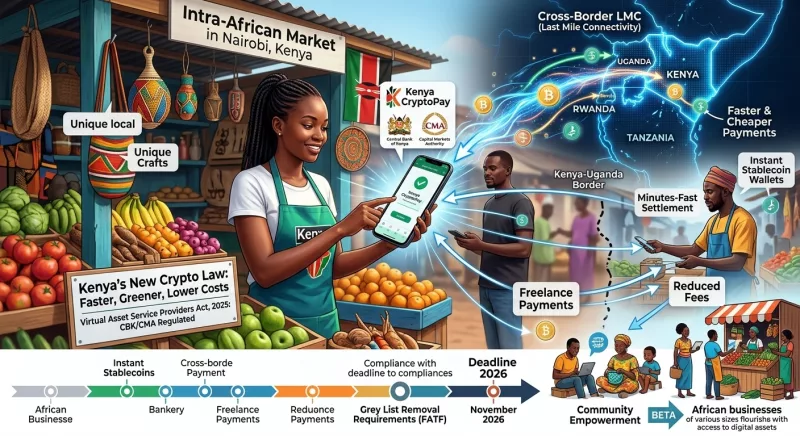
 AI ILLUSTRATION
Kenya’s new virtual asset law could help businesses move money across African markets in minutes, cut transaction costs and simplify international payments, as stakeholders welcome the regulatory framework ahead of a November compliance deadline.
The Virtual Asset Service Providers Act, 2025, came into force on November 4, 2025, giving existing operators one year to comply with its requirements by November 4, 2026.
Yellow Card Country Manager Isack Wabuge said the law provides a distinct regulatory framework by assigning oversight responsibilities to the Central Bank of Kenya (CBK) and the Capital Markets Authority (CMA).
The CBK regulates payment-related services, including wallets, payment processors and stablecoin issuers, while the CMA oversees exchanges, brokers and investment-related activities.
Wabuge said the framework could make digital assets a useful option for businesses operating across different markets by simplifying cross-border payments, speeding up currency conversions and reducing transaction costs.
“A business with operations in Kenya and Uganda can hold part of its working capital in stable coins and move it between markets in minutes, any day of the week,” he said.
He added that stablecoins had made treasury management more accessible to smaller businesses, a system previously available mainly to large corporations.
Wabuge said digital assets would not replace banks but could offer businesses an additional, potentially faster and cheaper payment option suited to African markets.
“A shop owner, a wallet operator or an online seller can accept payments from customers abroad without a complicated foreign currency setup and settle quickly. A freelancer in Nairobi can invoice a client overseas and receive payment without losing a significant portion to intermediary fees,” he said.
The country manager also linked the implementation of virtual asset regulations to Kenya’s efforts to address concerns raised by the Financial Action Task Force (FATF), which maintains a grey list of jurisdictions under increased monitoring.
Wabuge said countries on the list face additional scrutiny on cross-border payments, which can increase costs and delay settlement.
“However, the adoption of virtual asset regulations in Kenya is among the requirements set by the Financial Action Task Force for countries to address compliance concerns and qualify for removal from the grey list,” he said.
He called for greater adoption of stablecoins, arguing that the traditional correspondent banking system was not designed to meet the needs of African markets.
Wabuge said payments between African countries often pass through intermediary banks outside the continent because the US dollar serves as a bridge currency, adding fees and delays.
“A payment between two African neighbours should not need a stopover in New York,” he said.
He also cited differences in banking cut-off times, noting that Nairobi is seven to eight hours ahead of New York. These differences, he said, can delay settlements, disrupt stock deliveries, cost businesses customers and cause deals to fall through.
Wabuge urged traders in Kenya, Uganda and across Africa who intend to use digital assets to engage licensed providers, maintain proper records and begin with small transactions.
He said the new law would make the sector safer, adding that businesses that make informed decisions when adopting digital assets stood to benefit the most.