I was recently chatting with a friend about ‘the old days’, and the topic of Salaams shows, such as KBC’s iconic Yours for the Asking, or YFTA, came up.
This conversation took me down memory lane. At the start of my journalistic career, I helped begin ‘Weddings of the Week’, a column in the now-defunct Focus Magazine in the Sunday Times newspaper in the early 1990s.
In keeping with our tagline, ‘The lifestyle magazine for now’, we covered all sorts of ways of living. Our weddings write-up and photos mixed celebrations of ordinary people with those of celebrities.
We started that column to attract more readership for the paper, and it worked very well. I don't have the sales figures to hand, but I do recall our marketing team telling us the column really boosted sales.
One of my favourite editions of the column was when we reported on the wedding of KBC Radio Salaams royalty, Nakuru’s Robby Reuben Robbie. It was a celebrity wedding on par with anything from modern celebrity culture.
Robbie, alongside other stars in the Salaams firmament, such as Mama Safi, Agneta Machinga from Nakuru, Kiango Momanyi (popularly known as ‘Sura Mbili’), Francis Kadenge (‘Omwana wa Leah’) and Moses Shoto Omunyololo, just to name the ones that come immediately to mind, were true national celebrities.
Their names always featured prominently on the radio greetings show on what was then the country’s only radio station, the KBC.
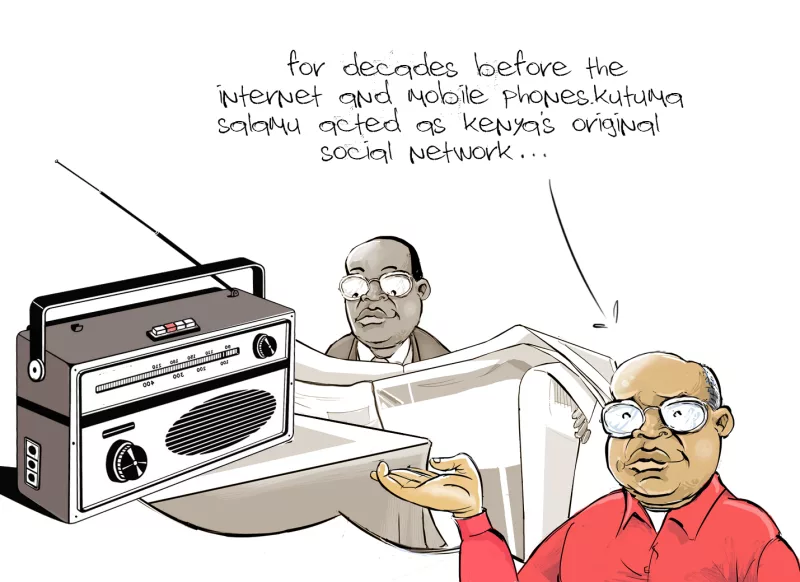
The culture of radio greetings, popularly known as ‘Kutuma Salamu’ (sending greetings), remains one of the most powerful and enduring social phenomena in East African media history.
For decades before the Internet and mobile phones, Kutuma Salamu acted as Kenya's original social network.
When mobile phones weren't a thing and landlines in many upcountry areas required a telephone operator, listeners couldn't just call in. Instead, they had to buy official, physical Salaam cards from VoK or Kenya News Agency outlets across the country.
Listeners filled out the card with their name, location, a list of people they wanted to greet, and a song request, then sent it to Nairobi via the post office.
To maximise their chances of being read on air, listeners formed community groups called ‘Salaams Clubs’. These clubs became highly competitive, trying to outdo each other with creative names and extensive member lists.
These shows, such as YFTA, were so popular that phrases like ‘Salamu ni nusu ya kuonana’ (Greetings are equivalent to half a physical meeting) became part of the national lexicon.
In 1991, the media landscape was liberalised, ending KBC's monopoly. Private commercial FM stations and localised vernacular stations exploded across the country.
With the parallel arrival of mobile phones and SMS, the Kutuma Salamu format shifted. Listeners no longer relied on postal cards; they could text their greetings directly to live studio dashboards.
Today, Kutuma Salamu remains highly active but has adapted completely to the digital age.
The transformation of Kenyan radio from the formal, slow-moving era of KBC greeting cards to the spontaneous world of live FM interaction began in the mid-1990s. KBC’s youth-oriented Metro FM provided an important bridge, with presenters such as Tony Msalame and John Karani opening the phone lines to listeners and introducing a more energetic, conversational style.
Rather than simply reading out mailed-in dedications, presenters could respond instantly to callers from across the country, creating a sense that listeners were participating in the programme rather than merely listening to it.
The arrival of private stations such as Capital FM and Kiss 100 accelerated the revolution. Presenters including Caroline Mutoko, Jimmy Gathu and Cess Mutungi turned live calls and banter into central features of radio. At the same time, debate became a central feature of radio, while Maina Kageni, Daniel ‘Churchil’ Ndambuki and Ciku Muiruri took audience participation into the territory of relationships, personal secrets and social drama.
Most modern Kenyan stations, whether major national platforms or localised stations, rely on WhatsApp voice notes and social media comment sections for their greeting segments. Listeners from the Kenyan diaspora in Europe or the US regularly send instant voice notes to local shows, maintaining a sense of community connection that began with a simple postcard more than 60 years ago.