
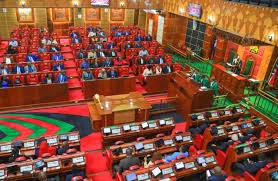
A House team has given the government an ultimatum to step up the war against illicit alcohol, proposing tougher penalties for offenders.
MPs at the Petitions Committee want the government to further extend tax relief for legitimate manufacturers and tighter controls on ethanol production and distribution.
The lawmakers want the executive to harmonise national and county licensing rules, strengthen border surveillance and form a multi-agency team to combat the trade.
The measures are contained in a report tabled by Runyenjes MP Muchangi Karemba, following a petition by Uasin Gishu Woman Representative Gladys Boss on behalf of her constituents.
The committee wants the government to report on progress within 90 days of the adoption of its recommendations by the National Assembly.
A reading of the report paints a grim picture of a country where illegal alcohol continues to thrive, costing the government not only billions of shillings in lost revenue but also lives of citizens.
It recommends amendments to several laws and coordinated action by at least seven ministries and multiple enforcement agencies.
The committee found illicit alcohol accounts for 59 per cent of the market by volume and 21 per cent by value, estimated at Sh67 billion in 2022.
The illegal alcohol economy cost the government an estimated Sh71 billion in lost revenue that year, with distilled spirits accounting for the largest share of the tax leakage.
The report further notes illicit trade across all sectors rose from Sh726 billion in 2017 to Sh826 billion in 2025.
Comparatively, the legitimate alcohol industry contributes about Sh660 billion of gross domestic product and generated Sh48.61 billion in excise revenue in 2024.
Artisanal brews account for 66 per cent of illicit alcohol by volume, followed by tax leakage at 16 per cent, counterfeit brands at 15 per cent and smuggling at four per cent.
The committee identified high taxes on legal alcohol, corruption, porous borders and weak enforcement as key factors sustaining the trade.
It found that illicit products can be 38 to 80 per cent cheaper than legal alcohol, giving consumers and traders a strong financial incentive to operate outside the law.
The committee also cited uneven licensing across the 47 counties as also creating loopholes that traders exploit to evade regulation.
The committee singled out the National Police Service, Kenya Bureau of Standards and Kenya Revenue Authority as agencies to be cited for enforcement failures.
In Uasin Gishu, the committee heard the smuggling and diversion of industrial ethanol had fuelled the production of illicit second-generation alcohol.
To make legal alcohol more competitive, the committee wants the National Treasury Cabinet Secretary, working with KRA, to fully operationalise the Excise Duty (Remission of Excise Duty) Regulations, 2026.
The Alcoholic Beverages Association of Kenya has described the measure as a critical tool for reducing the price gap between legal and illegal products.
The committee also wants the Interior Cabinet Secretary and the Council of Governors to develop proposals harmonising national and county alcohol control laws.
On penalties, the committee wants amendments to the Alcoholic Drinks Control Act to introduce tougher sanctions commensurate with economic crimes.
MPs also want amendments to the Anti-Counterfeit Act to increase fines and introduce criminal liability for beneficial owners of companies involved in offences.
They further want Agriculture Cabinet Secretary and Kenya Sugar Board to tighten controls over molasses-based ethanol production.
MPs want the Sugar Act amended to require millers to obtain licences, monitor production and submit quarterly reports.
They would also have to disclose buyers and end-users, with minimum quantity thresholds imposed on sales.
The committee further wants the Inspector General of Police and KRA Commissioner General to report on measures to improve surveillance at nine identified smuggling points.
These include Isibania, Shimoni, Busia, Mbale, Malaba, Lwakhakha, Namanga, Lunga Lunga and Moyale.
Kebs has also been directed to prepare a strategy for stronger inspections, quality assurance and market surveillance.
The committee wants the Interior CS to prepare legislation anchoring the multi-agency task force in law, giving the crackdown a formal coordination framework.
The proposed team would bring together security agencies, revenue and standards regulators, Nacada, governors, the Health ministry, ODPP and EACC.
The recommendations followed submissions from 11 stakeholders who appeared before the committee.
The National Police Service reported 35,700 arrests and the seizure of 1.56 million litres of illicit brew between January 2024 and May 2026. Of the seized volume, 949,800 litres were destroyed.
In Uasin Gishu, police arrested 672 suspects and seized 46,383 litres during the same period.
The Anti-Counterfeit Authority reported seizing 14,930 pieces of counterfeit alcohol worth Sh4 million between January and April 2026.
KRA, meanwhile, reported intercepting ethanol worth Sh9.9 million, cigarettes worth Sh338.6 million and alcohol worth Sh1.28 million between July 2025 and March 2026.
ABAK warned that illicit alcohol causes annual tax revenue losses exceeding Sh120 billion, while the Kenya Association of Manufacturers said legitimate businesses were struggling to compete with untaxed products.
The Council of Governors called for a national-county alcohol control framework and a traceability system to track products through the supply chain.






