Kenyans are industrious. We work hard at everything. Even our criminals do not like easy jobs, they pick the most challenging.
Remember when our unemployed youths made it on international news because they were caught writing theses for university students around the world? Give us technology and our bounds are limitless.
We use the social media platform X to exercise our democratic duty. We use Facebook to connect and sell our wares faster and more conveniently than opening a stall in a market somewhere.
More recently, the video-sharing platform TikTok has been largely embraced by Kenyans not just as a social media platform but as an active business channel. People share more about their businesses, engage with customers on Live and sell wares in real time, with customers paying through M-pesa. Some even have live bidding wars!
The idea that younger generations are able to grow businesses from their homes using only their smartphones is mind-blowing. Gone are the days of two-dimensional lives of studying and working in either blue-collar or white-collar fields. In today's world, the only limitation is imagination, and Kenyans do not lack this. Which brings me to my point.
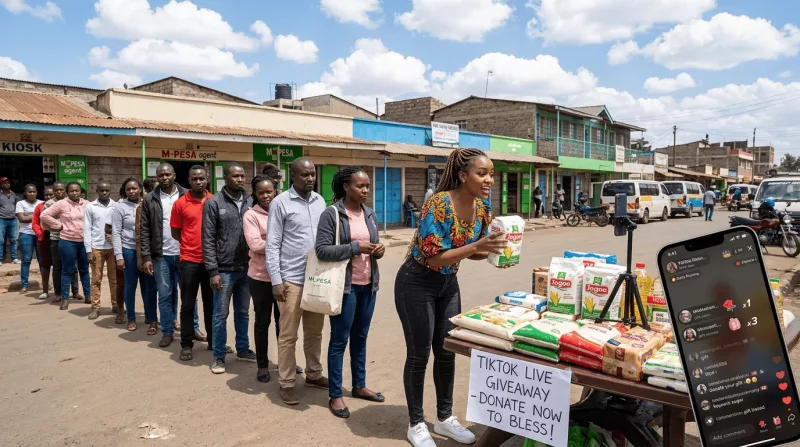
I am a big advocate of technology and social media being used as business channels and learning mediums. However, there is a current trend that leaves me with fear. There are some users or influencers who open pages for charity. They try to provide goods to the less fortunate in specific neighbourhoods by going on TikTok Live and asking the audience for charity donations to provide for these people.
The thing is, they have already bought these wares, usually packets of maize flour, rice and sugar, bread and other grocery items. They display these items on a large table and have people from the neighbourhood line up to await ‘blessors’.
From the first day I saw such videos, my skin crawled. There is just something wrong about using people and their situations for your benefit. I believe in helping people, I believe in charity, but I also believe in doing good anonymously. I do not believe in exploiting vulnerable people on the Internet for millions to see in the name of awaiting blessings. Either you are able to do good for others or you are not.
Seeing these people, often old, pregnant, women with babies, and even the young and able-bodied, being exploited on the Internet has made me question the whole thing. Is it really charity to make people stand in a line in the cold, staring at grocery items, waiting to be picked only to be given a kilo of rice or flour? It doesn't seem right to me.
Why should they wait for a stranger to ‘buy’ something for them when the charity influencer has already bought all these items in the first place? Wouldn't it make more sense for the person who runs the page to donate the items on live then ask people to share their donations so that they can buy more? What do they gain by making folks stand in line to wait for random strangers on the Internet to buy them something? Are they a charity page or a shop? What happens to the money they make off the monetisation of these videos and the ‘gifts’ they receive? Gifts are emojis that equate to different amounts of money on TikTok Live.
If it was really a page that is dedicated to charity, how comes they are the last thing I see when I scroll before bed and the first thing I see when I scroll in the morning? Surely no one is that dedicated to charity with no personal gain.
I may be getting old, but I'm Kenyan enough to know there is something fishy going on.