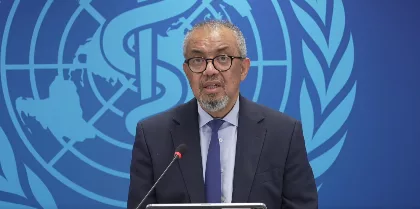
The World Health Organization (WHO) has commended Kenya for its prompt response to the country’s first reported Ebola case.
WHO Director-General Dr Tedros Ghebreyesus said the patient, a Kenyan citizen, fell ill in the Democratic Republic of Congo (DRC), where he received treatment at several health facilities before travelling to Kenya through Uganda.
Tedros said the patient travelled to Nairobi via Kampala and was taken to hospital immediately after arriving in the Kenyan capital, where he was isolated and later confirmed to have Ebola.
“He received care but died on Monday this week,” Tedros said.
Kenyan health authorities are monitoring 55 people who had contact with the patient, including passengers and crew members who travelled with him from Kampala to Nairobi
Tedros said he had spoken with Health Cabinet Secretary Aden Duale about the case and the measures Kenya had put in place to prepare for an Ebola incident.
“I commend the government for its prompt action and for reporting the case to WHO and the International Health Regulations in a timely way,” he said.
The WHO chief said new Ebola hotspots continued to emerge, including areas near the border with South Sudan, highlighting the need for continued vigilance and preparedness in the region.
Tedros also advised countries against imposing blanket travel and trade restrictions following Ebola cases, saying measures such as screening and contact tracing were more effective.
He stressed the importance of countries being transparent when reporting outbreaks, saying such openness should be encouraged rather than penalised.
“WHO advises against blanket travel or trade restrictions, which are less effective than screening and contact tracing, among other measures. Transparency should be rewarded and not punished,” Tedros said.
Kenya has designated 241 beds across five health facilities to manage Ebola Virus Disease (EVD), as the country steps up preparations following confirmation of its first imported case.
CS Duale said the designated facilities are Kenyatta National Hospital, Moi Teaching and Referral Hospital, National Police Hospital, Port Reitz Hospital and The Nairobi Hospital.
The Nairobi Hospital has the largest capacity, with 130 beds designated for Ebola patients, followed by Moi Teaching and Referral Hospital with 50 beds and National Police Hospital with 49 beds.
KNH has been allocated eight beds, while Port Reitz Hospital has four beds.
Duale said the available capacity will be increased through the establishment of additional facilities as the situation evolves.
The Ministry of Health has also designated five facilities as temporary isolation centres for suspected Ebola cases. They include Malaba Health Centre, Busia Border and Kocholia.
Alupe Sub-County Hospital in Busia county is also undergoing renovations to enable it to manage Ebola cases.