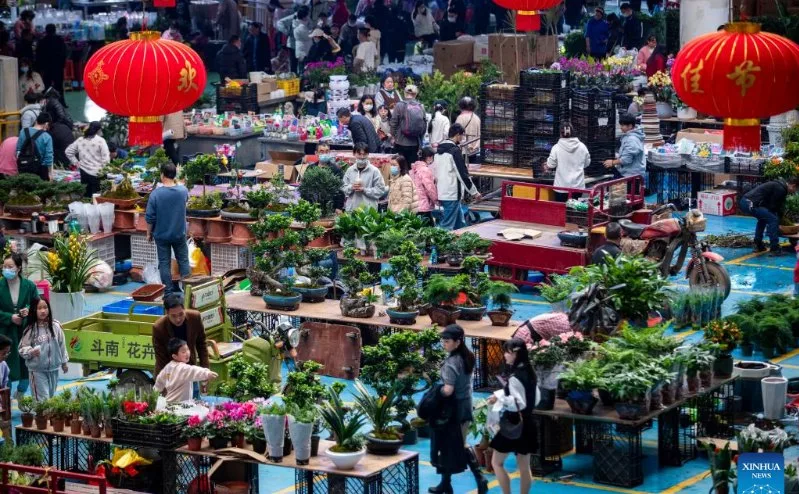
 People visit the Kunming Dounan Flower Market in southwest China's Yunnan Province, Jan. 31, 2023. Standing as China's largest fresh-cut flower market in terms of both trade volume and export value, Dounan has become the largest fresh-cut flower trading market in Asia. (Xinhua/Chen Xinbo)
A three-week seminar on the exchange of Chinese experience in governance for Indian Ocean countries, organised by the Yunnan International Centre for Economic and Technical Exchange (YICETE) through China’s Ministry of Commerce, offered a valuable opportunity to appreciate how the country has progressed to become one of the top global economies.
A great lesson was not that China has a model Africa should copy, but that long-term planning, strong institutions, people-centred policies, integrated development and technology innovation can transform societies when consistently translated into action.
China’s development experience demonstrates the value of clearly defined national priorities, strategic planning and establishment of institutions capable of implementing them over time.
The Communist Party of China’s central planning and policy coordination processes have provided a long-term development vision, with emphasis on economic transformation, modernisation and improving citizens’ welfare.
The Chinese approach, through its hybrid socialist system with Chinese characteristics, illustrates how political leadership can mobilise institutions and resources around national development objectives rather than leaving development entirely to individual interests or market forces.
There are deliberate efforts to strengthen institutions through training and capacity building of public officials, for example, through the country’s Academy of Governance, so as to align their service delivery with national goals and values.
The training is designed to cultivate competence, integrity, discipline, policy understanding and a results-oriented public service. This offers an important lesson for African countries: capable institutions require capable people, and public officials need continuous training that connects their responsibilities to national conditions and local development priorities.
Another
striking lesson was integrated development as an engine of prosperity. Visits
to historical, rural and cultural sites such the Haiyan Village, Dounan Market
and Stone Forest demonstrated how modern
agriculture, tourism, culture, enterprise and infrastructure can reinforce one
another.
The synergised development creates employment, expands markets, preserves culture, reduces poverty and gives communities a stake in their own economic transformation. Local resources, knowledge and cultural identity can become productive assets while improving the quality of life of rural citizens.
Food security emerged as another important dimension of integrated development. Modern agriculture, efficient markets, technology and rural infrastructure can contribute to both food availability and livelihoods. The Dounan Market experience illustrated the importance of connecting producers to organised markets.
For African countries, strengthening agricultural value chains, storage, markets and producer support, while using technology to improve productivity, can address food insecurity while creating jobs and income.
China’s experience in eradicating absolute poverty and pursuing rural revitalisation also raises important questions for Africa. Poverty reduction was presented as a process involving infrastructure, productive opportunities, education, employment, targeted interventions and the integration of rural communities into broader development.
Regional integration and coordinated development can similarly connect less-developed areas to markets, infrastructure, technology and investment. The lesson is that poverty eradication requires sustained and coordinated action rather than isolated projects.
China’s people-centred approach to community participation offered further lessons. Development is more sustainable when citizens are informed, sensitised, and given opportunities to participate. Structures for public education, community engagement, feedback and grievance redress, extending from grassroots levels to higher institutions, can help governments understand citizens’ concerns and improve accountability.
The protection and promotion of minority ethnic communities and their heritage also showed how cultural diversity can become a social and economic asset, including through tourism.
China’s adoption of technology such as robotics, artificial intelligence and highly automated systems demonstrates how technology can increase efficiency, productivity, quality and industrial competitiveness while supporting a cleaner and greener environment.
As Kenya and the rest of Africa continue to modernize, smart cities are the way to go. Their planning requires the use of big data and digital technologies. Such technologies help governments make better-informed decisions about infrastructure, services, mobility and the changing needs of growing populations.
Digital transformation is therefore not simply about putting government services online and promoting technology consumption. It is about using reliable data to understand society, plan cities intelligently, allocate resources efficiently and improve citizens’ experiences.
African cities facing rapid urbanisation have much to gain. For Africa, this points to its utilisation in research, technical skills, local manufacturing and innovation ecosystems capable of producing African solutions and industries.
All said and done, there are both opportunities and challenges in applying these lessons in Africa. African countries can learn from China’s long-term planning, infrastructure investment, technology, agricultural modernization, poverty-reduction strategies, public-sector capacity building and digital transformation.
It is not about African countries simply replicating China’s policies or institutions. Appreciating the differences in political systems, demographics, economic structures, resources, histories and cultures matters too.
Financing constraints, institutional capacity, inequality, digital inclusion and environmental sustainability must also be addressed. The task is to adapt useful principles to African realities.
The experience strengthened my conviction that Africa’s development is possible. Kenya and other African countries have enormous human, natural and cultural resources. What is required is political goodwill, strategic planning, competent institutions, investment in people and technology, and policies that place citizens at the centre of development.
We need leadership that rewards merit, integrity, innovation and results. We need incentives, affordable financing and supportive ecosystems for entrepreneurs, researchers and innovators, alongside investment in agriculture, manufacturing, science, digital transformation and green energy.
The greatest lesson I take from China is one of possibility. Development is not an accident; it is built through vision, planning, institutions, innovation, discipline and sustained commitment to people.
Africa does not need to become China, and Kenya does not need to copy China. But we can learn from what is possible when political leadership places national development and citizens’ welfare at the heart of governance.
The question for Africa is not whether transformation is possible, but whether we are prepared to build the institutions, leadership, policies and partnerships required to make it happen.
(The author isa lecturer with the University of Nairobi Dept. of Journalism & Mass Communication.)