Kiambu Governor Kimani Wamatangi has hosted a delegation from the European Union to discuss Kenya’s devolution model and explore potential areas of collaboration in ICT, urban development, trade and industrialisation.
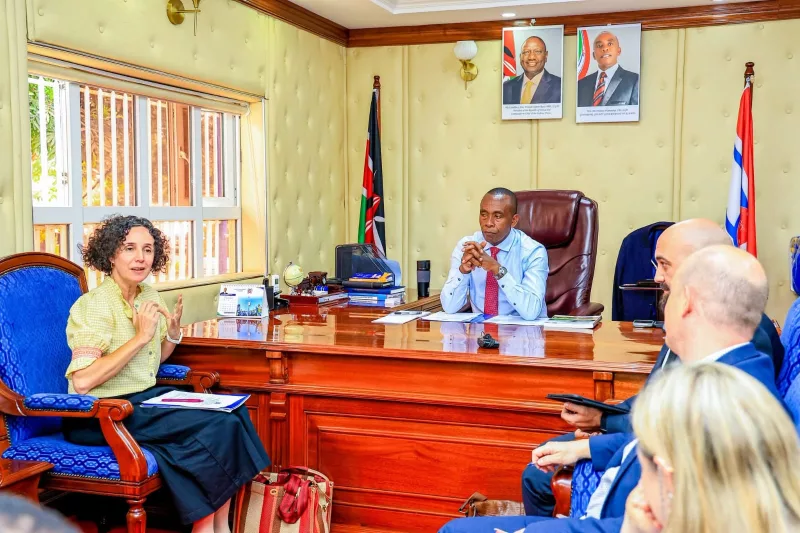
The delegation, comprising deputy ambassadors, deputy heads of commissions and heads of programmes from EU member states, was led by Dr Cristina Barrios, Head of Political, Press and Information Systems.
The discussions focused on Kiambu county’s development experience over the past four years, with the county government showcasing projects and initiatives aimed at improving service delivery and strengthening its economic base.
Barrios said the visit was part of efforts to strengthen relations between the European Union and Kenya while learning more about how devolution operates in the country.
“The main goal is to improve and make close relations between the EU and Kenya,” Barrios said.
She noted that devolution was an important feature of Kenya’s governance system and one that also exists in different forms across European countries.
“Devolution is popular in Kenya and in most of European countries also have it. We have regions, different ways of decentralisation,” she said.
The delegation also explored opportunities for collaboration in ICT and urban development, as well as trade and industrialisation.
Particular attention was given to the County Aggregation and Industrial Park in Githunguri and the gazetted 325-acre Economic Processing Zone at the soon-to-be-chartered Thika Industrial City.
Wamatangi told the EU delegation that Kiambu had recorded significant growth in its own-source revenue since he assumed office in 2022.
The governor said the county collected about Sh2.5 billion in own-source revenue when he took office, but the figure has since risen to approximately Sh6.5 billion.
“When I came to office in 2022, the county own-source revenue was Sh2.5 billion. In three years, we have managed to triple that. We are now collecting probably the highest increase in the country, about Sh6.5 billion,” Wamatangi said.
He attributed the increase to improved efficiency in revenue collection and efforts to eliminate corruption.
The governor explained that county governments mainly collect fees and levies, while the national government raises revenue through taxes.
“What we did was just to create efficiency around it and prudence and eliminate corruption,” he said.
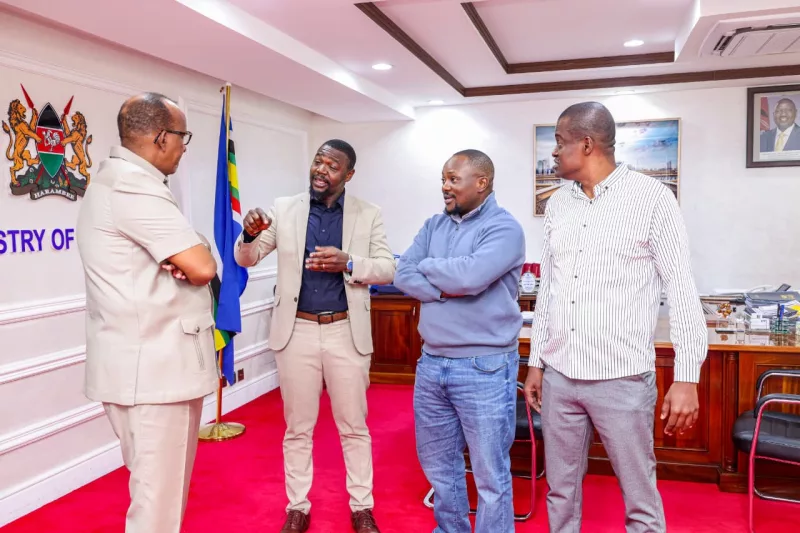
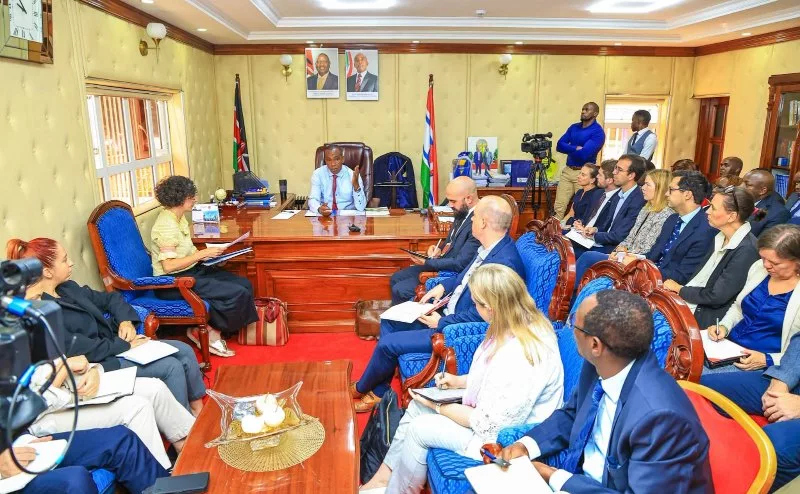 Kiambu Governor Kimani Wamatangi holds a meeting with delegation from the European Union at his office /HANDOUT
Wamatangi said the additional revenue had enabled the county government to invest in development projects, including learning facilities.
He told the delegation that Kiambu had constructed more than 500 learning centres that are not funded by the national government, as part of efforts to improve access to education and support communities.
The governor also highlighted the county’s investment in agriculture and industrialisation, saying Kiambu was seeking to create markets for small-scale farmers by adding value to their produce.
“We have small-scale farmers, so we want to take care of them, those who cannot access far markets. We value-add their products,” he said.
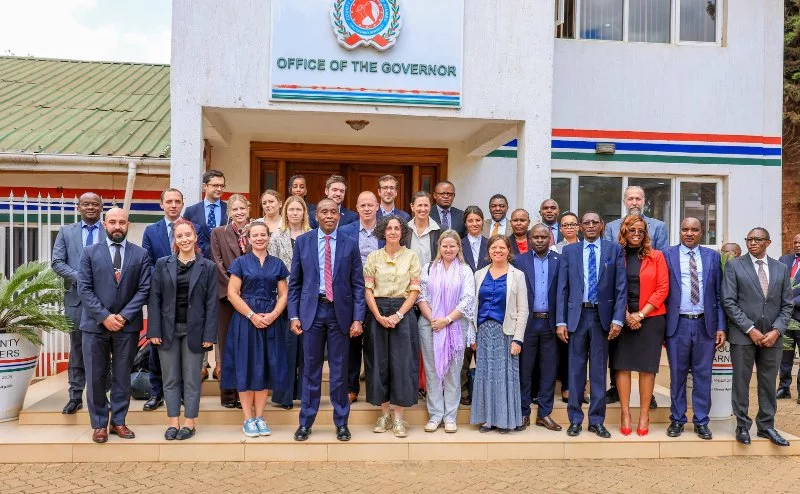 Kiambu Governor Kimani Wamatangi and a delegation from the European Union pose for a photo during a visit of the county /HANDOUT
Wamatangi said the Githunguri aggregation park was about 95 per cent complete and would provide an important platform for processing and marketing agricultural products.
The county is also seeking investors to support its industrialisation agenda and take advantage of emerging economic opportunities.
“We are also looking for investors,” the governor said.
He further told the EU delegation that Thika was on course to receive city status, which would make it the sixth city in Kenya.
“In about six months or so, Thika municipality will be a city and become the sixth in the country,” Wamatangi said.