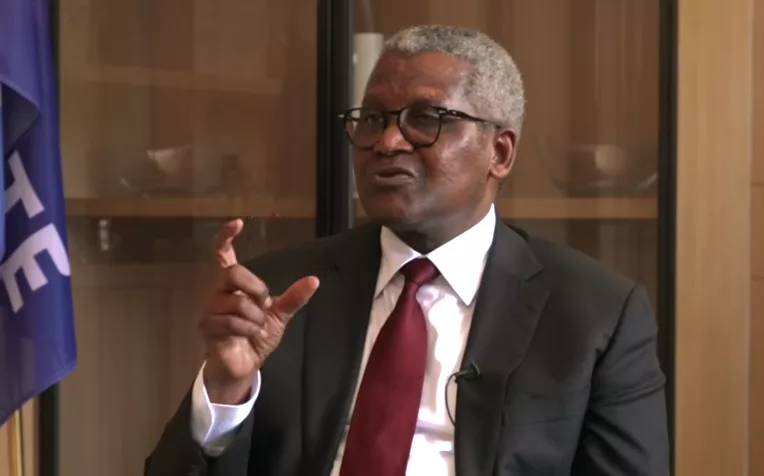
 Nigerian industrialist and billionaire Aliko Dangote during an interview with the BBC/SCREENGRAB
Nigerian industrialist and billionaire Aliko Dangote has defended plans to establish a multibillion-shilling oil refinery in Lamu, dismissing opposition to the project.
He maintained that Africa must take greater control of its resources and industrial development.
Speaking in an interview with the BBC, Dangote said African countries could no longer afford to rely on external players to determine the continent's development path.
“Nobody wants Africa to develop, that is why we Africans will develop Africa. Whether they like it or not we are moving. It is a moving train, either you join it or you will be crushed along the way,” Dangote said.
Dangote's remarks came amid protests and opposition to the proposed Dangote East African Oil Refinery, a planned industrial project in Lamu that he says will play a major role in transforming the region's energy and manufacturing landscape.
Responding to concerns and protests over the proposed refinery, Dangote questioned the motives behind the opposition and suggested that interests within the oil trading industry could be behind some of the resistance.
“Was there issue of land before? We know these games. The games are being played by oil marketers and international traders,” he said.
Dangote said the refinery was expected to begin operations in 2030, adding that the project would generate thousands of jobs during its construction and create opportunities across the wider economy.
“At the height of construction, we will have 60,000 people working there at the refinery,” he said.
He also questioned whether opposition to a project expected to create employment and stimulate economic activity was consistent with Africa's development needs.
“Have you ever seen people demonstrate against themselves in terms of development?” Dangote asked.
The billionaire argued that Africa must move away from exporting raw materials and importing finished products, saying the current model denies African countries opportunities to create jobs and build industries around their natural resources.
“We are going to destroy the sector where people come and collect our minerals, taking out without processing it here, creating jobs elsewhere and import poverty into the continent,” Dangote said.
He said the need to create jobs was becoming increasingly urgent because of Africa's rapidly growing population.
Dangote pointed to the continent's demographic growth, warning that Africa needed to begin planning now for the economic needs of future generations.
“The thing is, how do we create jobs here? Remember, in the next 24 years, for every four persons you see, one will be an African,” he said.
He questioned whether African countries could afford to postpone industrialisation and job creation until the middle of the century.
“So if we do not start planning today, when do you think we are going to plan? Is it when we get to 2050?” he asked.
Dangote also highlighted Africa's agricultural potential, arguing that the continent could become an important supplier of food to the rest of the world if its resources were properly developed.
“We have 60 per cent of the world's arable land. If we do not start today, how are we going to feed the world?” he said.
The Nigerian industrialist also defended his flagship refinery in Lagos against criticism that it had failed to reduce fuel prices in Nigeria despite producing petroleum products locally.
Dangote rejected the claim, arguing that Nigerian consumers were already benefiting from lower prices compared with neighbouring countries.
“When you check the price of oil products in Nigeria, they are actually cheapest compared to all our neighbours by 20 per cent,” he said.
He argued that the price of crude oil remained largely determined by the international market, meaning that local refining alone could not eliminate all costs associated with petroleum products.
“But the issue today is not price because we buy crude on price on market. But there are a lot of other expenses that have actually been cut down,” he said.
Dangote cited the refinery's distribution arrangements as an example, saying the company had reduced costs for customers by offering to deliver petroleum products across Nigeria without additional charges.
“Today in Nigeria, we say buy our product and we will deliver it to you anywhere free of charge,” he said.
According to Dangote, the arrangement effectively provides significant savings to consumers and businesses.
“When we do our calculations, it is like we give back to people US$1.2 million daily,” he said.
The planned Lamu refinery is part of Dangote's broader push to expand industrial investments beyond Nigeria and establish major production facilities in other African markets.