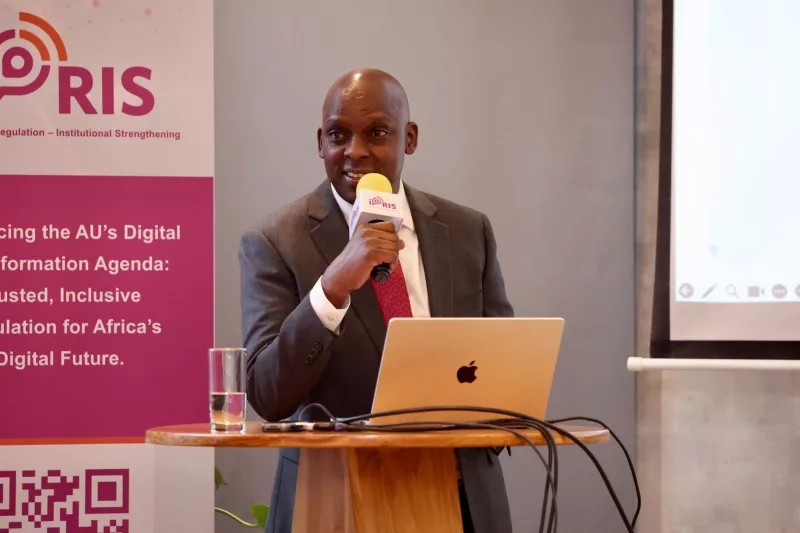
 Communications Authority of Kenya (CA) Director General David Mugonyi
The
Policy and Regulation Institutional Strengthening Programme (iPRIS), running
from October 5 to 9, brings together regulators from Sierra Leone, Mauritius,
Namibia, Zimbabwe, Tanzania and Liberia, alongside regional regulatory
organisations and development partners.
The
discussions are expected to focus heavily on the regulatory implications of
artificial intelligence (AI), digital platforms, next-generation networks,
cybersecurity, consumer protection, competition, online safety, data governance
and digital inclusion.
Speaking
at the opening session in Nairobi on Monday, Communications Authority of Kenya (CA)
director general David Mugonyi said the rapid development of AI, digital platforms
and next-generation networks is creating opportunities for economic growth and
better public services while presenting increasingly complex regulatory
challenges.
“Regulators
must therefore remain agile, evidence-driven and collaborative, while continuously
adapting their approaches to keep pace with technological developments,”
Mugonyi said.
The scale
of Africa’s digital transformation underscores the urgency.
The GSMA estimates that mobile technologies and services contributed $240 billion to Africa's economy in 2025, equivalent to 7.8 per cent of GDP.
It supports about 13 million jobs. The contribution is projected to rise to $290 billion by 2030.
But
regulators face the difficult task of ensuring that the economic benefits of
digitalisation do not deepen existing inequalities.
The
GSMA says nearly one billion Africans, or about 63 per cent of the population, are still not using mobile internet in 2025 despite living within mobile broadband
coverage.
Affordability,
lack of digital skills and access to suitable devices remain major barriers.
This
makes digital inclusion a regulatory as well as an infrastructure challenge,
particularly as governments and businesses increasingly shift essential
services online.
The
International Telecommunication Union (ITU) says only 18 per cent of African
countries have reached its most advanced stage of ICT regulatory development,
compared with a global average of 38 per cent.
It
argues that stronger digital governance is essential for infrastructure
investment, digital skills, inclusion and cross-sector collaboration.
Cybersecurity
will also be a key concern. Kenya's experience illustrates the scale of the
threat.
The
Communications Authority's latest sector statistics show that the National
KE-CIRT/CC detected more than 3.36 billion cyber threat events between January
and March 2026 and issued 20.6 million advisories.
Earlier,
the Authority detected more than 4.5 billion cyber threat events in the
October-December 2025 quarter, with system vulnerabilities accounting for the overwhelming
majority.
The
report also pointed to the increasing exploitation of AI and machine-learning
technologies by malicious actors.
AI
governance will therefore sit alongside cybersecurity, data protection and
digital trust as regulators consider how to encourage innovation without
exposing consumers to new forms of harm.
UNESCO
says AI could generate up to $1.2 trillion for Africa's economy by 2030, but
warns that many large language models remain poorly adapted to African
languages.
The forum will also examine competition and consumer protection as digital platforms increasingly influence markets.
The ITU notes that regulators are grappling with how competition rules should evolve as platforms, cloud services, apps and other digital business models reshape traditional telecommunications markets.
In
Kenya, the growing importance of data governance is already evident.
By
March 2025, the Office of the Data Protection Commissioner had received 7,128
complaints and issued determinations in 215 cases, highlighting the growing
regulatory demands surrounding personal information and digital services.
Beyond discussions, iPRIS participants will review institution-specific “Change Initiatives”, practical projects designed to turn peer learning into regulatory reforms and stronger institutional practices.