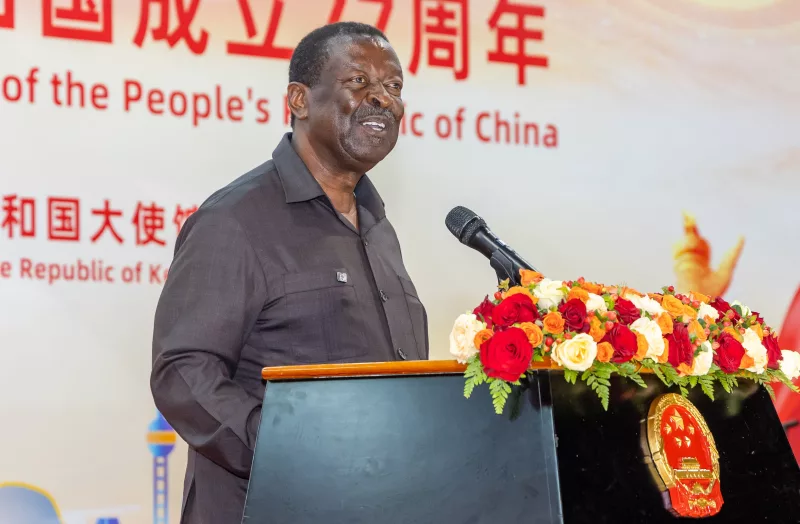
Prime CS Musalia Mudavadi and Chinese Ambassador Guo Haiyan made this call during celebrations to mark 77 years since the founding of the People’s Republic of China.
The two officials highlighted China’s transformation and the opportunities for Kenya in infrastructure, trade, manufacturing, education and technology.
They were addressing a reception at the Chinese Embassy to mark the 77th anniversary of the founding of the People’s Republic of China earlier this week.
Mudavadi said Kenya was already looking beyond Vision 2030 and could draw lessons from China’s experience in national transformation.
“As Vision 2030, Kenya’s long-term development blueprint approaches conclusion, we are already looking ahead to craft our development agenda beyond 2030,” he said.
“In this regard, Kenya and China have much to share in national transformation into the future.”
Guo cited China’s transformation from a largely poor agricultural country in 1949 into the world’s second-largest economy.
She stated the country’s rise stems from decades of development and what she described as Chinese-style modernisation.
The envoy reported that China’s per capita GDP had risen from $36 in 1949 to about $13,900 as a result of the efforts.
At the same time, China has eliminated absolute poverty and developed large education, healthcare and social security systems.
China had also become the world’s largest manufacturing country and trader in goods, she said, while making major advances in new energy vehicles and other technologies.
Guo said China’s development had also been accompanied by improvements in its environment, including increased forest coverage and reduced desertification.
For Kenya, Mudavadi said strong institutions would be critical to sustaining development and national stability.
He said institutions were necessary to fight corruption, combat tribalism, strengthen national unity and protect democratic ideals.
Mudavadi particularly called for the independence of the Independent Electoral and Boundaries Commission to be strengthened and protected ahead of the 2027 General Election.
He also pointed to infrastructure as a key area of Kenya-China cooperation.
Mudavadi said Kenya appreciated China’s support for roads, railways and renewable energy, citing the proposed dualling of the Nairobi-Nakuru-Mau Summit highway towards Kisumu and Malaba.
He also cited the extension of the Standard Gauge Railway from Naivasha through Kisumu to Malaba.
The PCS said the projects would improve regional connectivity and enable landlocked countries to access the Indian Ocean.
The highway and railway, Mudavadi said, could also form the foundation of an economic corridor that would transform rural agricultural areas into Special Economic Zones focused on manufacturing, value addition and trade.
Trade has emerged as another major pillar of the relationship.
Guo said Kenyan avocado oil exports to China had increased by 700 per cent since zero-tariff measures took effect in May.
Exports of aquatic products, such as sea cucumbers, had risen by 350 per cent, while coffee exports had nearly doubled by the end of August, she said.
“More and more high-quality Kenyan specialty products are now entering the Chinese market,” Guo said.
Mudavadi said the growth in exports of coffee, avocadoes and tea was contributing to job creation in agriculture, particularly for women and young people.
He said Kenya was now ready to commence comprehensive negotiations with China under the China-Africa Development Economic Partnership Agreement.
The negotiations, he said, could unlock investment opportunities and improve Kenya’s capacity to compete in the Chinese market.
Guo said China was ready to help Kenyan products enter its market faster and in greater quantities, including through zero tariffs and an upgraded “green channel”.
She said Beijing was also ready to deepen cooperation with Kenya in infrastructure, energy, agriculture, education, youth affairs, science and technology.
The ambassador said China and Kenya had continued to strengthen their relationship through high-level visits, with Chinese Vice President Han Zheng visiting Kenya and President William Ruto making a state visit to China in April 2025.
The two countries subsequently elevated their relationship to an All-Weather Comprehensive Strategic Partnership.
Guo said the partnership had also expanded into people-to-people exchanges, with more than 1,000 Kenyans travelling to China this year for training and study programmes.
More than 20 activities have been held in Kenya and China under the 2026 China-Africa Year of People-to-People Exchanges.
Mudavadi said Kenya remained committed to implementing agreements reached with China and strengthening the strategic partnership.
The reception brought together government officials, MPs, diplomats, representatives of international organisations, Chinese businesses and members of the Chinese community.
Guo said China would continue working with Kenya on their respective paths towards modernisation and support greater cooperation between the two countries.