
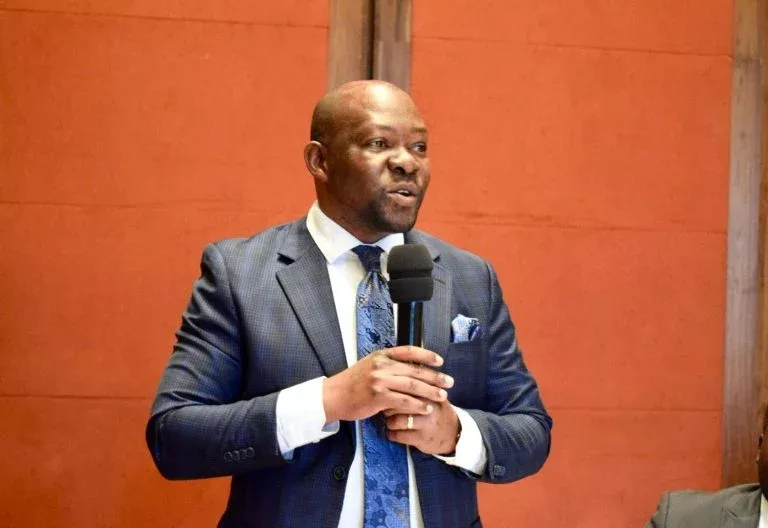
Saboti MP Caleb Amisi has called for what he described as Kenya’s “fourth liberation”, saying the country’s next generation of leaders must focus on delivering economic freedom to citizens.
Amisi said previous generations had fought and achieved political milestones including independence, multiparty democracy and the promulgation of the 2010 Constitution, leaving the current generation with the responsibility of addressing the country’s economic challenges.
“Our founding mothers and fathers gave us independence. They gave us multiparty democracy. They gave us a Constitution. Our task is to give the next generation economic freedom,” Amisi said.
The MP acknowledged that achieving economic transformation would not be easy, but said it remained possible if Kenyans worked collectively to address the challenges facing the country.
“It will not be easy. It will take all of us. But it is possible,” he said.
Amisi said Kenya’s history demonstrated that major political and social changes that once appeared impossible could eventually be achieved through sustained efforts.
“Where you start does not decide where you finish,” he said, arguing that the country’s current challenges of debt, unemployment and political divisions should not determine its future.
The Saboti MP cited the struggle against colonial rule, saying leaders including Koitalel Arap Samoei, Mekatilili wa Menza, Jomo Kenyatta, Oginga Odinga, Daniel arap Moi, Ronald Ngala and Paul Ngei helped advance the struggle for independence.
He similarly pointed to the struggle for multiparty democracy, naming Masinde Muliro, Oginga Odinga, Kenneth Matiba, George Anyona, James Orengo, Martha Karua and Paul Muite among those who fought for political pluralism.
Amisi also highlighted the making of the 2010 Constitution, saying it was the result of years of struggle, negotiation and sacrifice involving leaders from different political backgrounds and communities.
“Now it is our turn. The fourth liberation is economic liberation,” he said.
Amisi argued that the events of June 25, 2024, demonstrated the capacity of Kenya’s younger generation to challenge established political practices.
“It is possible because we have already seen the power of this generation,” he said, referring to the protests led largely by young Kenyans.
He said the country could achieve economic transformation by industrialising and reducing dependence on imported goods, while creating an environment that attracts investment.
According to Amisi, Kenya must also prepare young people for the technology and artificial intelligence economy while improving management of public debt.
He called for greater scrutiny of public finances, including efforts to trace money both locally and abroad and recover assets he alleged had been stolen.
“Prosecute the corrupt, and be faithful to our Constitution,” he said.
The MP further called for national unity, arguing that ethnicity should not determine who gets an opportunity to lead the country.
“It is possible because we no longer have to be divided,” Amisi said.
He argued that Kenyans from all communities should have an equal opportunity to seek the presidency.
“A Giriama, a Turkana, a Pokot, a Maasai, a Borana or a Taita deserves the same chance at the presidency as a Kikuyu, Luo, Luhya or Kalenjin,” he said.






