

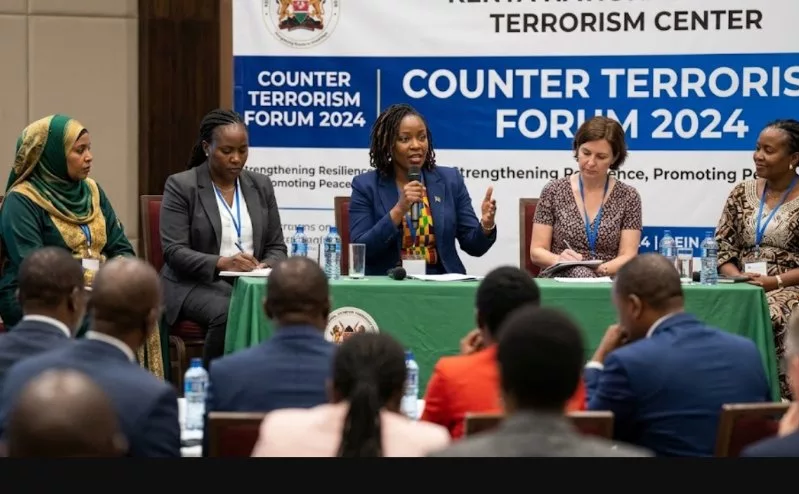
 AI generated image
Kenya’s efforts to prevent women from being
radicalised and recruited into violent extremist groups have been hampered by
weak implementation of County Action Plans (CAPs), inadequate funding and
limited coordination among stakeholders, a new study has found.
The study assessing programmes aimed at preventing
women’s radicalisation and recruitment into violent extremism found that
although most of the 11 counties examined had CAPs, the plans were rarely used
as the basis for implementing prevention programmes.
The study titled “Effectiveness ofCounty Action Plans (CAPs) on the Prevention of
Women's
Radicalization and Recruitment into Violent
Extremism” in Kenya was conducted by the National Crime Research Center (NCRC).
It says instead, many interventions were developed
in response to immediate security and community needs, with their connection to
the CAPs largely coincidental.
The research examined programmes in Mombasa, Lamu,
Kwale, Garissa, Wajir, Isiolo, Nyeri, Kisumu, Bungoma, Nakuru and Nairobi.
Researchers conducted 107 key informant interviews
and 22 focus group discussions involving government officials, security
agencies, civil society organisations, religious leaders, women leaders,
community representatives, political leaders and other stakeholders.
The study found that CAP implementation remained
low in most counties, resulting in fragmented interventions and weak
coordination among organisations working to prevent violent extremism.
It also found that few programmes specifically
targeted women, with most initiatives simply including women among their
broader beneficiaries.
Media campaigns emerged among the interventions
considered most effective in reaching women and countering extremist narratives.
Education and awareness programmes also recorded
positive results, particularly where they used trusted community structures
such as chiefs’ barazas, schools, religious institutions and local media.
In Isiolo, Wajir and Garissa, for example,
counter-extremism messaging was delivered through local media in languages
familiar to communities.
The researchers found that the use of
community-based media, appropriate local languages and youth-friendly
broadcasting times helped increase the reach of prevention messages.
School-based programmes were also considered
effective because they reached girls and boys at an early age while requiring
relatively limited resources.
Interfaith initiatives involving Muslim and
Christian religious leaders were similarly identified as important in
challenging extremist narratives and addressing the misuse of religious
teachings.
Women-specific programmes remain limited
Despite the focus of the study on women,
researchers found that relatively few programmes were specifically designed
around the gender-specific drivers of radicalisation.
One example cited was the “Mothers in Solidarity”
programme by YADEN East Africa, which was implemented in several of the
counties studied.
The initiative brought together women of different
ages, including women whose close family members had been radicalised and
widows affected by radicalisation.
Women-led organisations were also found to play an
important role in psychosocial support, community mobilisation and economic
empowerment.
In Kwale, for example, the Agatha Foundation and
Kwale Voices of Women Organization were identified as grassroots actors
involved in psychosocial interventions.
"Political pillar is a key component of the various CAPs, but the study established that the political
pillar existed only on paper; its effectiveness in supporting the implementation of County Action
Plans (CAPs) on the prevention of violent extremism largely remained limited," the report said.
Economic empowerment faces sustainability
challenges
Economic empowerment programmes were identified as
another important tool in preventing vulnerability to extremist recruitment.
The interventions included vocational training,
entrepreneurship support, start-up funding, financial assistance and links to
employment and markets.
Programmes involving the Women Enterprise Fund,
Youth Fund and Kazi Mtaani were cited as having contributed to economic
empowerment, although researchers noted that their sustainability was affected
by funding constraints and changing donor priorities.
The study also found that women-focused community
organisations helped mobilise women into self-help groups, making it easier for
government agencies, development partners and business organisations to reach
them.
"The findings also revealed specifically targeted widowed women affected by radicalization, aiming to address feelings of discrimination, exclusion, and bitterness that could increase sympathy for or affiliation with extremist groups," the report said.
"These interventions were particularly
evident in counties across the North Eastern region (Isiolo and Garissa), Nairobi, and the Coast
region. For example, in Garissa, programmes such as the Sister-to-Sister initiative brought female
security officers together with local women to discuss security issues while integrating messaging
on the risks of radicalization."
Political involvement and policing criticised
The political pillar of the CAPs was found to have
limited effectiveness, with researchers reporting low levels of engagement by
political leaders.
Some respondents said political interests
sometimes undermined prevention initiatives, including allegations that some
politicians mobilised young people into criminal gangs.
The study also raised concerns about some
law-enforcement approaches.
It found that the involvement of the
Anti-Terrorism Police Unit (ATPU), particularly what respondents described as
threats directed at families of people who had been recruited into extremist
groups, created fear and undermined trust between communities and security
agencies.
The researchers concluded that such approaches
could reduce the effectiveness of community-based prevention efforts.
CAPs poorly integrated into county planning
A major finding was the weak institutionalisation
of County Action Plans.
Researchers found that many county governments had
not fully integrated CAPs into their planning systems or allocated sufficient
resources for their implementation.
Counties including Nyeri, Bungoma and Kisumu were
identified as having notable gaps in the development and operationalisation of
CAPs.
Meanwhile, awareness of CAPs was relatively high
among respondents in Nairobi, Wajir, Garissa and Nakuru, particularly among
those involved in their development.
However, the study found that this
awareness did not necessarily translate into alignment between the plans and
actual programmes.
The researchers attributed the disconnect partly
to inadequate dissemination and sensitisation on the contents of the CAPs.
The study further found that monitoring and
evaluation systems were inadequate, making it difficult to determine the
long-term impact of programmes targeting women.
NCTC coordinates some monitoring through County
Commissioners’ offices, with Assistant County Commissioners involved in
reporting.
However, researchers cited inconsistent reporting, financial
constraints and data challenges.
Some organisations, including the International
Organization for Migration, YADEN East Africa, Peace Link and Midrift Hurinet,
conduct their own monitoring and evaluation, but these systems are primarily
designed for internal accountability rather than coordinated county-level
tracking.
The lack of gender-disaggregated data was also
identified as a major obstacle to measuring women’s participation and the
effectiveness of women-focused interventions.
Study recommends greater funding and coordination
The researchers recommended that national and
county governments provide sustainable financing for CAP activities and
integrate prevention and countering of violent extremism into County Integrated
Development Plans and ward-level development plans.
The study also calls for stronger monitoring and
evaluation systems led by the National Counter Terrorism Centre, better
information sharing and greater awareness of CAPs among grassroots
organisations.
Counties have also been urged to deliberately
incorporate gender-responsive programmes into their action plans and position
women not only as beneficiaries but also as key actors in preventing
radicalisation.
The researchers further recommended integrating
emerging issues such as online radicalisation into CAPs and strengthening
community ownership by involving peace committees, religious leaders, youth
groups and women’s networks.
The study identifies digital radicalisation as an
area requiring further research, noting the growing use of social media,
encrypted messaging applications and other online platforms by young people.
Overall, the study concludes that Kenya has made
progress in establishing a framework for preventing violent extremism, but the
impact of County Action Plans remains limited because of inadequate
implementation, weak coordination, insufficient financing and poor monitoring.
It recommends stronger integration of CAPs into
county planning and deliberate investment in programmes addressing the specific
vulnerabilities and roles of women in preventing violent extremism.






