

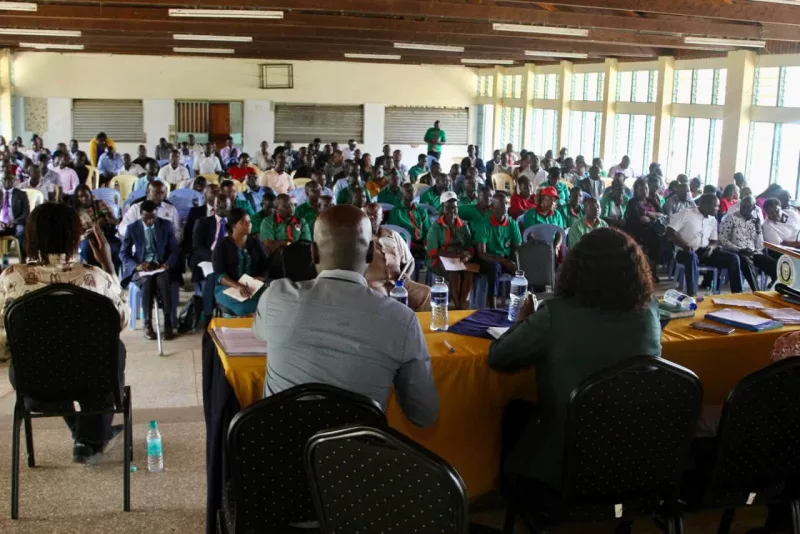
 Public participation forum on proposed education reform bills in Nyamira county on Thursday, October 1, 2026. /PARLIAMENT
The Seventh-day Adventist Church has asked Parliament to amend the proposed Basic Education Bill, 2026, to give it representation on County Education Boards in areas where it is a majority sponsor of schools.
The proposal was among submissions made during public participation forums on the six education reform Bills held in Nyamira, Tharaka-Nithi and Migori counties on Thursday.
Appearing before the National Assembly Departmental Committee on Education in Nyamira, the church argued that the proposed composition of County Education Boards does not adequately recognise faith-based sponsors with a significant presence in particular regions.
The church wants Section 32(1)(e), (f) and (g) of the Bill amended to allow representation based on the level of institutional presence of faith-based sponsors.
"We propose to retain the rendering as it was in the 2013 Education Act to include option of any other majority faith-based institution that could be having more institutional presence in that region, replacing the one that could be having less," Pastor Enock Ooga told the Julius Melly-led committee.
Section 32 provides for a County Education Board comprising a chairperson and 15 other members appointed by the Cabinet Secretary for Education.
The Bill provides for a representative of the National Council of Churches in Kenya and Evangelical Fellowship of Kenya, a representative of the Kenya Episcopal Conference and a representative of the Muslims Education Council.
The Adventist Church wants the provision changed to allow three persons representing majority-based sponsors, where applicable, instead of reserving representation for the named religious bodies alone.
The proposed change would mean a faith-based organisation could secure representation on a County Education Board in counties where it has a dominant role in sponsoring schools.
In Migori, calls for a split in the management of public primary and junior schools dominated discussions, with concerns over the definition of comprehensive education in the proposed Basic Education Bill.
Kuppet described the management model as unclear and called for the structure to be spelt out more clearly in law.
The union wants public primary, junior and senior schools to operate as distinct levels, each with its own leadership and clearly defined administrative responsibilities.
The proposal echoes concerns raised by education stakeholders in other counties during the public participation exercise, particularly over the management of junior schools.
Kuppet has consistently argued that junior school has distinct curriculum requirements, specialised teachers, national assessments and learning needs that require a management structure suited to the level.
The union has consequently pushed for junior school to have greater autonomy, with clear leadership and accountability, rather than being absorbed into a comprehensive school structure.
It argues that separating primary, junior and senior schools would help reduce administrative conflicts and ensure that each level receives attention and resources appropriate to its mandate and needs.
Currently, junior schools are domiciled in primary schools as a matter of policy, as proposed by the Presidential Working Group on Education Reform.
The proposed Basic Education Bill seeks to give the comprehensive-school model a legal basis, under which different levels of basic education would operate within a common management structure.
Kuppet has opposed this approach, while the Kenya National Union of Teachers (KNUT) has backed the comprehensive-school model.
The issue generated controversy and emerged as one of the most contested proposals during the nationwide public participation exercise.
Kuppet seeks clarity on school funding
Kuppet's Migori branch also called for clearer provisions on the financing of public schools, particularly the division of responsibilities between the government and parents.
The union was responding to the Bill's provision that no tuition fees should be charged in public schools.
Kuppet said the legislation should clearly state the level of government capitation and set out what each stakeholder is expected to fund.
"For smooth running of public schools, Clause 11 of this Bill should clearly state role of each stakeholder; the government and the parent. Once established, each should play their role efficiently and pay on time for us as school principals to run the institution smoothly," Kuppet Migori executive secretary Willy Otunga said.
The concern comes against a backdrop of persistent debate over the adequacy and timeliness of government funding to public schools, with school managers arguing that clarity on funding obligations is necessary for effective planning and administration.
The six Bills under consideration are the Tertiary Education, Placement and Funding Bill, 2026; Basic Education Bill, 2026; Kenya National Educational Assessments Council Bill, 2026; Pre-Service Education and In-Service Training Bill, 2026; Kenya National Qualifications Framework (Amendment) Bill, 2026; and Kenya Institute of Curriculum Development (Amendment) Bill, 2026.
The proposed laws seek to reform tertiary education placement and financing, basic education management, national assessment, teacher training, qualifications and curriculum development.
Education Committee chairperson Julius Melly told stakeholders that their submissions would form part of the legislative process and urged them to continue sending memoranda before the exercise closed.
"What you've given us shall form part of the law. We are here to hear you and get your views. You are the final people in decision making," he said.
The committee will conclude the nationwide public participation exercise on Friday with hearings in Bomet and Samburu, completing the additional phase covering 16 counties after the initial 31-county programme was extended to October 2.
The deadline for written memoranda is Friday at 5pm, after which the committee will retreat to analyse the submissions and prepare a report for consideration as the Bills proceed through Parliament.
Judiciary sets public participation standards
The conclusion of the education hearings comes as the Judiciary continues to emphasise the standards that should guide public participation in lawmaking.
Deputy Chief Justice Philomena Mwilu said public participation has evolved from a constitutional principle into an enforceable legal doctrine through judicial decisions.
Speaking on Wednesday during a public lecture at the Kenyatta University School of Law on the evolution of public participation and emerging jurisprudence from the Supreme Court, Mwilu cited nine guidelines that provide the authoritative framework for assessing the sufficiency of public participation.
They include provision of reasonable notice and opportunity to participate, inclusivity, transparency, clarity of the subject matter, and ensuring that public input is real, purposive and meaningful.
"It's not a mere formality to be undertaken as a matter of course just to fulfil a constitutional requirement," she said.
The courts have previously held that the absence of a prescribed legal framework is not an excuse for failing to conduct public participation, and that the process should be both quantitative and qualitative.
The Education Committee will therefore have to consider not only the number of forums held and submissions received, but also the substance of the views presented as it prepares its report on the education reform Bills.






