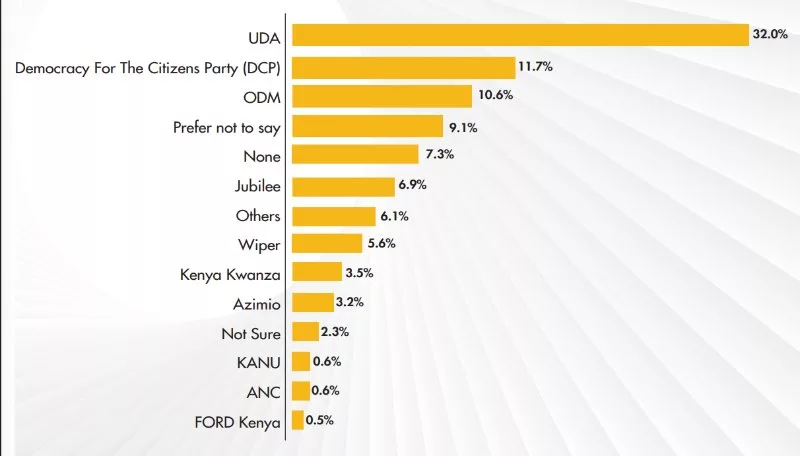
The United Democratic Alliance (UDA) remains the most popular political party in Kenya, according to a new poll by the Politrack Research Team, with the ruling party commanding 32 per cent support.
Respondents were asked to identify the political party they support the most in a survey conducted between September 15 and 25, 2026.
UDA's support was nearly three times that of its closest individual rival, the Democracy for Citizens Party (DCP), which recorded 11.7 per cent.
The Orange Democratic Movement (ODM) followed closely with 10.6 per cent, placing it 1.1 percentage points behind DCP.
The narrow difference between DCP and ODM is within the poll's reported margin of error.
The poll comes as political parties intensify their preparations for the 2027 General Election, with new alliances and political formations emerging as established parties seek to consolidate their support bases.
The survey targeted potential voters across the country and used a text-based technology platform to invite sampled respondents to participate and answer the questions at their convenience.
A total of 20,419 respondents took part in the survey. The findings have a 95 per cent confidence level and a reported margin of error of +/-3 per cent.
DCP, associated with former Deputy President Rigathi Gachagua, has been expanding its national presence as it positions itself for the 2027 political contest.
ODM, meanwhile, continues to reorganise following the death of its former leader Raila Odinga and amid discussions about its political direction and possible alliances ahead of the election.
Jubilee ranked fourth with 6.9 per cent, followed by Wiper at 5.6 per cent.
The poll also recorded support for the broader coalition labels Kenya Kwanza and Azimio, which received 3.5 per cent and 3.2 per cent, respectively.
Among other parties, KANU and the Amani National Congress (ANC) each recorded 0.6 per cent, while FORD Kenya registered 0.5 per cent.
Parties that were not individually listed in the poll were grouped under “Others”, which received 6.1 per cent support.
The survey also showed a significant level of uncertainty or lack of party affiliation among respondents.
Those who said they preferred not to say accounted for 9.1 per cent, while 7.3 per cent said they supported no party. A further 2.3 per cent said they were not sure which party they supported.
Combined, the three categories account for 18.7 per cent of respondents, making them a significant bloc in the survey.
With parties expected to intensify recruitment, coalition negotiations and grassroots mobilisation in the months ahead, the sizeable proportion of respondents without a declared party preference could become an important feature of the evolving political landscape.