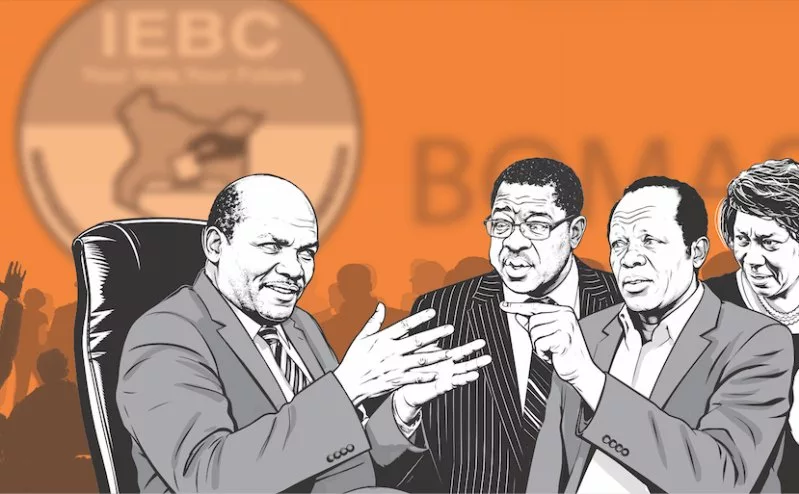
On September 20, 2022, the chairman of the Independent Electoral and Boundaries Commission, Wafula Chebukati, dropped a legal blockbuster by swearing an explosive affidavit before the Supreme Court.
In a section aptly titled “Attempts to subvert the will of the People,” Chebukati gave a dramatic, blow-by-blow account of the extreme lengths the Azimio Coalition allegedly went to secure an electoral victory outside the rule of law.
Two nights before the final results were announced, Chebukati claimed he had to play late-night host to former cabinet ministers Raphael Tuju and Charity Ngilu at Bomas.
They were apparently there to aggressively protest the verification process of the presidential tally. According to the former IEBC boss, Tuju eagerly attempted to corner him for a private chat, but Chebukati successfully dodged the encounter.
Fast forward to the morning of August 15, and Tuju pulled a sequel, returning to Bomas accompanied by former Attorney General Amos Wako and the advocate Kyalo Mbobu.
If the details sworn in that affidavit are accurate, the dialogue in that meeting reads like a Hollywood script for political espionage.
According to the affidavit, Wako was the opening act, subtly nudging the commission to remember the delicate link between election outcomes and national stability.
He walked down memory lane, reminding the IEBC chair that he had once walked in his shoes and would graciously “moderate results guided by the need to achieve law and stability.”
But it was Tuju who decided to skip the diplomatic pleasantries and cut straight to the chase, making it clear that the results desperately needed to be “moderated in favor of baba.”
He warned that any declaration to the contrary would instantly “plunge the country into chaos.”
In the event that the commission’s "math couldn’t math," Tuju reportedly suggested that they force a run-off. Naturally, this patriotic flexibility would be quite adequately rewarded.
Chebukati, playing the ultimate diplomat, invited his fellow commissioners to weigh in on these extraordinary requests.
In the document, Chebukati claimed the four commissioners who would later famously stage a Bomas rebellion—Juliana Cherera, Justus Nyang’aya, Irene Masit, and Francis Wanderi—all enthusiastically nodded along with the creative suggestions.
The remaining wing of the commission, anchored by Chebukati, stood their ground, that they wouldn't trade the collective will of the voters for any earthly reward.
Just a few hours later, a new set of VIPs from the National Security Advisory Committee (NSAC) marched into Bomas with a cinematic, apocalyptic warning:
If William Ruto was declared president-elect, “the country is going to burn” and the “blood of dead Kenyans” would be squarely on their hands. The group repeated the exact same playlist: either announce Raila or force a re-run.
Once again, the rebel quartet of commissioners allegedly backed the NSAC’s grim forecast, while Chebukati’s faction stubbornly refused to budge.
According to Chebukati, once the numbers were finally cooked and the official copies handed out, a lively debate erupted.
What followed in paragraph 78 of that affidavit sounds like a satirical political thriller, except it was a sworn statement delivered to the country’s highest court by an official holding the status of a Supreme Court Judge:
“Commissioners Masit and Wanderi were of the view that the results should be pushed towards a re-run, which in their view would be a win-win situation. Commissioner Prof Guliye questioned how that would be done, to which vice chair Cherera suggested the margin is not too big and could be manipulated by moving 233,211 votes from Hon Ruto to the rejected ballots category.”
Chebukati dryly concluded: “From my observation... it appeared that they had a pre-arranged consensus towards altering the results.”
I have agonised over these claims for years. Granted, these wild allegations were fiercely disputed, especially by Tuju.
Yet, the country truly missed out on a masterclass in drama by not having a comprehensive, totally independent investigation.
Treating the democratic will of millions of Kenyans like a high-stakes game of poker is taking political comedy a step too far.
Now, as we casually march toward another election cycle, we haven't even properly buried the ghosts of Bomas past. What will stop the next VIP delegation from strolling into Bomas and politely requesting a little tailored "moderation" for their own favourite candidate?
Musau, an Advocate of the High Court, is a Senior Project Manager with the Friedrich Naumann Foundation. The views expressed here are his own