
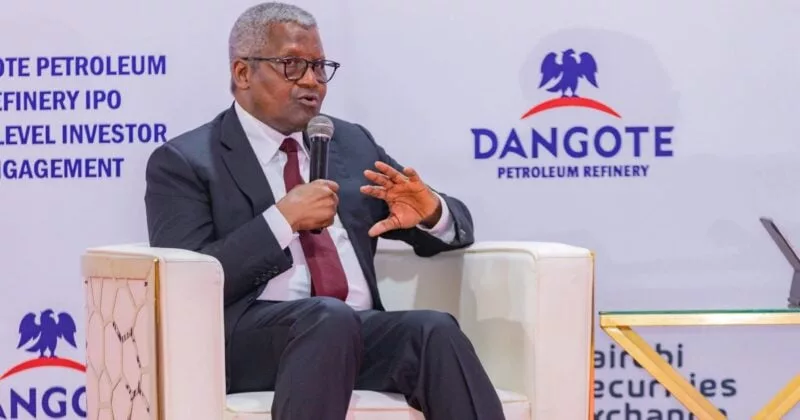
 Nigerian billionaire and industrialist Aliko Dangote/HANDOUT
Nigerian billionaire and industrialist Aliko Dangote has defended the decision to locate his planned Sh2 trillion refinery in Lamu, saying an oil refinery does not necessarily have to be established where crude oil is produced.
Speaking during an interview with NTV on the proposed Dangote East African Refinery, Dangote said the location of a refinery should be determined by factors such as access to water, port depth and the ability to receive large crude carriers, rather than proximity to oilfields.
“An oil refinery doesn't have to be set up where crude oil is,” Dangote said, citing Singapore and India as examples of countries with significant refining capacity despite producing little or no crude oil.
“Singapore doesn't have any oil, but they have a huge refining capacity. India has a huge refining capacity with very little oil, less than five per cent of their own demand.”
Dangote said even his existing refinery in Lagos, Nigeria, is not located in an oil-producing area.
“Where we are in Lagos, there is zero oil. The oil is in the southern part of the country,” he said.
He said logistical considerations, particularly access to water and the depth of the port, which would allow the facility to receive very large vessels carrying crude, informed the choice of Lamu.
“We are looking at water, location, depth because ships carrying two million barrels,” Dangote said.
The billionaire said the refinery would initially prioritise crude produced in East Africa, including Kenya's Turkana oilfields, before sourcing additional supplies from the Middle East and other producing regions.
“Crude will come from all the East African countries that are producing oil; we will give them the priority, and then we will get more from the Middle East and everywhere,” he said.
Dangote also noted the global competition for crude oil, saying the refinery would need to secure supplies from different sources.
“Every country on earth is looking for oil,” he said.
He argued that refining crude creates a wide range of products and industrial inputs, noting that “from crude oil, you produce 6,800 items.”
The planned Dangote East African Refinery is estimated to cost about $16 billion, equivalent to roughly Sh2 trillion, and is expected to have a processing capacity of approximately 700,000 barrels per day.
Dangote said Lamu was not his first preference when he began considering locations for the project, revealing that he had initially considered other ports along the East African coast.
“At the beginning I would have said if not Tanga, I would have said Mombasa,” he said.
He said he only became familiar with Lamu recently.






