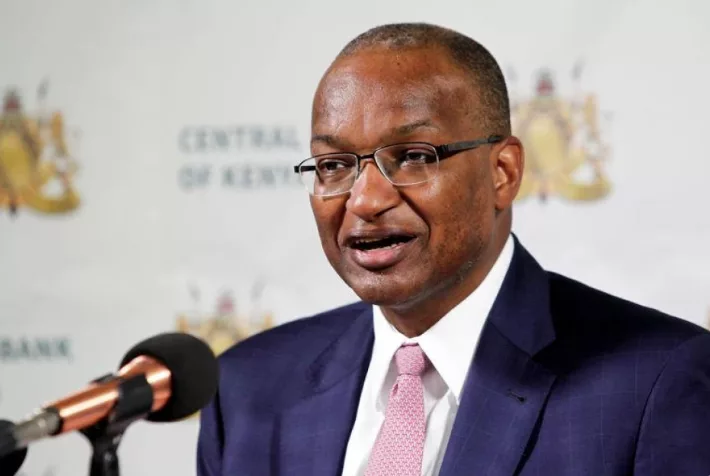
Former Central Bank governor Patrick Njoroge wants a shift in Kenya’s mobile money regime to give customers a share of the income generated by the money in their accounts.
In comments submitted on the Draft National Payment System Policy, Njoroge wants payment service providers (PSPs) to make regular “bonus payouts” to wallet holders from income earned on customer funds held in trust, after meeting the operating and related costs of the trust.
The proposal targets an unusual feature of Kenya’s mobile money model.
Under the 2014 National Payment System Regulations, PSPs must keep customer money in a trust fund, with balances at least equal to what is owed to customers.
The funds can be placed in licensed commercial banks or government securities.
Under the existing regime, the trust uses generated income in accordance with trust law and in consultation with CBK, and donates it to a public charitable organisation for public charitable purposes.
However, Njoroge argues that the original rationale for the arrangement has been overtaken by the extraordinary growth of mobile money.
He proposes that surplus income, after the trust's costs, generate direct benefits for the people whose money produces the returns.
“Customers would receive part of the return generated by funds that underpin their wallets, rather than the entire surplus being channelled elsewhere,’’ Njoroge says.
His submission does not prescribe a particular interest rate or payout frequency, but the sums involved could be significant simply because of the scale of Kenya’s wallet economy.
Latest data by the apex bank shows 94.35 million registered mobile money accounts and 575,400 active agents in July 2026, while agent cash-in and cash-out transactions were valued at Sh728.7 billion that month.
His suggestion mirrors a 2024 GSMA study covering Ghana, Jordan, Kenya, Mexico, Pakistan, Paraguay, Rwanda, Tanzania, Uganda and Zambia, which found that trust or float accounts typically earn interest.
The study identified Kenya and Paraguay as the two markets where the regulatory framework specifically prohibits distribution of float interest to customers while prescribing how the interest should otherwise be used.
According to the report, while Kenya requires charitable use, Paraguay directs interest towards administrative costs of the trust.
Some other countries, including Mexico and Pakistan, prohibit mobile-money providers from paying interest to customers but do not prescribe the same specific treatment of float interest as Kenya and Paraguay.
Just like Njoroge, GSMA's research outlines various benefits of passing interest to customers. For instance, they both agree that direct interest payments can provide passive income, encourage savings and strengthen customer trust.
They, however, warn that distribution creates administrative and compliance costs for providers.
They recommend flexible frameworks allowing interest to benefit customers through direct payments, lower fees or improved services.
Njoroge’s proposal comes as Treasury and CBK seek to replace the 2011 National Payment System Act with a broader framework covering interoperability and instant payments.
It intends to foster open finance, cybersecurity, consumer protection and competition.
The draft policy proposes a national instant payment switch, open API standards, stronger cybersecurity requirements and new consumer dispute and fraud-liability frameworks.
Beyond the bonus payouts, Njoroge wants customers to be able to cash in or cash out through agents regardless of their PSP.
He is also rooting for stronger rules on fraud liability and consumer redress, explicit and revocable consent for sharing personal data, safeguards against discriminatory practices by vertically integrated groups and secure offline payments during network outages.
He also questions the policy's relationship with the National Payments Strategy 2022–2025, National Digital Master Plan 2022–2032 and National Financial Inclusion Strategy 2025–2028, arguing that the new framework should make clear whether it replaces or builds on those plans.
The proposals remain subject to public participation.
Last week, CBK and Treasury invited comments on the draft policy and Bill, with submissions due by October 9, 2026.