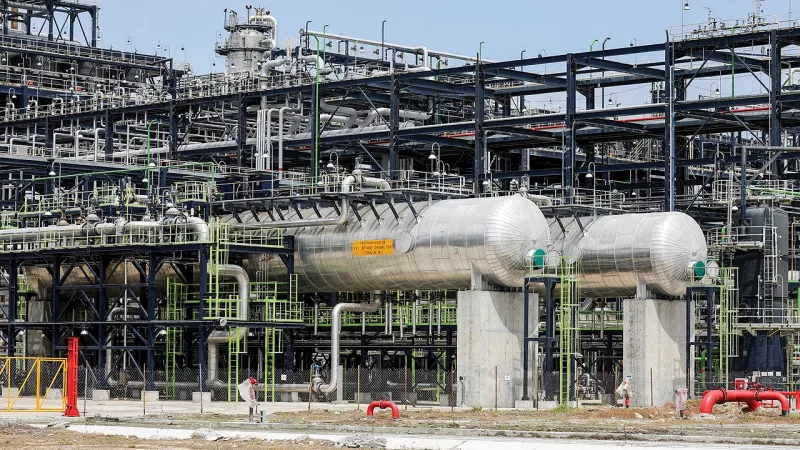
The planned Sh2 trillion Dangote East African Refinery in Lamu is set to place Kenya on the map of countries seeking to build large-scale refining capacity, with the proposed facility expected to process about 700,000 barrels of crude oil per day.
The $16 billion investment by Nigerian billionaire Aliko Dangote has generated excitement in Kenya, with the government positioning it as a major industrial and energy project that could transform Lamu and create thousands of jobs.
The refinery is expected to serve not only Kenya but also the wider East African market.
At 700,000 barrels per day, the Lamu facility would be among the largest refineries globally if completed at its planned capacity.
The world's largest refinery complex is the Jamnagar facility in Gujarat, India, operated by Reliance Industries. Its commonly cited capacity is about 1.24 million barrels per day, making it substantially larger than the proposed Lamu refinery.
Other major facilities include Venezuela's Paraguaná Refining Complex, with a nameplate capacity of about 940,000 barrels per day, and South Korea's Ulsan refinery, at about 840,000 barrels per day.
The Ruwais refinery in the United Arab Emirates has capacity of about 817,000 barrels per day, while South Korea's Yeosu facility is commonly listed at around 730,000 barrels per day.
At 700,000 barrels per day, Lamu would therefore sit below these giant facilities but above a number of other major refineries.
It would also be larger than the existing Dangote Petroleum Refinery in Lagos, Nigeria, which has a capacity of about 650,000 barrels per day. The Nigerian facility is currently Africa's largest single refinery.
This means the proposed Lamu refinery would have a processing capacity roughly 13 times Kenya's current daily petroleum demand, according to industry estimates cited by Kenya Engineer, highlighting the project's intended regional rather than purely domestic market.
Where will the crude come from?
Dangote has said the refinery will first prioritise crude produced in East Africa before looking further afield.
“Crude will come from all the East African countries that are producing oil; we will give them the first priority, and then we will get more from the Middle East and everywhere,” he said.
The facility is expected to process crude from Kenya's Turkana oilfields as well as supplies from other African producers and international markets. The project is being designed around access to the deep-water Lamu port, allowing large vessels to deliver crude for processing.
Dangote has also argued that a refinery does not necessarily have to be located where crude is produced, pointing to countries such as Singapore and India that have developed major refining industries despite limited domestic oil production.
What does a refinery actually do?
At its most basic level, an oil refinery converts crude oil into products that can be used by households, industries and transport systems.
The process begins with separation, where crude is heated and divided into different fractions according to their boiling points.
The refinery then uses conversion processes, including cracking, to break heavier hydrocarbon molecules into lighter and more valuable products.
Finally, treatment removes impurities such as sulphur to ensure the products meet required environmental and market standards.
The resulting products include petrol, diesel and jet fuel, as well as industrial feedstocks such as naphtha, ethylene and propylene used in manufacturing plastics and other products. Refineries can also produce asphalt, lubricants and other heavy petroleum products.
A regional industrial hub
Beyond fuel production, the Lamu project is expected to support a wider industrial ecosystem involving storage facilities, pipelines, shipping, logistics, petrochemicals and other businesses.
The East African Refinery would therefore represent a major expansion of Kenya's petroleum infrastructure and, at its planned 700,000-barrel-per-day capacity, would rank alongside some of the world's largest individual refining facilities.
However, the project still faces challenges, including questions around crude supply, infrastructure and land and environmental concerns. A Kenyan court has ordered preservation of parts of the proposed site following a legal challenge by local residents, although Dangote has said the groundbreaking would proceed.
If completed as planned, the Lamu refinery would not be the world's largest, but its 700,000-barrel-per-day capacity would put it firmly in the upper tier of global refining facilities and make it one of the largest projects of its kind in Africa.