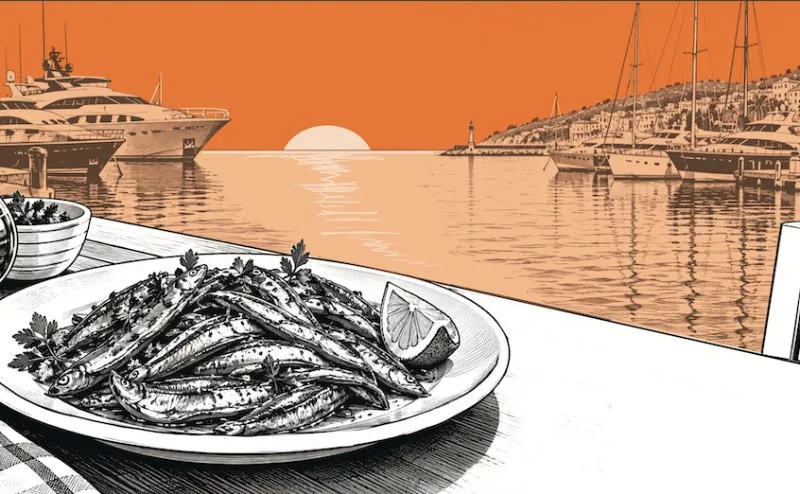
Ten euros and 50 cents bought me a plate of fried anchovies at Flisvos Marina in Athens on Friday. Yachts on one side, the sun going down on the other, people in good shoes photographing their food. Small silver fish, floured, fried whole, salt and a squeeze of lemon.
One bite and I was in my wife's kitchen in Nairobi.
I will say it plainly, because Athens will not read this and my wife will. Her version was better than the 10 euro one. I knew that before the plate arrived, and the plate only confirmed it.
Anyone from the lake already knows why. Take away the marina and the Greek name and what was on my plate was omena. Different species, different water, same fish: small, oily, eaten whole, fried until it crackles. In Athens it is what you order to catch the sunset. At home it is what you eat when you cannot afford fish.
Nothing about the fish changed between the two plates. Only the story did.
I have stood inside that story. Some years ago I was in a supermarket queue with a packet of omena in my basket. The man ahead of me, a white man, had the same packet. He was buying it for his dog. I was buying it for my dinner. Neither of us said a word. The shelf had already sorted us.
I would like to say I was above it. I was not. For most of my life I ate omena as a duty, a meal that smelled faintly of hardship. What changed my mind was not a lecture. It was a frying pan.
I cannot tell you what my wife does to it. The recipe is family property and it goes to the grave with us, or to our children. What I can tell you is what it does to people. It converted me. It converted my grandfather, who had eaten omena for the better part of 80 years and thought he knew the ceiling of the dish. When he went home to Dudi, he started a quarrel because nobody there could cook it the way she does, and he said so.
The quarrel ended the only way it could. My grandmother, the keeper of how things are done in that house, picked up the phone and called my wife for the recipe.
Here is the principle that call taught me: a food is worth what we believe about it, not what is in it. Change the belief and the value follows. Leave the belief alone and no amount of nutrition science will reach the plate.
The science is not in doubt. The Lake Victoria Fisheries Organisation reports that omena is about 60 per cent of everything landed on the lake by weight, yet only about 16 per cent of the catch by value. The global fish database FishBase puts its calcium at 592 milligrammes per 100 grammes against 107 for Nile perch, with more than twice the iron and nearly twice the omega-3 fat. Dried, it is more than half protein by weight. Gramme for gramme, the fish we look down on beats the fish we look up to.
I meet the other side of that arithmetic at the end of the story. As an orthopaedic surgeon, I operate on bone that has been short of calcium for a lifetime, and I treat children whose growth is behind their birthdays. I cannot tell you that any one of them would have been spared by a plate of omena. I can tell you that the cheapest, richest source of what their bones needed was in the market down the road, and nobody thought it was good enough for them.
The market has already read the science we ignore. A regional study for the Lake Victoria Fisheries Organisation found that less than 30 per cent of the lake's omena is eaten by people; the rest goes to feed mills to raise chickens, pigs and farmed fish. The poor man's fish is being priced, and the people it should feed are being priced out of their own nutrition by a story they inherited.
So here is what I am asking. This week, buy the packet. Cook it as if it cost 10 euros: hot pan, patience, lemon at the end. Put it in the middle of the table, not at the side. Serve it to a guest you would normally serve chicken. Then watch the children who saw it happen.
I know how that ends, because I watched it end in my own family. It ended with the most stubborn woman I know swallowing her pride and dialling a number.
The recipe is not for sale. The fish should not be for dogs.