
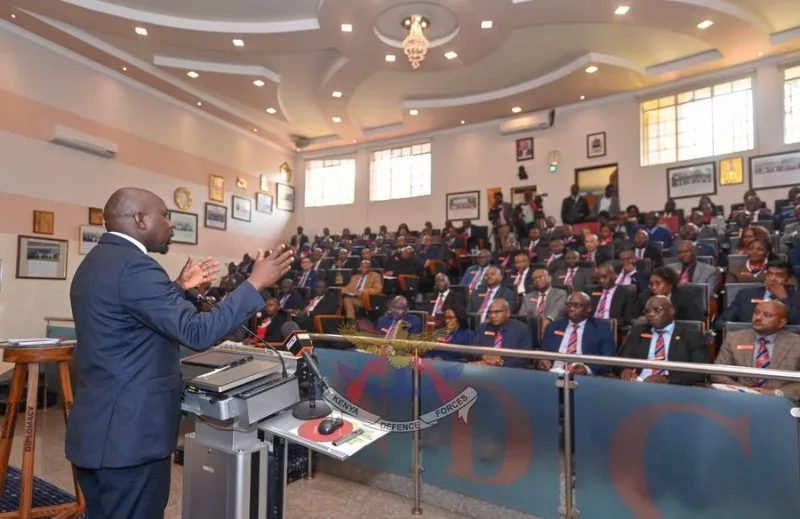
 CS Murkomen Addresses NDC Officers in Karen / HANDOUT
Interior and National Administration Cabinet Secretary Kipchumba Murkomen has called for stronger citizen participation in national security, saying information gathered from communities can help security agencies identify emerging threats and guide government action.
Murkomen spoke while delivering a Lecture of Opportunity to participants of the National Defence College (NDC) Course 29/2026-2027 at the College in Karen.
The lecture, themed “Citizen Engagement as a Strategic Pillar of National Security and Resilience”, focused on the role of citizens in strengthening national security, resilience and responsive governance.
The CS said information from communities could become a valuable source of strategic intelligence when reports from different areas are collected and analysed collectively.
“Ten communities reporting similar patterns is a signal that can reveal a pattern, enabling us to anticipate future risks and guide policy. It then becomes strategic intelligence,” Murkomen said.
He said the approach requires the government to move beyond conventional community policing and establish a more continuous exchange of information between citizens and security agencies.
Murkomen cited Jukwaa La Usalama as one platform through which citizen participation could become a more permanent part of security governance.
“Jukwaa La Usalama gives Kenya an opportunity to make that relationship between government and citizens a permanent part of security governance,” Murkomen said.
He said citizen engagement should not end once public meetings are concluded, but should be linked to concrete government action and feedback to communities.
“We will therefore continue to enrich the model, creating a continuous two-way relationship, identifying problems, connecting those problems to multi-agency action, and reporting back on what has changed,” the CS said.
He said the effectiveness of Jukwaa La Usalama should be assessed by the action resulting from public participation rather than simply the number of meetings held.
“Jukwaa La Usalama must, however, move beyond the number of meetings held to the actions triggered, the issues resolved, the time taken to respond, and the change experienced by communities,” Murkomen said.
The CS said the government had placed citizen participation at the centre of its security management approach, linking it to accountability, transparency and public trust.
“We have placed citizen participation at the centre of our security management because the whole-of-society approach is accountable and transparent, builds trust, and delivers results,” Murkomen said.
The approach, he said, would allow security agencies to identify concerns raised by communities, connect them to appropriate multi-agency interventions and report back on the action taken.
Murkomen also highlighted the importance of multi-agency coordination in responding to complex security challenges, with closer cooperation among government and security agencies supporting information sharing and coordinated interventions.
The Ministry of Defence similarly said the lecture addressed the links between citizen participation, governance, intelligence, multi-agency coordination and national security.
The Cabinet Secretary also cited Rwanda's experience in involving citizens in strategic intelligence as an area from which Kenya could draw lessons, while emphasising the need to strengthen mechanisms for citizen participation in security governance.
Murkomen was received at the National Defence College by its Commandant, Lieutenant General Juma Mwinyikai.
The Lecture of Opportunity forms part of the NDC academic programme, which exposes participants to perspectives from senior national leaders, policymakers, practitioners and subject-matter experts on strategic national, regional and international issues.
The engagement enabled Course 29 participants to examine the relationship between citizen participation, governance, intelligence, multi-agency coordination and national security.






