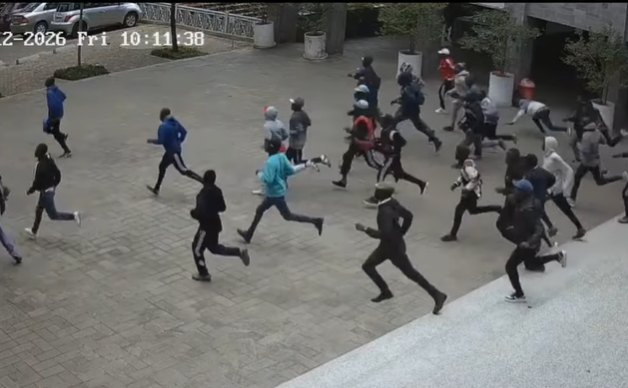
 Suspected goons escape after attacking All Saints Cathedral on Friday, June 12, 2026. /FILE
I was surprised the other day when my 96-year-old mother in Baringo casually talked about koons (kuns).
Koons?
I paused. How had this word, so strongly associated with political rallies, street violence and the language of our elections, found its way into my mother’s vocabulary in the village?
At that moment, it dawned on me, rather frighteningly, just how fast the phenomenon of goonism has spread.
Goons, ngoons and koons. Different pronunciations across our Kenyan tongues, but increasingly understood. From political rallies and newspapers to social media and village conversations, the word has entered ordinary Kenyan vocabulary.
But what exactly is a goon? The Oxford Advanced Learner’s Dictionary defines a goon as “a criminal who is paid to frighten or injure people.”
That definition is revealing. It puts money at the centre of the relationship. A goon is not simply a violent person. In the political context, a goon can be understood as violence that has been hired.
And once violence is hired, the questions become economic: Who is paying? Who is being paid? Who is organising? Who is transporting? Who gives the instructions? Who provides protection? And, ultimately, who benefits?
That is where the economics of political violence begins.
Goonism is not new. Kenya has a long history of groups associated with political and extra-state violence. Names such as Mungiki, Taliban, Jeshi la Mzee, Baghdad Boys, Kamjeshi and Chinkororo appear in official records and human-rights documentation concerning organised criminal and political gangs. A 2002 legal notice formally listed several such groups as societies considered dangerous to the good government of Kenya.
The Waki Commission later documented how, during the 2007–2008 post-election violence, violence in some areas involved planning and organisation, including the enlistment of criminal gangs by politicians, businessmen and others.
The lesson is simple: the person holding the weapon is only one part of the story.
The traditional picture of the goon is familiar: a young man at a political rally carrying a panga, club, metal bar or other weapon. But political mobilisation can be more sophisticated.
Recent news reports of gun-wielding men travelling in SUVs in political settings have added another dimension to the public conversation about political muscle. The reports are disturbing not simply because of the weapons allegedly displayed, but because they raise questions about organisation, resources and the capacity to mobilise.
A photograph, video or news report, however, does not by itself establish who organised or financed a group. Those are matters requiring evidence. But such reports should make us ask: Who is behind the person we see?
This is where Public Choice Theory offers an interesting lens. At its heart is the proposition that people respond to incentives. Political actors, like other actors, respond to perceived costs and benefits.
That does not mean every politician is violent, or every young person involved in political mobilisation is motivated by money. Political loyalty, identity, grievance, belonging and ideology also matter.
But somewhere along the chain, there may be an economic transaction.
A political actor may believe intimidation will frighten an opponent, disrupt a meeting or control political space. A young person may receive money, food, transport, protection, status or the promise of future opportunity.
There is, therefore, potentially a demand for violence and a supply of people willing to provide it.
But there is another element in this economic equation: the belief that one will get away with it.
Violence becomes attractive when the expected benefit is greater than the expected cost. If the person paying for violence believes the political benefit will be immediate, while the chances of investigation, prosecution and punishment are remote, violence can become a rational political investment.
Put simply: if violence pays and impunity is cheap, violence will continue to have a market.
The political actor may gain a temporary advantage. The young person may receive a payment. But the community pays the larger bill: injuries, deaths, damaged property, disrupted businesses, fear, displacement and broken relationships.
Economists call this an externality: those who make the transaction do not necessarily bear the full cost of its consequences.
There is another cost that is harder to measure: the destruction of trust.
When political competition turns neighbours against one another, the damage does not necessarily disappear when the election is over. Politicians change alliances. Yesterday’s political enemies can become today’s political partners. But the people in the village, estate or neighbourhood remain.
Accountability must follow the money.
Our response must therefore go beyond arresting the young man found at the scene.
The NCIC has an important preventive role in monitoring hate speech, ethnic tension and conflict early-warning indicators. The National Intelligence Service, within its constitutional mandate, can contribute intelligence on threats and networks that may not be visible at the rally ground.
But intelligence must lead somewhere.
Kenya needs professional, coordinated investigations capable of following the trail beyond the person carrying the weapon: The organiser, financier, transporter, communications network and those who may have provided protection.
Investigative agencies must work with prosecutors early enough to preserve evidence, trace financial transactions and build cases that can withstand scrutiny.
The ODPP has the constitutional mandate to institute and undertake criminal proceedings and to direct and guide criminal investigations. Where sufficient evidence exists, investigations should be completed professionally and prosecutions pursued expeditiously and fairly, with due regard to the rights of accused persons and victims.
The objective should be to change the economic calculation.
If someone contemplating political violence knows that the weapon carrier may be arrested, the financier's transactions may be traced, the organiser may be investigated, the transporter may be identified and those providing protection may also face lawful scrutiny, then the expected cost of violence rises.
That is what reform must achieve.
We must make political violence expensive ; not through arbitrary or selective punishment, but through credible, lawful and impartial accountability.
Otherwise, we arrest the hand while leaving the market for violence intact.
From managing violence to transforming society.
But accountability alone cannot transform the conditions that produce that market.
If our response is limited to arrest, prosecution and election-day security, we may contain an episode without changing the conditions that make political violence attractive in the first place.
Social transformation asks a deeper question: What must change in our political, economic and social relationships so that violence ceases to be a rational political investment?
That means creating political spaces where disagreement does not automatically become hostility; economic opportunities where young people are not easily recruited because a small payment is one of the few immediate opportunities available; institutions that communities trust; and local systems capable of identifying tensions and resolving them before they become violence.
It also means changing the relationship between citizens and those who seek political power.
Young people should not be treated merely as bodies to fill rallies or instruments to intimidate opponents. They are citizens with political agency. They can organise, debate, campaign, vote, contest elections and participate in peacebuilding without being converted into instruments of violence.
Transformation therefore requires more than asking young people to reject violence. The political economy that rewards violence must also change.
And we must not criminalise Kenyan youth as a generation. Many are voters, candidates, entrepreneurs, activists, peacebuilders and community leaders. Some may be manipulated into violence; others resist it. Many can themselves become victims of the same political economy.
So perhaps the question is not simply: “Why are our young people becoming goons?”
It is also: “What political and economic incentives make goonism possible?”
And then there is the question of brotherhood.
What happens when a Kenyan is paid to regard another Kenyan as an enemy because they support a different candidate? What happens when political competition turns neighbour against neighbour, youth against youth, brother against brother?
Elections come and go. Politicians move on. Communities remain.
We return to the same villages, estates, workplaces and places of worship. We remain neighbours. We remain brothers and sisters.
Perhaps that is why, as another electoral contest approaches, we should listen again to what we sing together as a nation:
“Haki iwe ngao na mlinzi,
Natukae na undugu,
Amani na uhuru,
Raha tupate na ustawi.”
Justice as our shield and defender. Let us live in brotherhood, peace and liberty, and enjoy happiness and prosperity.
Our rallying call must now advance beyond “Linda kura.” The ballot matters and must be protected. But the ballot is cast by a person : A neighbour, a brother, a sister, a fellow Kenyan , who must still be there when the election is over.
The challenge before us is therefore not merely to secure the election. It is to transform the conditions under which elections are contested, so that political competition does not require the buying and selling of violence.
Linda kura. Linda ndugu.