
County governments missed their own-source revenue target by Sh10.85 billion in the 2025-26 financial year despite reporting a sharp increase in collections.
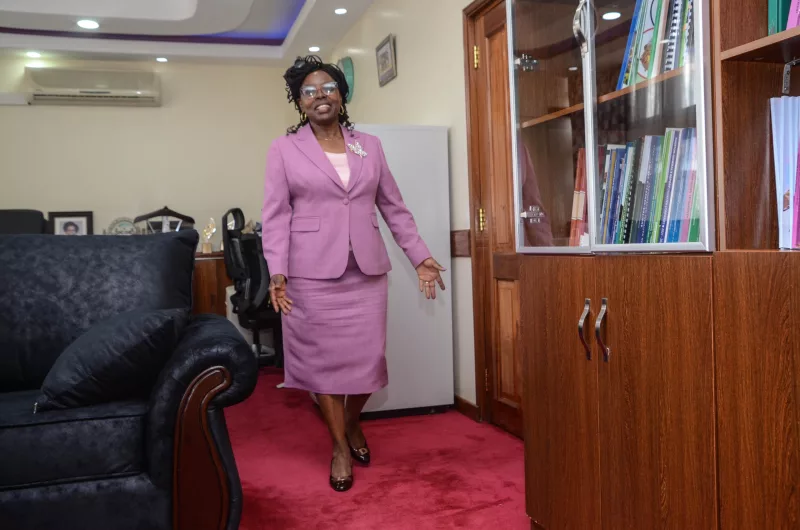
The 47 counties collected Sh97.55 billion against a combined target of Sh108.40 billion, achieving 89.99 per cent of the target, according to the latest report by the Controller of Budget Margaret Nyakang’o.
The collections were, however, 44.95 per cent higher than the Sh67.30 billion raised in the 2024-25 financial year.
The report shows that 15 counties exceeded their individual revenue targets, while 12 recorded performance of below 70 per cent.
According to the report, Mombasa achieved 251.8 per cent of its annual target, albeit from arrears of previous years. The county collected Sh21 billion against a target of Sh8.39 billion.
“The top performer, Mombasa county, reached 251.86 per cent, attributed to strong performance by FIF and reported arrears,” Nyakango said.
Garissa recorded the highest performance against its target at 165.51 per cent, followed by Kirinyaga at 145.37 per cent, Samburu at 132.73 per cent and Trans Nzoia at 116.62 per cent.
“An analysis of own-source revenue (OSR), including Facility Improvement Financing, as a percentage of the annual OSR target shows that 15 counties achieved performance levels exceeding 100 per cent.”
Other counties that exceeded their targets were Vihiga, Tharaka-Nithi, Laikipia, Lamu, Makueni, Kajiado, Nyeri, Narok, Wajir and West Pokot.
Nairobi City County, which is traditionally the largest revenue generator among the devolved units, collected Sh15.54 billion against a target of Sh21.58 billion, achieving 72 per cent.
The Controller of Budget attributed the overall increase in collections partly to stronger Facility Improvement Financing, including reimbursements under the Social Health Insurance Fund, revenue arrears and tourism-related receipts.
The report said Mombasa had automated all its revenue streams, helping improve collection efficiency.
Ordinary own-source revenue accounted for Sh55.69 billion of the total collections, while FIF contributed Sh39.75 billion.
Appropriations-in-Aid and other revenues contributed Sh649.27 million and Sh1.47 billion respectively.
The CoB, however, raised concern over counties' growing reliance on FIF, which accounted for 40.75 per cent of total own-source revenue.
Garissa was the most dependent on FIF, with the stream accounting for 88.18 per cent of its total own-source revenue.
It was followed by Elgeyo Marakwet at 84.11 per cent and Kitui at 80.12 per cent.
“Heavy reliance on this stream exposed counties to fiscal concentration risk and weakened resilience where ordinary own-source revenue streams underperformed,” Nyakang’o said.
She urged counties to look into more ordinary revenue streams to reduce their dependence on the proceeds from health services.
The report also reveals that counties had accumulated Sh113.29 billion in revenue arrears by June 30, 2026, highlighting the challenge of collecting money already owed to the devolved units.
Nairobi accounted for more than half of the outstanding revenue at Sh59.09 billion, equivalent to 52.15 per cent of the total.
Nakuru followed with Sh16.84 billion, Mombasa with Sh13.68 billion and Kiambu with Sh5.63 billion.
“The overall situation regarding receivables underscores persistent challenges in revenue mobilisation, which constrain liquidity for service delivery in the devolved units,” the report said.
Twelve counties recorded OSR performance of below 70 per cent, with three counties reporting OSR performances of less than 50 per cent.
These counties are Kisumu at 49.77 per cent, Kajiado at 49.04 per cent and Siaya at 26.94 per cent.
“The low performance in these counties may be attributed to weak results in ordinary OSR streams, failure to utilise revenue forecasting tools, and/or inadequate performance in FIF streams.”
Siaya recorded the lowest performance at 26.94 per cent, followed by Kajiado at 48.01 per cent, Kisumu at 49.77 per cent and Isiolo at 57.76 per cent.
The CoB attributed the underperformance to weak collections from ordinary revenue streams, failure to use revenue forecasting tools and poor performance in FIF.
The increase in collections was also partly linked to accrual-based reporting and the inclusion of revenue arrears in reported revenue.
Stronger FIF collections, including SHIF reimbursements, and tourism-related receipts also contributed to the growth.
However, some counties recorded lower collections because of changes in park fees and reduced FIF receipts.
With counties missing a combined Sh10.85 billion of their OSR target, the CoB has called for stronger revenue collection measures in the current financial year.
Counties have been directed to set realistic and evidence-based revenue targets and develop plans to recover outstanding arrears.
They have also been asked to reconcile their receivables registers every month and assign officers to follow up on major revenue streams.
“County governments should develop and implement revenue arrears recovery plans for FY 2026-27,” Nyakang’o said.
The CoB further urged counties to prioritise development projects, finalise procurement and cashflow plans early and submit exchequer requisitions promptly.
Counties have also been advised to contain payroll costs through staff rationalisation as they seek to improve their financial position.
The latest figures show that while county own-source revenue has grown significantly, devolved units still face a sizeable gap between what they expect to collect and what they actually raise.
The Sh113.29 billion in outstanding revenue also presents a major collection opportunity for counties as they seek to bridge the gap without placing additional pressure on residents and businesses.






