
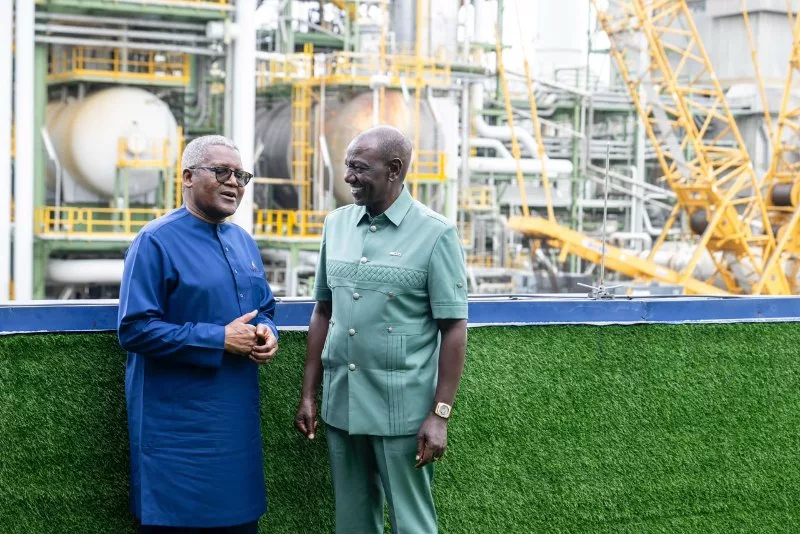
 President William Ruto with billionaire Aliko Dangote at Dangote refinery in Lagos on September 25, 2026/PCS
Nigerian billionaire Aliko Dangote says the planned refinery in Lamu will generate up to 1,000 megawatts of electricity, with part of the power potentially supplied to the Kenyan government.
Dangote spoke in Lagos on Friday while hosting President William Ruto, who toured the Dangote Petroleum Refinery ahead of the planned groundbreaking of the Lamu project on September 30.
The proposed Lamu refinery is expected to have a processing capacity of 700,000 barrels of crude oil per day.
Explaining the potential benefits of the Kenyan investment, Dangote said the refinery would serve as an entry point for additional industrial investments around the facility.
“What this investment (Lamu refinery) will do for the Kenyans, it's not only the refinery; the refinery is like the gate. Once you open and have the refinery, you'll be shocked at how many people will know come and invest in Kenya,” Dangote said.
He said the power-generation component of the Lamu project would be significantly larger than the corresponding facility at his Lagos refinery.
“What we are going to have, the power plant in Lamu will be actually double (the one in Nigeria) because we are going to produce about 1000 megawatts in Lamu out of petcoke and we'll have 500 megawatts to sell to the government of Kenya,” he said.
Dangote also pointed to differences in the processing equipment planned for Lamu, citing that some of the technology would be larger than that installed at the Lagos facility.
“Some of the equipment that we have here, like the RFCC, will be much heavier than the one in Lamu,” he said.
RFCC, or Residue Fluid Catalytic Cracking, is a major refinery process used to convert heavier, lower-value oil residues into lighter petroleum products such as gasoline and diesel.
The technology is used to improve the value and usefulness of heavier refinery feedstocks.
Petcoke, short for petroleum coke, is a carbon-rich solid material produced during the oil-refining process.
It is formed when heavier petroleum residues are further processed and can be used as a fuel in industrial power generation because of its high carbon content.
Dangote's remarks place power generation among the wider industrial components he expects to accompany the Lamu refinery.
Earlier reports have indicated that the proposed power plant could form part of a broader energy and industrial complex around the refinery.
The billionaire said the refinery itself should also attract other investors once operations begin, suggesting that the facility would serve as an anchor for additional industries and businesses.
The project has been reported at between $15 billion (Sh1.9 trillion) and $17 billion (Sh2.2 trillion), with construction expected to take about three years.
Ruto's visit to the Lagos refinery came days before the planned groundbreaking in Lamu.






