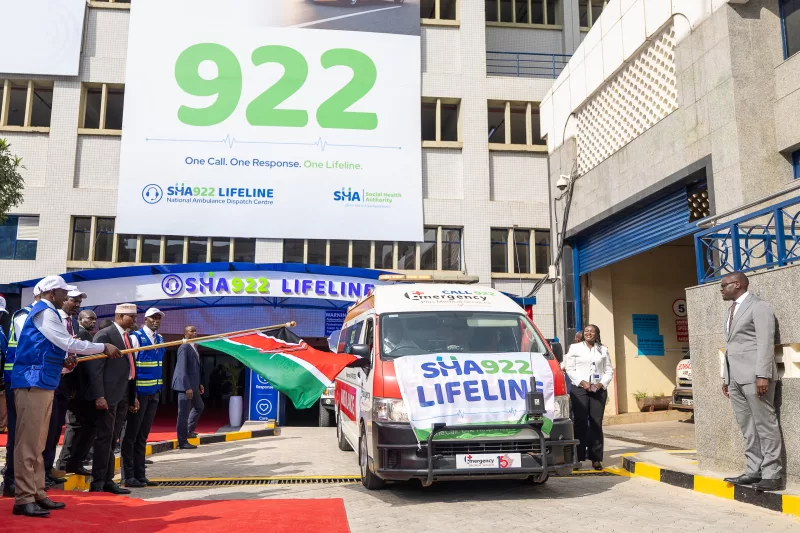
I used to be convinced SHA did not work. I had reason to think so. The transition from NHIF to SHA, Taifa Care, the promises and the confusion around what was actually covered made it feel like another healthcare reform arriving before the system was ready.
But I have to be fair because it has improved and even works to an extent.
The problem is that we have confused health financing with healthcare. A medical scheme can only work within the health system it is sitting in, and Kenya's health system has problems that a medical scheme, by itself, cannot solve.
Think about what being sick in Kenya can actually look like. You go to a public hospital. You have SHA. You expect to see a doctor, get tested, receive your medicine and go home.
Except the test cannot be done because the laboratory has no reagents and the medicine prescribed is not in the pharmacy. You need a catheter, an injection or another basic supply, and you are told to go and buy it.
This isn't theoretical. In May, the Kenya News Agency reported patients in Tinderet being prescribed medicines and sent to private chemists because public facilities did not have them. In August, the Nation reported shortages affecting essential supplies, including antibiotics and dialysis supplies. An Auditor General finding also showed that Kemsa supplied only 41 per cent of medicines and medical supplies ordered by public facilities in the year ending June 2025.
So yes, you are covered, but you still need money. Woe unto you if you need a specialist. A public hospital may technically have one, but that does not mean the specialist is available when you need them. In many facilities, specialists are shared across hospitals or run clinics on particular days. You may be seeing a medical officer most of the time and told to book a specialist clinic weeks in advance.
But what if you are sick today? You pay. You find the Sh3,000 consultation fee at a private hospital because you cannot wait three weeks. And this is where the difference between being insured and actually being able to access healthcare becomes real.
If you have money, you can work around the system. You use SHA where you can then pay for the gaps. You buy the medicine that is unavailable. You pay the consultation fee. You get the test elsewhere. You buy the catheter. You go private when the public system is too slow.
But what happens to the person who cannot? That is where healthcare becomes a question of inequality.
Let’s take the recent story of Mercy Kanini, for instance. She went to Thika Level 5 Hospital and delivered five extremely premature babies, reportedly at about 25 weeks and six days, weighing between 600 and 800 grams. The babies were stabilised at Thika and transferred to Kenyatta National Hospital because they required specialised neonatal care. All five later died.
There have been family allegations about the circumstances of the transfer, including concerns about oxygen support. Those allegations need proper investigation; I would not present them as established fact without evidence.
But even without that, the story forces us to confront something uncomfortable: What happens when the hospital you have gone to cannot provide the care you need?
SHA cannot create a neonatal ICU. Neither can it put a ventilator in a hospital. It cannot manufacture medicine or laboratory reagents. It cannot create a specialist where there isn't one. It cannot repair a broken machine or put an ambulance outside a hospital, and it cannot fix a health facility whose infrastructure is collapsing.
I mean, we saw this in Ishiara in April, when reporting and photographs showed a Level IV hospital struggling with deteriorating infrastructure, water damage and shortages of basic equipment.
This is why I have changed my mind about SHA while becoming more concerned about the system around it. You can insure a patient against the cost of treatment, but if the treatment is unavailable, the insurance can only do so much.
What good is cover if the test cannot be done or the medicine isn't there? These are not arguments against SHA. They are arguments for understanding what SHA can and cannot do.
Kenya needs the financing mechanism. But it also needs the healthcare system under it to function: medicines, reagents, equipment, specialists, nurses, oxygen, ambulances, laboratories, functioning referral systems and hospitals that are safe and properly equipped.
Because a person with money can often buy their way around a weak system. They can go private. Pay the consultation. Buy the medicine. Get the test elsewhere. But the person without money cannot, and in emergency care, you might die altogether.
So perhaps the question should no longer be simply whether SHA works. It should be whether the health system actually has what it needs to treat patients.
Because I don't just want to be covered. I want there to be healthcare to access when I need to use that cover.