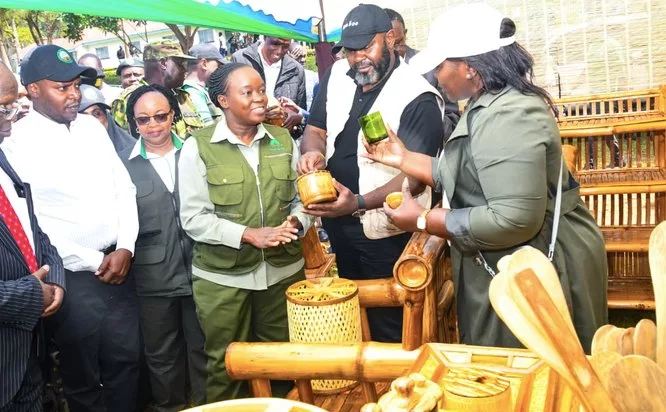
 Forest Development Secretary George Tarus, Kenya Forestry Research Institute CEO Dr Jane Njuguna, Environment CS Dr Deborah Barasa samples products made out of bamboo /handout
For generations, bamboo has stood quietly in Kenya’s forests, protecting water catchments and riverbanks while providing communities with material for everyday use.
Now, the government wants to move the plant far beyond the forest edge and transform it into a major driver of the country’s green economy, climate resilience, environmental restoration and industrial transformation.
The state is pushing for the wider adoption of bamboo farming, with a target of establishing 370,658 acres under cultivation.
Kenya has 329,324 acres of indigenous bamboo forest, located primarily in the Aberdare Ranges, Mount Kenya, Mount Elgon, the Mau Forests Complex and the Cherangany Hills.
The largest bamboo cover is in the Aberdare Ranges, with 123,646 acres, followed by Mount Kenya with 64,163 acres.
Environment CS Deborah Barasa says the government is determined to unlock the full economic value of bamboo by connecting farmers, manufacturers, researchers and investors.
“The focus is on strengthening collaboration between government, research institutions, farmers, private investors, development partners and communities; promoting technology and innovation; expanding bamboo cultivation; increasing value addition; creating markets; and attracting investment,” Barasa said.
She said bamboo connects restoration with enterprise, farmers with manufacturers, research with markets and environmental stewardship with economic opportunity.
The global bamboo industry is estimated to be worth $72 billion (Sh9.32 trillion) and supports the livelihoods of 1.5 billion people, with more than 10,000 documented uses.
Kenya has been positioning itself to tap into this lucrative market.
In 2019, the government gazetted bamboo as Kenya’s 16th scheduled cash crop, a move aimed at laying the foundation for its commercial development.
Last year, the Ministry of Environment launched the Kenya National Bamboo Development Strategy and Action Plan 2025–35, a 10-year framework for developing the sector.
The strategy is backed by a Sh17 billion roadmap intended to move bamboo from the forest edge to the factory floor.
According to Barasa, bamboo sits at the intersection of several national challenges, including pressure on natural forests, a housing deficit of more than two million units, rising construction costs, and a building sector that consumes more than 2.4 million tonnes of steel each year.
Unlike hardwood, which can take decades to mature, bamboo reaches maturity in three to five years and regenerates naturally after harvesting.
Studies cited by the ministry show bamboo can replace a sizeable share of steel in construction at a fraction of the cost.
For the government, these characteristics offer an opportunity to address environmental and economic pressures simultaneously.
The Kenya Forest Service (KFS) notes that bamboo also plays a critical role in protecting water catchments, restoring riverbanks and rehabilitating degraded land.
KFS chief conservator Alex Lemarkoko said the plant can supply raw materials for several industries, including construction, furniture, energy, textiles and handicrafts.
“The government is encouraging investors to put money into processing and manufacturing, rather than trading raw bamboo, so that more jobs and value remain in Kenya,” Lemarkoko said.
The country has also introduced more than 40 exotic bamboo species through the Kenya Forestry Research Institute (Kefri), with at least 12 reported to be performing well across different ecological zones.
The government’s ambition is now to transition bamboo from being viewed merely as a forest resource to becoming a commercially viable cash crop supporting farmers, manufacturers, and the broader industrial economy.