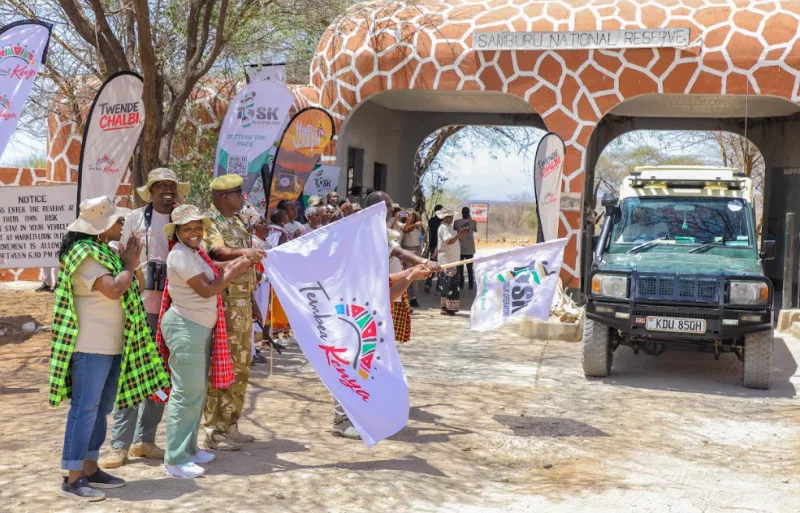
 KTB CEO June Chepkemei (in red Maasai shuka) flags off the Hapa Ni Wapi Sales Conversion Campaign at the Samburu National Reserve. Initiative aims to drive up domestic tourism /HANDOUT
Kenya Tourism Board is targeting 5.6 million domestic tourism bed nights as it steps up efforts to drive more Kenyans to lesser-known destinations and boost travel during low and shoulder seasons.
The target represents an increase from 5.15 million domestic accommodation bed-nights recorded in the 2025-26 financial year, according to the Ministry of Tourism and Wildlife, which was up 2.6 per cent from 5.02 million recorded the previous year.
KTB chief executive June Chepkemei said the board is seeking to convert growing interest in local travel into actual bookings through stronger partnerships with tour operators, county governments and other players in the tourism industry.
The strategy is being implemented through the “Hapa Ni Wapi Sales Conversion Campaign”, which seeks to move domestic tourism marketing beyond awareness creation towards the development of affordable, structured and ready-to-book travel packages.
“This campaign marks a shift in how we approach domestic tourism marketing. Rather than simply raising awareness, we are building direct pathways from interest to booking, working closely with trade partners to package our regions affordably and deliver steady, measurable growth in bed nights nationwide,” said Chepkemei.
The campaign was launched in Samburu on Tuesday, with the northern Kenya circuit selected as the first destination for the initiative.
KTB plans to use the region as a launchpad for promoting destinations that have traditionally attracted fewer domestic tourists, before expanding the campaign to other parts of the country.
The Chalbi Desert and wider northern Kenya circuit will form the first leg of the activation, showcasing the region's landscapes, cultural attractions and tourism experiences.
The campaign will later move to Mambrui-Malindi, Western Kenya and other circuits as KTB seeks to spread domestic travel beyond the country's traditional coastal and safari destinations.
More than 50 tour operators from the Tour Operators Society of Kenya (TOSK) and Kenya Association of Tour Operators (KATO) are participating in the inaugural activation.
Chepkemei said the board expects the partnerships to help address some of the barriers that have limited domestic tourism, particularly affordability, accessibility and limited information about destinations outside the established tourism circuits.
The board is also banking on improved infrastructure to unlock tourism potential in northern Kenya.
Chepkemei said improved road access would make destinations that were previously considered difficult to reach more accessible to domestic travellers.
The focus on bed-nights reflects the industry's interest in increasing not only the number of people travelling but also the duration of their stays, which directly supports hotels, camps, restaurants, transport operators and other businesses along the tourism value chain.
TOSK chairperson Raymond Cheruiyot said the private sector was ready to work with KTB to turn domestic demand into actual business.
“Our members have long known that Kenyans want to travel locally, but pricing and access have often stood in the way. This campaign gives us a clear structure to package the north affordably and sell it directly, and we are ready to deliver on that promise,” said Cheruiyot.
KTB said the approach will provide a model that can be replicated across other regional circuits, helping tourism businesses develop affordable packages while encouraging Kenyans to explore more destinations throughout the year.