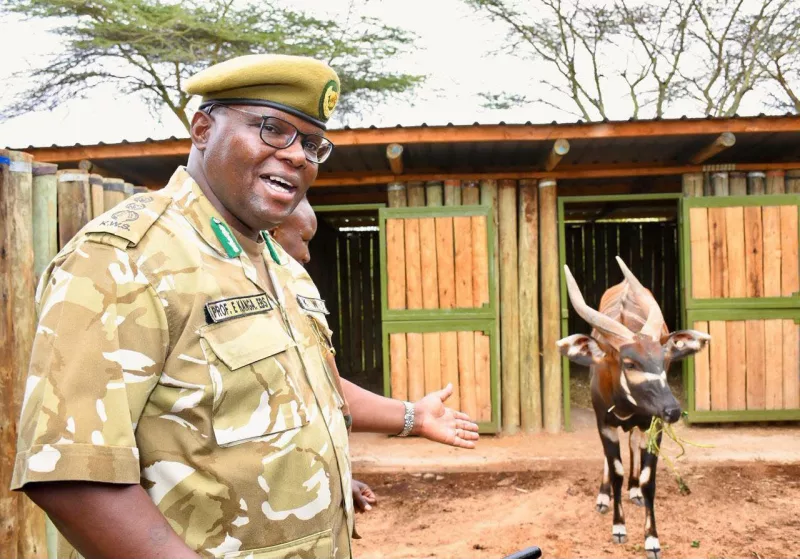
 KWS Director-General Prof Erustus Kanga gestures near a Mountain Bongo/HANDOUT
Kenya has launched a new five-year national strategy to rescue the critically endangered Mountain Bongos from the brink of extinction, setting an ambitious target to rebuild wild populations of the rare forest antelope.
The second edition of the National Recovery and Action Plan for the Mountain Bongo (Tragelaphus eurycerus isaaci) 2026–2030 seeks to accelerate population recovery through habitat protection, scientific breeding, reintroduction and stronger collaboration between government agencies, conservation organisations, researchers and local communities.
The plan was launched at the Mount Kenya Wildlife Conservancy in a joint event involving the Kenyan Government, key mountain bongo conservation stakeholders and the International Union for Conservation of Nature Species Survival Commission (IUCN SSC) Committee, which is meeting in Africa for the first time.
The launch was seen as a significant recognition of Kenya's role in efforts to conserve some of the world's most threatened wildlife species.
Led by the Kenya Wildlife Service through the National Bongo Taskforce, the plan provides a long-term framework for managing existing mountain bongo populations in the Aberdares National Park and Maasai Mau while expanding recovery efforts to other parts of the species' historic range.
These include Mount Kenya, Eburu Forest and other suitable montane habitats where conditions can support the return of the species.
The mountain bongo is found only in Kenya and is among the country's most threatened large mammals.
Fewer than 65 are estimated to remain in the wild, placing the species in the Critically Endangered category on the IUCN Red List.
Its dramatic decline has been linked to decades of hunting and poaching, loss and degradation of habitat, disease, and the fragmentation of Kenya's montane forests.
Conservationists say the fragmentation of forests has isolated remaining populations, making it harder for the animals to breed and maintain viable populations in the wild.
The new plan seeks to move conservation efforts beyond protecting the few animals that remain and towards rebuilding populations capable of surviving independently in their natural habitats.
Kenya Wildlife Service (KWS) Director-General Prof Erustus Kanga described the strategy as a turning point in efforts to rescue the mountain bongo.
“This plan represents a turning point in Kenya’s efforts to bring the mountain bongo back from the brink of extinction,” Kanga said.
He said the strategy was the product of years of scientific research, planning, and collaboration involving government, communities, and conservation partners in Kenya and internationally.
“A recovery plan is not just successful because it is well written. It is successful when it is implemented,” Kanga said.
He said the immediate priorities were to protect the remaining animals, restore degraded habitats, reconnect isolated populations, strengthen breeding programmes and undertake responsible reintroductions.
“Our task is clear; protect what remains, restore what has been lost, reconnect what has become isolated, strengthen breeding and reintroduce responsibly,” he said.
The strategy marks a shift towards a long-term approach to species recovery, with conservationists seeking to establish viable populations in several suitable habitats rather than concentrating recovery efforts in a small number of locations.
Captive breeding and carefully managed reintroduction will form an important part of the strategy. Animals bred under conservation programmes can potentially be returned to suitable habitats once conditions are considered safe and sustainable.
The approach will also require continued protection of forests and improved management of landscapes where mountain bongos historically occurred.
The plan sets an ambitious long-term goal of establishing self-sustaining mountain bongo populations across Kenya, with a target of reaching 750 individuals by 2075.
Kanga said conservation could not succeed without the involvement of communities living around Kenya's montane forests.
“Our long-term goal is to establish self-sustaining mountain bongo populations across the country, reaching 750 individuals by 2075, while maintaining ecological integrity and supporting the livelihoods of communities living alongside these ecosystems,” he said.
The recovery plan also places science at the centre of efforts to rebuild the species, with research expected to guide breeding, habitat restoration, population monitoring and decisions on where animals can safely be reintroduced.