
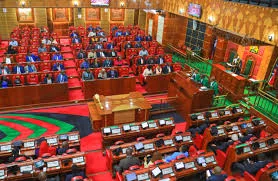
 MPs in session at Parliament Buildings
Budget experts who advise MPs on economic matters have sounded the alarm over the poll agency’s cash woes as the clock ticks towards next year's General Election.
The Parliamentary Budget Office (PBO) says the Independent Electoral and Boundaries Commission's (IEBC) may not adequately prepare for the upcoming elections under the current circumstances, particularly in acquiring electoral technology.
The commission faces a Sh4.7 billion funding shortfall for electoral technology, threatening the acquisition of KIEMS kits and other critical preparations.
IEBC required Sh9.4 billion for information and communication technology in the 2026/27 financial year but was allocated only Sh4.7 billion, leaving a 50 per cent funding gap.
“The shortfall will adversely impact ICT interventions, with the most significant effect relating to the acquisition and replacement of KIEMS kits, which are integral to voter identification, voter verification and results transmission,” the PBO says in its latest Budget Watch report.
The warning comes at a critical phase of IEBC's preparations, with about 11 months left to complete several key tasks before the election.
The commission is expected to undertake continuous voter registration, plan procurement for the 2027 election, purchase poll ICT systems and implement legal reforms between July and December this year.
From January to March 2027, IEBC is expected to audit the voter register, acquire KIEMS kits, upgrade electoral systems and conduct simulation exercises.
The final voter register, voter education and completion of procurement are scheduled for April to June, leaving little room for delays before the election.
Recruitment and training of temporary election officials will follow in July, while printing and distribution of ballot papers are scheduled for August.
The technology funding gap is part of a wider Sh23.7 billion shortfall facing IEBC in the current financial year.
The commission required Sh48.7 billion for election preparations but was allocated Sh25 billion, representing only 51 per cent of its requirement.
The Martin Masinde-led PBO says the deficit affects almost every major area of election preparedness.
Voter registration and electoral operations received Sh12.8 billion against a requirement of Sh18.4 billion, while general administration, planning and support services received Sh5.5 billion against a requirement of Sh15.1 billion.
Voter education received the lowest allocation relative to its needs, with Sh1.8 billion allocated against a requirement of Sh5.6 billion.
Only the Sh100 million required for the delimitation of electoral boundaries was fully funded.
The technology shortfall comes as IEBC seeks to expand and clean up the voter register ahead of the election.
The commission projects the register will grow from the current 22.1 million voters to about 28.5 million by 2027, an increase of 6.4 million voters.
IEBC is also expanding voter registration for Kenyans living abroad from 12 to 26 countries.
By August 2026, the commission had registered 2.9 million eligible voters, representing 45 per cent of its projected target.
The PBO says voter registration, verification and auditing of the register are expected to continue until 60 days before the General Election.
The commission is also dealing with a Sh5.6 billion backlog in pending bills, largely arising from legal fees and election logistics.
The budget office says the outstanding obligations could constrain IEBC's finances and slow the implementation of election preparations.
“These outstanding obligations may constrain the commission's fiscal space and adversely affect the timely implementation of election preparedness activities if not adequately addressed,” the report says.
The problem is not limited to technology. The PBO says IEBC required Sh15.1 billion for general administration, planning and support services but received only Sh5.5 billion.
The funds cover training and remuneration of polling officials, transport and logistics, election planning and operations and legal fees.
The PBO says the allocation may not be adequate and that budgetary shortfalls are already evident across critical areas.
The experts also called for timely electoral reforms, saying legislation must be concluded early enough to give the commission time to implement the changes before the election.
“Timely enactment of electoral reforms is critical in providing certainty to stakeholders, facilitating effective planning and implementation, and minimising the risk of litigation and operational disruptions during the electoral cycle,” the report says.
The office wants outstanding legislative and regulatory changes finalised before the end of the 2026/27 financial year.
The PBO says Parliament must address the financial bottlenecks while monitoring whether IEBC sticks to its implementation timetable.
“While significant progress has been made towards preparations for the election through enhanced allocations, strategic planning and institutional interventions, considerable financing gaps remain in voter registration, election operations and electoral technology,” it says.
The report recommends that Parliament ensure the funding gaps are addressed alongside timely electoral reforms.






