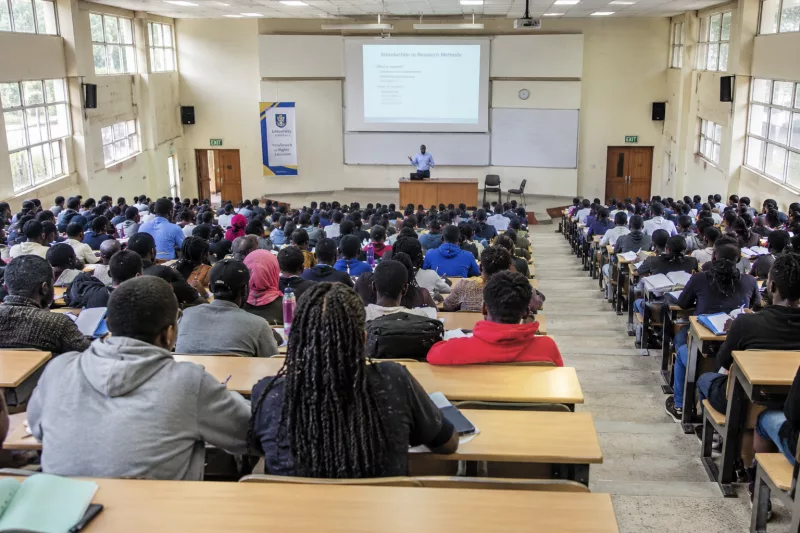
 Public university constituent colleges recorded an even higher student-lecturer ratio from 70:1 in 2024 to 77:1 in 2025. /AI ILLUSTRATION
Lecturers in Kenya's public universities are facing growing pressure as student numbers continue to rise faster than staffing capacity, the University Statistics Report 2025 shows.
The report by the Commission for University Education (CUE) shows that university enrolment rose by 12.5 per cent from 628,541 students in 2024 to 707,150 in 2025, while academic staff increased by 6.8 per cent from 15,383 to 16,434 over the same period.
The report notes that constituent colleges recorded the highest student-to-academic staff ratio in 2025, followed by public chartered universities where the student-to-academic staff ratio deteriorated significantly during the year.
In public chartered universities, the ratio increased from 44.36 students per academic staff member in 2024 to 51.12 in 2025, a 15.2 per cent rise.
Public university constituent colleges recorded an even higher ratio, rising from 70:1 to 77:1 during the period. CUE said this represented a 9.7 per cent increase.
CUE warned that the widening gap could translate to unsustainable marking and supervision, as well as diminished faculty availability for student mentoring, which could potentially affect educational quality.
"Crucially, such high ratios constrain the time available for faculty research and professional development, potentially undermining long-term institutional competitiveness," the commission said.
By contrast, private chartered universities recorded an improvement, with their ratio falling from 34:1 to 29:1.
"However, extremely low ratios do not automatically equate to superior quality; they may also signal constrained access, under-utilised capacity, or niche programme diversity typical of early-stage institutional growth," CUE said.
The staffing changes reveal a shift in the composition of academic staff. While the overall number increased by 1,051, the number of lecturers actually fell slightly from 6,627 in 2024 to 6,606 in 2025.
Tutorial Fellows also declined from 3,117 to 2,970. The biggest increase was recorded among adjunct academic staff, whose numbers more than doubled from about 757 to 1,607, accounting for much of the net growth in academic staffing.
CUE says the growing reliance on adjunct staff may help universities meet immediate teaching demands but raises questions about teaching continuity, student mentorship, curriculum development and participation in research and institutional activities.
The report also points to a contraction in the core academic pipeline, noting that a decline in lecturers and Tutorial Fellows could affect long-term capacity building, succession planning and academic career progression.
Meanwhile, senior academic ranks expanded. Associate Professors increased from 919 to 1,093, Professors from 551 to 631, while Senior Lecturers rose from 2,144 to 2,278.
However, the report notes that this growth was slower than the expansion in adjunct staffing.
The pressure on teaching capacity comes against continued growth in student numbers.
Enrolment across Years 1 to 5 rose from 625,404 in 2024 to 702,684 in 2025, an increase of 77,280 students or 12.4 per cent.
CUE warns that continued expansion without corresponding growth in academic staffing and facilities could undermine teaching and learning quality, particularly in large public universities.
The report recommends aligning enrolment growth with staffing, infrastructure and student-support plans to ensure the expansion of university education remains sustainable.
As of 2025, the number of universities and university institutions licensed to operate in Kenya increased from 79 in 2024 to 83.
The growth was largely attributed to the increase in the number of Chartered Private Universities and Public University Constituent Colleges.
"The data has revealed that generally, Kenya’s higher education system is becoming larger and more inclusive but sustaining quality and relevance will be the central challenge as growth continues," CUE said.