Kenya has formalised a strategic partnership with artificial intelligence company Anthropic to promote responsible AI development, strengthen local expertise and support the use of emerging technologies in national development.
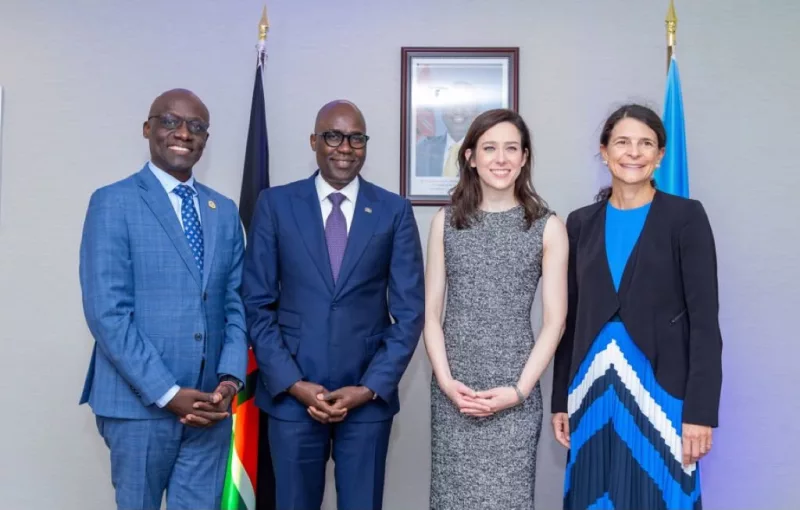
The agreement was concluded by Foreign Affairs Principal Secretary Korir Sing’oei and Elizabeth Kelly from Anthropic’s Beneficial Deployments team following several months of joint development.
The partnership establishes a framework for cooperation in skills development, research, public sector solutions, AI safety and evaluation, education and healthcare.
It seeks to ensure that AI solutions are developed in collaboration with Kenyan institutions, adapted to local needs and deployed in compliance with national laws.
The agreement comes as Kenya intensifies its engagement in global discussions on artificial intelligence, including efforts to strengthen technological independence and ensure that African countries participate in shaping international AI standards.
Under the partnership, Kenya and Anthropic will collaborate on developing and testing AI solutions while strengthening the country’s ability to evaluate and govern advanced technologies.
The initiative is expected to focus on Kenya’s institutional environment, linguistic diversity and development priorities.
Its operating approach involves designing solutions with Kenyan institutions, building domestic technical capacity, piloting effective applications and expanding successful projects within the country’s legal framework.
The agreement was supported by several key contributors, including Sing’oei, Kelly, Kenya’s Special Envoy for Technology Ambassador Philip Thigo, and United States Ambassador Courtney O’Donnell, alongside technical teams from both countries.
The partnership was announced during Kenya’s increased participation in global AI discussions at the 81st United Nations General Assembly in New York.
President William Ruto used the high-level meetings to advocate for technological cooperation that strengthens countries’ ability to determine their own development priorities.
Ruto, who co-chaired the High-Level Artificial Intelligence Middle Powers Coalition alongside Finland’s President Alexander Stubb, promoted the AI Middle Powers Initiative as a platform for cooperation among middle-income countries.
The voluntary initiative seeks to facilitate the sharing of computing resources, data and specialised talent among participating nations.
The President described the concept of “shared sovereignty” as an approach to expanding national agency through collective action.
He also cautioned against a situation where African countries provide the minerals, energy, data, creative content and human capital used to develop AI systems, only to purchase the resulting technologies at high costs.
“We must ensure that Africa is not left behind in the AI revolution,” Ruto said in remarks outlining the importance of technological participation and national capacity.
Kenya is also pursuing the African Development Bank-supported $10 billion AI Initiative, which seeks to attract up to $10 billion in continental investment by 2035.
The government is further implementing the National Artificial Intelligence Strategy 2025 to 2030, which prioritises digital infrastructure, data governance, AI regulation, research, innovation and commercialisation.
The strategy identifies several areas where AI could support national development, including agriculture, healthcare, education, public services, financial inclusion and employment creation.
The government has also placed emphasis on safeguarding children in the age of artificial intelligence.
During the United Nations Assembly, Ruto participated in the Coalition for Children’s Rights and Protection in the Age of AI and endorsed a global declaration and roadmap.
The framework addresses safety by design, protection of children’s data, AI-facilitated abuse and deepfakes, age assurance and AI literacy.
These priorities are expected to inform Kenya’s forthcoming Artificial Intelligence and Emerging Technologies Policy.
Ruto also held discussions with United States Secretary of State Marco Rubio on responsible AI oversight and practical applications in different sectors.
The President has advocated for the United Nations to maintain a central role in developing global AI governance frameworks.
He said international rules should be developed through inclusive participation rather than imposed on countries.
“Such rules must be globally shaped, not globally imposed,” Ruto said.
The partnership with Anthropic forms part of Kenya’s broader efforts to build domestic AI capacity, strengthen technological governance and promote applications that address national development needs.
Through the agreement, Kenya seeks to combine international technological expertise with local institutions, ensuring that AI deployment supports public interests while strengthening the country’s role in global technology discussions.