
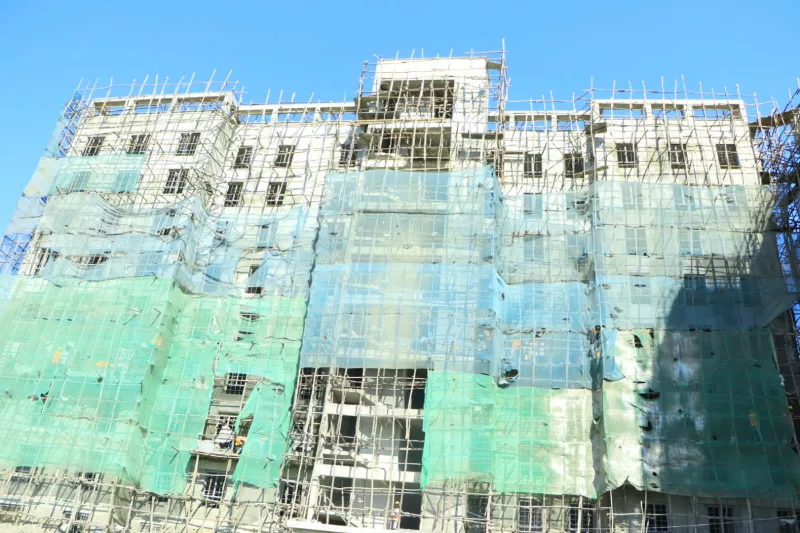
 Kwa-Ngindu affordable housing project that is under construction in Kitui town /FILE
President William Ruto’s flagship affordable housing programme faces a Sh118.3 billion financing gap in the new financial year, with 176 projects already stalled.
In a new report, Parliament’s budget watchdog warns that the project could fail to meet its desired objective if cautionary steps are not taken.
The Parliamentary Budget Office says the housing programme is struggling with financing constraints.
This is even as it emerged that the government has collected only Sh205.7 billion through the affordable housing levy since its inception of the required Sh1.8 trillion budget.
The State Department for Housing and Urban Development is currently overseeing 1,186 projects across four portfolios with a combined estimated cost of Sh1.8 trillion.
Only Sh198 billion had been spent on development by the end of June, leaving projects worth Sh1.56 trillion yet to be financed.
PBO says financial challenges has emerged as one of the key contributors to the slow progress of the programme and the stalling of projects.
“When compared to the total project cost, the overall actual expenditure as at the end of FY 2025-26 is 11 percent,” the PBO says in its 2026 Budget Watch report.
The report shows that affordable housing projects have absorbed 14 per cent of their total cost, while social housing and slum upgrading projects have absorbed 18 per cent.
Institutional and student housing projects have recorded the lowest financial progress at only three per cent, while social and physical infrastructure projects have absorbed 31 per cent of their total cost.
The PBO says the problem may worsen in the 2026-27 financial year with Sh228.3 billion required to finance ongoing projects but only Sh110 billion has been provided.
A Sh118.3 billion funding hole ensues.
“This funding shortfall is likely to expose the AHP to more fiscal and operational challenges since it will be unable to support an uninterrupted implementation path across the entire portfolio,” the PBO warns.
The office says the shortfall could trigger further project stoppages, increase costs through penalties arising from delayed payments to contractors.
These, combined with other factors, are said could push up construction costs as projects take longer to complete.
Ruto’s team is currently implementing 227 affordable housing projects valued at Sh825 billion, 216 social housing and slum upgrading projects costing Sh228 billion, 329 institutional and student housing projects worth Sh634 billion and 414 social and physical infrastructure projects valued at Sh71 billion.
The four portfolios were launched in 2023 and have an expected completion date of 2032.
The programme is financed through the National Housing Development Fund, whose main source of revenue is the affordable housing levy.
By the end of the 2025-26 financial year, 1,010 projects were still ongoing while 176 had stalled.
Of the stalled projects, 16 are affordable housing projects, 22 are social housing and slum upgrading projects, 91 are institutional and student housing projects and 47 are social and physical infrastructure projects.
PBO defines a stalled project as one whose progress has stopped for more than 12 months because of funding shortages, contractor abandonment or bureaucratic delays.
The figures show that the bulk of the stalled projects are in institutional and student housing, where 91 out of 329 projects have stopped.
The affordable housing levy has so far generated Sh205.7 billion, with collections rising from Sh53.4 billion in 2023-24 to Sh73.2 billion in 2024-25 and Sh79.1 billion in 2025-26.
Of the Sh202.8 billion spent from the National Housing Development Fund, Sh4.8 billion went to recurrent expenditure and Sh198 billion to development projects.
Development spending included Sh118 billion on affordable housing, Sh40 billion on social housing and slum upgrading, Sh18 billion on institutional and student housing and Sh22 billion on social and physical infrastructure.
PBO says the cashflow problems stem from a mismatch between the timing of levy collections and project payment obligations.
“The risk of stalling becomes particularly acute since the payment cycles for projects are not concurrent with the annual AHL collection cycle,” the report says.
As such, even where the levy continues to generate revenue, the timing of collections may not match contractual obligations falling due on construction projects.
The budget office is urging the government to change its approach from expanding the project to focusing on completing the existing ones.
“The key policy requirement for FY 2026-27 would be a transition from pipeline expansion towards active portfolio management,” it says.
The PBO wants projects to be sequenced in terms of how much the contracts are exposed, completion status, infrastructure readiness, expected social and economic returns and realistic prospects for take-up.
The team of experts who advise MPs on economy says funding should first go to projects that are close to completion.
The economists say it would be best to have the ready ones converted into occupiable and saleable homes and begin generating revenue for the fund.
Projects still at preliminary stages, including contractor mobilisation, site handover and procurement finalisation, should only proceed after the government establishes it has budget.
PBO is also calling on the National Assembly to ringfence housing levy resources for projects already under contract and approaching practical completion.
It says this would improve cashflow discipline, reduce exposure to contractor claims and speed up the conversion of public expenditure into completed housing.
Parliament should also monitor whether new projects continue receiving money while more advanced projects remain underfunded.
The budget experts want MPs to track the proportion of annual disbursements going to ongoing and near-complete projects.
The team further wants lawmakers to follow up on changes in completion rates and the number of housing units moving from construction to occupation.
The team warns that the financing gap and stalled projects raise concerns whether the housing objective would be realised.
With 176 projects already classified as stalled and only 11 per cent of the total project cost spent by June, the PBO is calling for the government to slow the expansion of the programme and concentrate resources on completing projects already under way.
INSTANT ANALYSIS
For the housing programme, the immediate challenge is therefore not simply raising more money, but deciding how existing resources are deployed across a huge portfolio of projects.






