
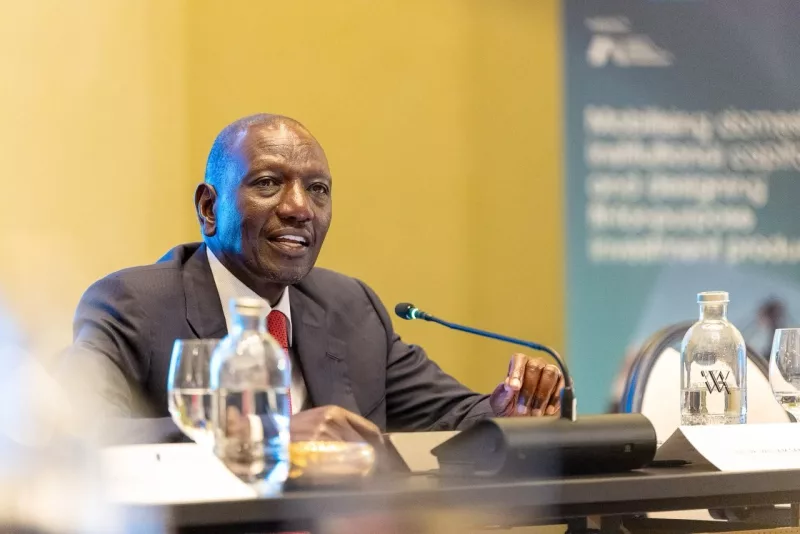
 President William Ruto speaking on the margins of the 81st United Nations General Assembly on September 21, 2026 / PCS
President William Ruto has called for greater African ownership of artificial intelligence.
The head of state warned that countries risk losing meaningful control over their sovereignty if they remain dependent on technologies they do not control.
Speaking in New York on Monday, September 21, 2026, during a high-level meeting of the AI Middle Powers (AIM) Coalition on the margins of the 81st United Nations General Assembly, Ruto said technological dependence could undermine political sovereignty.
“Our territory, our laws and our institutions remain ours. Yet more of the decisions shaping our economies, security and societies will depend on computing power we do not own, models we did not train, chips we cannot readily obtain, data systems we may not control, and standards we did not help write. Political sovereignty without technological agency risks becoming sovereignty in law but dependency in practice,” Ruto said.
The President said artificial intelligence was transforming not only production but also the distribution of capability, opportunity and power.
He said countries needed the capacity to choose, negotiate, adapt and, where necessary, replace critical systems on which their economies and societies depend.
Ruto said this was particularly important for middle powers, which have talent, resources, markets and diplomatic influence but cannot independently control the entire AI value chain.
“No nation can efficiently secure every critical mineral, fabricate every advanced chip, build every data centre, train every frontier model, and determine every global standard,” he said.
He proposed shared sovereignty as a way for countries to pool capabilities in areas where scale is necessary while retaining national control where accountability is essential.
“Shared sovereignty is not sovereignty surrendered. It is agency enlarged through organised cooperation. For Africa, this question carries the weight of history,” Ruto said.
Ruto warned that Africa must avoid reproducing its traditional extractive economic model in the digital economy.
He called for the continent to move from consuming AI technologies to developing and owning them.
“Africa cannot provide the minerals, energy, data, content, and talent of the AI revolution, only to import the resulting intelligence at a premium. Africa must move from consumption to creation, from mine to model; from adoption to ownership, and from being a subject of global rules to being a co-author of them,” Ruto said.
The President noted that African researchers, developers, writers, teachers, health workers and entrepreneurs were already contributing knowledge, data and talent to the global digital ecosystem.
However, he said African languages, contexts and institutions remained under-represented in many AI systems increasingly used in education, healthcare, commerce and public discourse.
“A model that cannot understand millions of people in their own language cannot claim to be truly global,” Ruto said.
He said Kenya's National Artificial Intelligence Strategy focuses on three areas: digital infrastructure; data and AI governance; and research, innovation and commercialisation.
Ruto said Kenya's goal was to use AI to increase agricultural productivity, strengthen healthcare, expand access to education, improve public services, advance financial inclusion and create enterprises and jobs.
Ruto said countries with abundant renewable energy should take advantage of the growing demand for AI computing infrastructure.
He argued that countries endowed with renewable energy should not remain consumers of AI but should host computing infrastructure, develop enterprises, support research and participate more fully in the value created by the technology.
The President said the AIM initiative would initially focus on mobilising finance, expanding trusted infrastructure and developing the human and institutional capacity needed to build, adapt, evaluate and govern AI.
He said countries should cooperate in areas including computing infrastructure, trusted data ecosystems, research, skills, multilingual models and public-sector capacity.
Ruto also warned that the development of AI must be accompanied by safeguards against its potential harms.
He cited misinformation, deepfakes, cyber threats and harmful AI-generated content as challenges that could undermine public trust and democratic institutions and expose children to new forms of harm.
Ruto called for AI governance to be anchored in human dignity, sovereign equality and international law.
He also said the United Nations should remain central to global discussions on AI, arguing that the rules governing the technology should not be determined by a small group of governments, companies or laboratories.






