
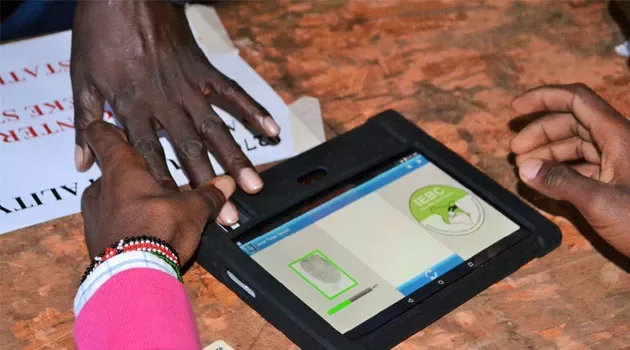
 A Kenyan registering as a voter
Companies seeking to win IEBC’s Sh6.5 billion tender for a new Integrated Elections Management System will have to meet tougher technical requirements.
This is in the wake of the electoral agency rewriting the specifications to comply with the recent ruling of the procurement review board.
The new tender, published on Thursday, introduces stricter demands on biometric equipment, scanning capabilities, system testing and technology ownership.
IEBC is seeking suppliers for the technology to be used in the next general election on grounds the current one is obsolete.
The changes replace the tender issued on August 11 and push the deadline for submission of bids from September 1 to October 2.
Among the biggest changes is the requirement for fingerprint sensors to meet both FBI PIV IQS and India’s STQC certification standards.
The original tender allowed bidders to provide equipment certified by either of the two programmes.
The new requirement means prospective suppliers must demonstrate compliance with both standards, tightening the window for prospective bidders.
In the new tender, electoral agency has also expanded the requirements for scanners that will form part of the biometric kits.
The equipment must be capable of scanning A4 documents, identity cards and passports.
It must also have automatic alignment and double-feed detection capabilities and produce an encrypted PDF from every scanned document.
The revised tender also gives IEBC greater powers to test the technology proposed by the successful bidder before the contract is awarded.
The original document expressly stated that the commission would “not carry out tests” at the post-qualification stage to establish whether the proposed system met the technical requirements.
That provision has now been reversed.
Under the revised tender, the best-evaluated bidder will be subjected to conformity tests, eligibility checks and due diligence before the award is made.
As such, a company that wins the paper-based evaluation will still have to demonstrate that its proposed system can meet the technical requirements before IEBC commits itself to a contract.
The new tender has also tightened requirements for the Online Voter Pre-Registration System.
The system must now cater for QR-code scanning, automatic population of biographic information and secure exchange of data.
The post-warranty support period has also been expressly set at 24 months.
The requirements are among the changes made after the Public Procurement Administrative Review Board found ‘material deficiencies’ in the original tender.
The board thus directed IEBC to correct, clarify and amend the disputed provisions before publishing a new tender, rather than cancelling the procurement.
The procurement dispute arose after Galadirel Investments Limited challenged the tender.
The supplier raised concerns over technical specifications, evaluation criteria and requirements relating to hardware and ownership of technology.
The board found that some of the requirements were not sufficiently clear and objective.
It argued that the situation potentially affected the principles of fairness, transparency, equality and competitiveness in public procurement.
Some requirements have, however, been removed.
The previous requirement for Results Transmission System backend to have ‘user friendly import and export functionality’ is not in the revised document.
IEBC has also corrected an earlier error on performance security.
The original tender had required a performance security of 20 per cent of the contract value in certain circumstances, which the procurement review board found contrary to the law.
The revised tender provides for the statutory 10 per cent ceiling, excluding recurrent costs, with the amount reduced to two per cent during the warranty period.
The changes come as IEBC races against time to procure and deploy the technology ahead of next year’s election, which is barely 11 months away.
The new specifications will therefore determine the type of companies and equipment capable of competing for the contract.
The procurement process has been under intense political scrutiny especially from the opposition side.
Former Deputy President Rigathi Gachagua alleged that the tender was drawn in favour of a South Korean company. He called for the procurement to be withdrawn.
The opposition, and election experts, have also questioned whether the electoral agency has enough time to introduce and test an entirely new election system before the polls.
Their clarion call has been that the existing technology suffices, and should instead be upgraded.
IEBC has denied that the procurement has been predetermined or that a particular company has been selected.
Chairman Erastus Ethekon recently said the tender is open to all qualified suppliers and that no award has been made.
The procurement board also rejected claims that IEBC had unlawfully tailored the tender to a particular supplier.
PPRAB said the commission was entitled to prescribe reasonable experience and technical capacity necessary for the performance of the contract.
The revised tender now gives potential bidders until October 2 to submit their proposals.
The commission says it may require up to 60,000 new devices, depending on the number of registered voters and polling stations.
The commission has projected that the number of registered voters could reach 30 million by 2027, up from more than 22.3 million in the current system.
Each Kiems kit will be linked to the register for a particular polling station through a QR code.
The kit will contain biometric information for voters in its designated area and will be restricted to the relevant polling station.
It will display a voter’s biographical information and voting status and will stop identifying voters once the polling period has closed.
The system will generate audit trails showing voter identification, turnout and the opening and closing of polling stations.
The commission further wants verifiable, read-only logs of voting-day activities and unique digital certificates for each deployed kit.






