
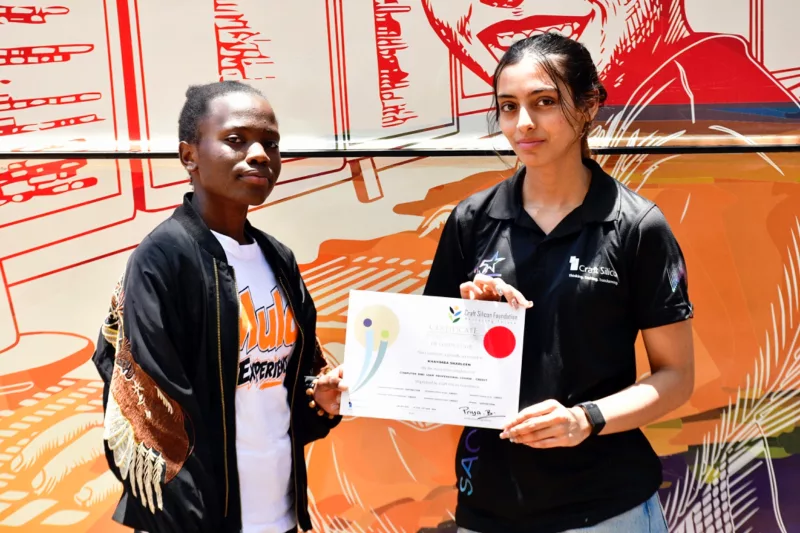
The training covered basic computer skills, Microsoft Office applications, internet and networking, cybersecurity and artificial intelligence fundamentals.
The programme is delivered through a mobile ICT laboratory equipped with computers, internet connectivity and solar power, allowing training to be conducted within the communities.
Speaking during the graduation ceremony, Craft Silicon CEO Priya Budhabhatti said the Foundation was established in 2010 to address barriers that prevent young people from disadvantaged backgrounds from accessing education and technology.
“We wanted to reach students at their doorstep so they don't drop out,” Budhabhatti said.
The Foundation targets young people, particularly women and those from low-income communities, including school leavers and others who may not have been able to pursue college or university education.
Successful learners receive certificates, while those who demonstrate potential are considered for further training. The advanced programme includes software development, website development and other technology-related skills.
The Foundation also follows up with graduates to track employment, entrepreneurship and further training opportunities, and seeks to connect them to employment and business opportunities.
Some former trainees have gone on to work for Craft Silicon and other organisations, while others have taken up training roles.
Griffin Khendi joined the Foundation as a trainee in 2019 before receiving support to pursue an advanced full-stack software development course. He later returned to the Foundation as a trainer.
Khendi now trains learners in Microsoft Office applications, cybersecurity fundamentals and internet networking.
“This programme gives people an opportunity to do something else with their lives,” he said.
The Foundation currently operates its mobile ICT programme in Kangemi, Mathare, Kibera and Korogocho. It also runs programmes in other locations.
The organisation says demand for the programme exceeds its current capacity, with one mobile ICT bus serving communities during the week.
Budhabhatti said additional partners and resources would enable the Foundation to acquire more mobile laboratories and reach more learners.
“With more buses, you can imagine how many more students we would educate,” she said, noting that the Foundation has a waiting list of young people seeking to join the programme.
The Foundation is also developing partnerships to help graduates transition from training into employment and freelancing opportunities, including collaboration with Ajira Kenya.
Other partners supporting the programme include Microsoft, Java House and Alpine, which provide certification, food and water support respectively.
The Foundation is expanding its curriculum to include artificial intelligence and software development as demand for technology skills grows.
Simran Budhabhatti, Gen Z AI Consultant at Craft Silicon Group, said the long-term ambition is to expand the programme beyond Nairobi and eventually reach communities across Kenya.
“We want to bridge the digital divide and ensure that young people in the slums and villages are able to compete with the rest of the world,” she said.






