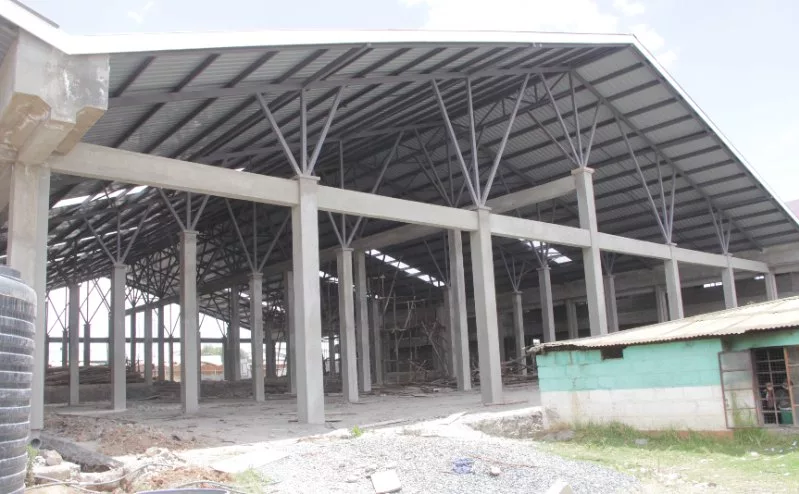
 The Sh360 million Nanyuki market is nearing completion and is set to provide traders with a conducive working area /ALICE WAITHERA
Nanyuki traders in Laikipia are set to move into a Sh360 million modern market expected to transform the town’s commercial landscape and improve their working environment.
The facility, which is 95 per cent complete, is expected to be ready by December and will accommodate more than 1,000 traders once operational.
The market, constructed by the national government, will replace the dilapidated makeshift structures where traders have operated for years, providing them with a cleaner and more dignified environment.
It will have 720 stalls, 20 shops and a range of social amenities, including a lactation room, crèche, ICT hub, first aid room, kitchen, meeting rooms, sanitation facilities and secure storage areas with cold rooms.
Nanyuki Market Traders chairman Simon Mwangi welcomed the project, describing it as a major milestone for the town. He said traders were looking forward to moving into the modern facility.
“The project is good for Laikipia. We have not seen another project like this since independence. This is the first and we are proud to have a modern market,” Mwangi said.
He said the facility would also address some of the challenges traders had faced, including unreliable water and electricity supply, noting the market would have a borehole, electricity and solar panels.
Mwangi urged traders to cooperate during the allocation of stalls, saying those who had been relocated to pave way for construction should be prioritised when the facility is ready.
He commended the contractor for maintaining steady progress since the project was launched in March 2024, saying construction had continued without major interruptions.
Trader Agnes Maina said they had closely followed the project from its inception and were pleased it was nearing completion.
“We are very happy because this is a modern market that has been built for us. We thank the government and the contractor because we have worked together from the beginning to ensure the project moves forward,” Maina said.
She said traders were confident the allocation of stalls would be conducted fairly by the county government and market management committee, allowing beneficiaries to resume their businesses in an organised environment.
The project is also expected to improve trading conditions for women and young people, who form a significant proportion of the informal trading sector in Nanyuki.
Beyond providing space for businesses, the market is designed to improve sanitation, drainage, security and access to essential services, while creating a more efficient link between farmers, producers and consumers.
Site foreman Isaac Mahinda said the construction had created employment opportunities for residents, with workers benefiting from jobs throughout the project.
“Since we started, this project has had many benefits for the community. People have got jobs and their lives have improved, and that is why we appreciate the government for initiating it,” he said.
Mahinda said the first section would accommodate hundreds of traders, with the entire market expected to serve significantly more businesses once all sections are completed.
The project has generated opportunities for masons, artisans, suppliers, transporters and other workers involved in construction, while traders expect further employment opportunities once the market becomes fully operational.
The modern facility is part of the government's broader efforts to improve infrastructure for small businesses under the Bottom-Up Economic Transformation Agenda (BETA).
The project is among several modern markets being developed by the national government in Laikipia county, with the ongoing Sh260 million Rumuruti Modern market expected to accommodate more than 750 traders.
Instant analysis
The Sh360 million Nanyuki market marks a vital BETA infrastructure milestone, shifting over 1,000 traders from makeshift structures into a modern commercial hub by December. Beyond solving water, power, and sanitation deficits, the project boosts Laikipia’s local economy, though equitable stall allocation remains critical for relocated small-scale vendors.