
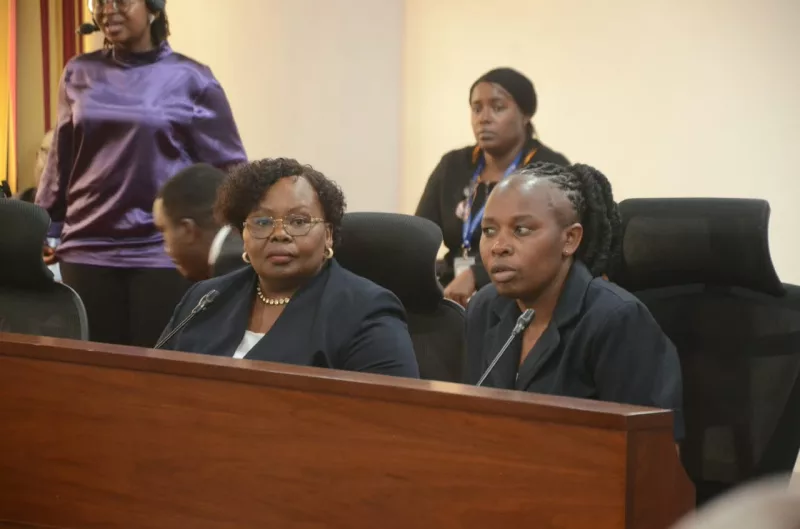
 Limuru Girls principal Susan Kariuki before the National Assembly Public
Investments Committee on Governance and Education to examine the
Auditor General’s reports at Bunge Towers yesterday /DOUGLAS OKIDDY
This is even as MPs agreed with the Auditor General's conclusion the payments to the Kenya Secondary School Heads Association (Kessha) have no legal basis.
The National Assembly Public Investments Committee on Governance and Education yesterday questioned a number of principals over millions of shillings sent to the association.
The House team warned that public money cannot be channelled to a private members’ organisation without a clear legal framework and accountability.
The committee, chaired by Luanda MP Dick Maungu, were reviewing the payments which have repeatedly featured in Auditor General Nancy Gathungu’s reports covering national schools.
The auditor general has questioned the payments, with recent audit findings putting the spotlight on annual transfers running into millions of shillings.
Maungu said one school examined by the committee had paid about Sh6 million to Kessha, while another had remitted about Sh5 million.
“If you convert them into all the schools in the country, there are billions going to Kessha, and we want to find out whether Kessha is a recipient of public money,” Maungu said.
He questioned why schools should send public funds to an organisation that is not a government entity and whose operations are not subjected to the same scrutiny as public institutions.
The issue was brought into sharp focus when Loreto High School Limuru chief principal Lenah Ngesa appeared before the committee yesterday.
Ngesa said the subscriptions were made to facilitate joint co-curricular activities, including sports, music and drama, and to enable students to participate in competitions organised through the association.
“There is no law, what guided is the love of our work of teaching and developing talent. It is to help enhance talent. We wish that we get a way forward that protects the principle behind this,” Ngesa said.
Alliance Girls principal Margaret Njeru said there would be a problem if schools cut funding to the association, citing fears of unrest in case co-curricular activities are affected.
But Central Imenti MP Moses Kirema questioned whether principals had received any formal authority from the Ministry of Education to transfer public funds to Kessha.
“Was there a letter from the ministry to allow you send money to an amorphous institution? Does it get audited? It gets millions,” Kirema asked.
Maungu told the principals that good intentions could not substitute for a legal authority to spend public money.
“The only thing you said is that you did out of love and apply the same love to withdraw the funding since there is no circular that gave you permission to subscribe to Kessha,” he said.
The committee said Kessha should instead lobby Parliament to enact legislation giving it a clear legal foundation if its activities are to continue being financed through public schools.
“Until a law is in place, the deductions are illegal and must be rerouted to school accounts,” Maungu said.
Gathungu has in her reports classified the payments as irregular, arguing that Kessha is essentially a welfare association for school heads.
She held that subscriptions should be paid by individual principals rather than from public school funds.
Kessha has defended the contributions as members’ subscriptions used to finance the association’s activities.
Even so, the audit queries have raised questions over whether schools can lawfully use taxpayer-funded resources for that purpose.
Ngesa said principals would welcome a permanent solution to the dispute.
“We would be happy as head teachers to get the ultimate solution to the challenge with Kessha subscriptions,” she said.
Maseno School principal Peter Owino Otieno similarly told MPs his school made the payments in good faith to facilitate students’ participation in co-curricular and extracurricular activities.
“Without paying them, the institution’s students are completely locked out and disallowed from participating in sports, drama, music or other regional and national talent competitions,” Owino said.
He, however, acknowledged the payment mechanism required policy intervention.
“The permanent regularisation of this payment channel requires policy intervention from higher authorities,” he said.
This raised another question before the committee of why schools cannot simply budget directly for co-curricular activities instead of transferring money to an association.
Lungalunga MP Chiforomodo Mangale said Parliament needed to first establish the legal status of Kessha and its relationship with public schools.
MPs said ministry officials and Kessha leaders would be invited to the committee to shed light on the same.
Kiminini MP Maurice Kakai Bisau described Kessha as a private members’ organisation whose membership is drawn from school heads.
“Kessha remains a private club, a private organisation managed by principals in the teaching fraternity. In the absence of it being formalised, we still look at it as a private members’ organisation,” Bisau said.
The committee said it would summon Kessha officials to explain how the money received from public schools is used and the legal framework under which the association operates.
The committee was examining Auditor-General reports covering the 2020-21 to 2024-25 financial years for national schools in Nyanza and Western regions.
Principals of Ng’iya Girls', Maseno, Bunyore Girls', Chavakali Boys', Maranda and Kisumu Girls' appeared before the committee, with Kessha payments among the audit queries raised.
Principals of Alliance High School, Kiambu High School and Mang’u High School have also faced scrutiny over audit queries, including Kessha subscriptions.
The committee also raised concerns over financial management systems in some schools, including slow adoption of Public Sector Accounting Standards.
Maungu said school managers and bursars needed training to comply with public financial management requirements.
“Some of these schools are not shifting to Public Sector Accounting Standards. We need to know why, and they need to be empowered so that they can be able to do the right thing,” he said.
Despite the concerns, Maungu said the committee was impressed by the general performance of the schools and the work of their management teams.
INSTANT ANALYSIS
The Kessha funding dispute exposes a wider accountability problem in public schools, where good intentions have been used to justify spending without clear legal authority. While principals argue the payments support students’ participation in national competitions, MPs and auditors are demanding proper safeguards. The standoff now places pressure on the Education Ministry and Kessha to establish a lawful, transparent funding mechanism.






