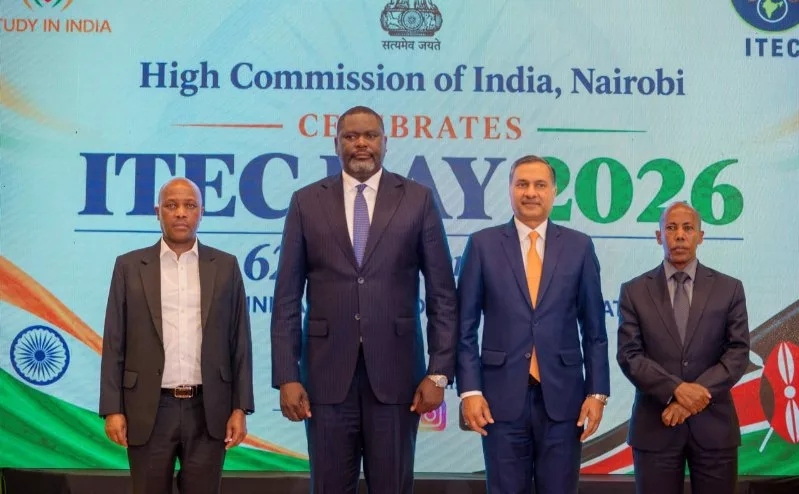
 Cabinet Secretary for Public Service, Human Capital Development and Special Programmes, Geoffrey Ruku (2nd from left) and other leaders during ITEC Day celebrations in Nairobi/HANDOUT
A scholarship is easy to count. Its real value is harder to measure, because that value only shows up later, when the student comes home and puts the training to use. That question matters more than the headline number of Kenyans heading to India this year.
For 2026 to 2027, India has offered Kenya 100 scholarships under the India-Africa Maitri Scholarship Scheme, plus three Quad STEM scholarships.
The students will pursue undergraduate, master's and PhD programmes in fields ranging from engineering and agriculture to artificial intelligence, cybersecurity, data science and health sciences.
It is tempting to treat this simply as another scholarship programme, but that would miss the bigger story.
Education and technical training have quietly become one of the most durable foundations of Kenya-India relations. They attract less attention than trade, infrastructure and investment, but their effects can last considerably longer, because they are carried by people rather than by contracts or capital.
At the recent ITEC Day celebrations in Nairobi, India's High Commissioner Dr. Adarsh Swaika noted that the Indian Technical and Economic Cooperation programme, launched in 1964, has trained more than 200,000 officials from more than 160 countries.
Over the past decade alone, more than 3,000 Kenyan professionals have benefited from it.
Kenya's Cabinet Secretary for Public Service, Human Capital Development and Special Programmes, Geoffrey Ruku, put the point even more sharply.
The value of ITEC lies not in the training received in India, but in what happens afterwards - the knowledge brought home, the institutions strengthened, the innovations introduced and the services improved.
A certificate is not development. A degree is not development. Training becomes development only when knowledge is applied to solve real problems, and there are encouraging signs that the relationship is moving in that direction.
ITEC cooperation increasingly involves customised programmes built around specific Kenyan institutional needs rather than generic courses. Recent examples include training for Kenya Revenue Authority officials on taxation, forensic training for investigators and prosecutors, and remote sensing and GIS training for the Kenya Space Agency.
Twenty-five senior Kenyan civil servants have also recently undertaken a Smart Governance programme in India. This is a more useful model that links training directly to an institutional need.
Kenya has developed substantial experience in mobile money, digital finance, entrepreneurship and technology-enabled services.
India has built large-scale capabilities in digital public infrastructure, technical education and technology deployment. There is real scope for both countries to teach and learn from each other, which calls for greater joint research, institutional partnerships, innovation and technology transfer.
This matters as both economies confront a rapidly changing technological landscape. Kenya wants deeper cooperation with India in artificial intelligence, cybersecurity, digital public infrastructure, digital skills and e-government, and the latest scholarships are already aligned with several of these priorities.
A Kenyan engineer trained in India could become a link between universities, researchers and industry. A data scientist could contribute to digital public services.
A health researcher could strengthen local research capacity. A doctoral graduate could return as someone capable of training the next generation. That is the multiplier effect.
India's High Commissioner referred to India's proposed G20 Africa Skills Multiplier Initiative, which seeks to train one million trainers across Africa over a decade. The principle is to train people who can train many others.
For Kenya, that idea deserves serious
attention, because the country does not only need more qualified people, it
needs institutions capable of producing, retaining and applying specialised
knowledge.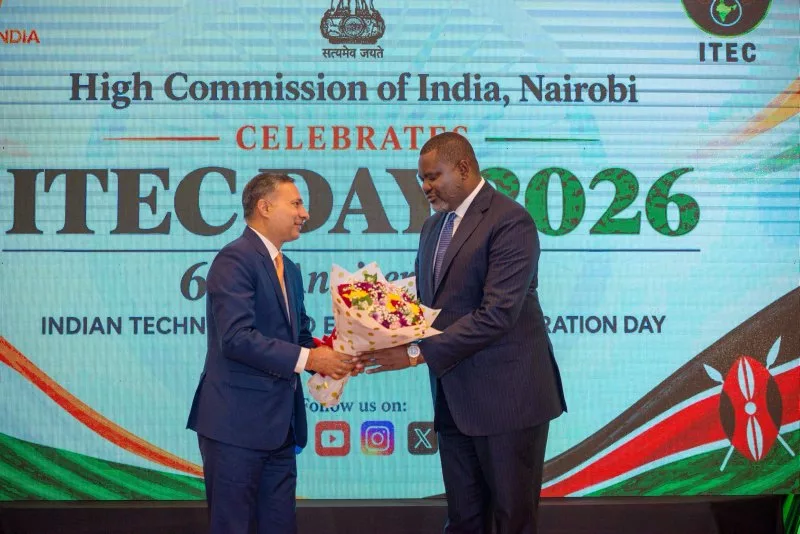 Cabinet Secretary for Public Service, Human Capital Development and Special Programmes, Geoffrey Ruku (right) gifting flowers during ITEC Day celebrations in Nairobi/HANDOUT
Indeed, the future of Kenya-India cooperation will go beyond scholarships and short courses to include more joint research, university partnerships, technology transfer, institutional exchanges and private-sector collaboration.
The wider relationship provides ample room for this. India and Kenya already have longstanding commercial, diplomatic and people-to-people links, and India's official account of the relationship describes the two countries as maritime neighbours with growing trade, investment and extensive people-to-people contacts. Education can become the connective tissue between these different strands.
The history of ITEC is instructive. When India launched the programme, it was itself a developing country facing formidable challenges, and its premise was that developing countries could share practical experience and build capacity together.
Six decades later, that logic remains just as relevant to employment, healthcare, food security, technology and institutional development.
Beyond the numbers, if a scholarship produces a better engineer, doctor, researcher, lecturer, entrepreneur or public servant, its impact extends far beyond one individual.
If those graduates go on to strengthen institutions and train others, the return multiplies again. That is the real India-Kenya dividend. Its value will ultimately be measured by what those Kenyans build when they return home.
The writer heads Global South Conversations, a think tank dedicated to South-South dialogue.